This year, the AIA National Convention was in San Diego, and the conference wrapped up ten days ago. For two days (Thursday and Friday), architectural industry professionals got a chance to experience a massive surge of both old and new digital solutions, infused with new types of AI (artificial intelligence) and automation capabilities.
Agentic and Agent-based AI
Over the last two years, AI technology at AIA24 and AIA25 has steadily matured, and we saw many AI solutions last year. However, this year, AI and automation were scaled up a notch. In particular, we are beginning to see Anthropic’s MCP (model context protocol) technology rolling out across product solutions and agentic AI technologies that orchestrate data and workflows. This is different than AI that simply finds information for you, whether about your application or data out on the internet.
Model Context Protocol
For clarity, Model Context Protocol (MCP) is closely tied to agentic AI, but the MCP standard is an infrastructure protocol, not an autonomous AI agent itself. Think of it as plumbing. In fact, the popular analogy for MCP is “USB-C for AI.” Tools that now support MCP are becoming numerous in AEC. Two key ones were awarded Architosh’s AIA26 BEST of SHOW honors yesterday. (see, Architosh: “AIA26: Architosh 12th ‘BEST of SHOW’ honors for digital technologies at AIA San Diego,” 22 June 2026)
MCP by itself doesn’t really do much. You need an AI architecture that can orchestrate the core software system and manage the AI’s state, controls, and logic flow. Such systems instruct the software on what step to take next. So we are seeing Anthropic’s Claude AI technology now connected to software systems like SketchUp and Bluebeam Max to do very useful kinds of things that normally take a considerable amount of time to do the old human-only way. Claude is used as a natural language user interface (NLUI) and can speak to the software and get work done.
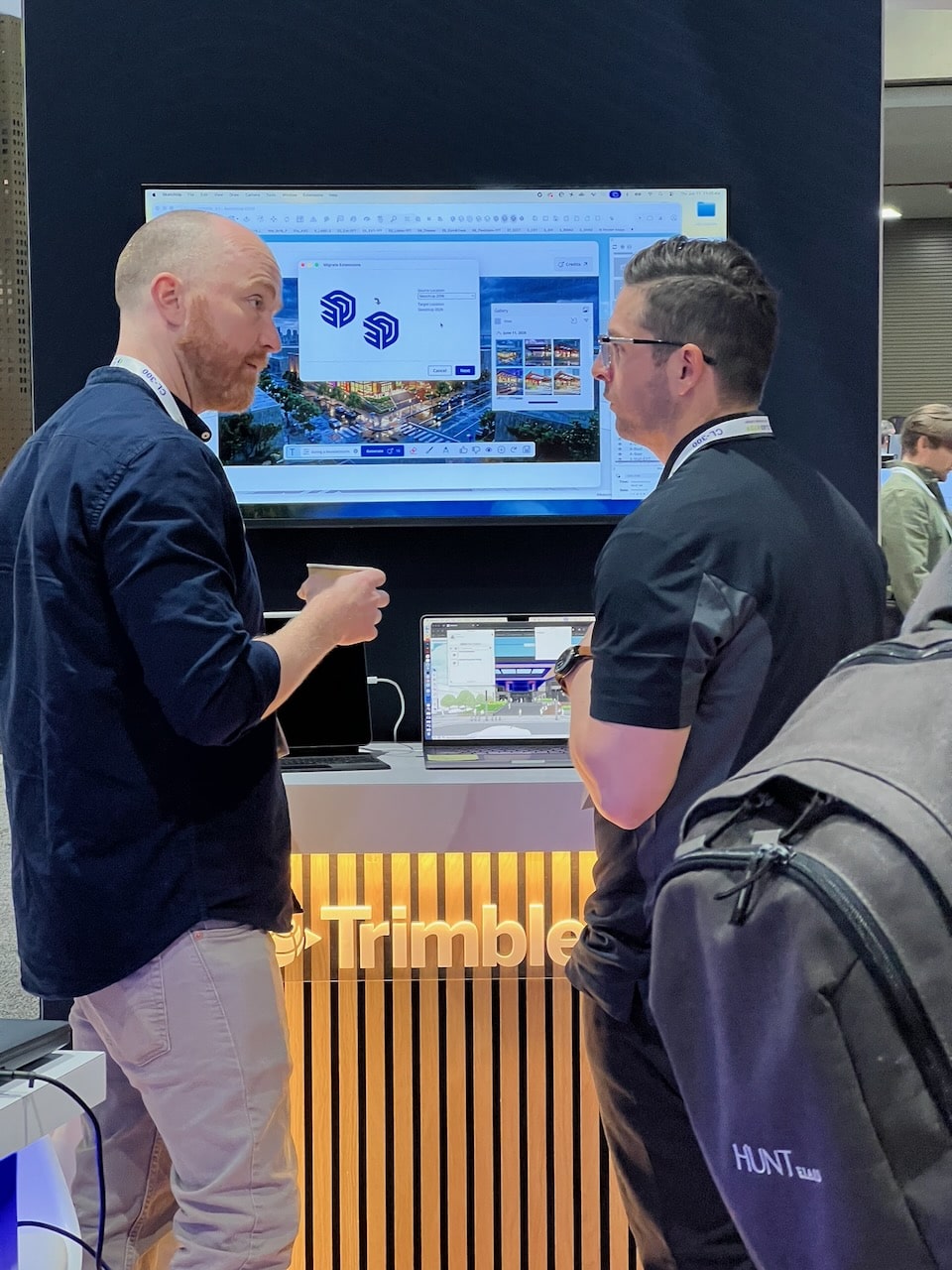
SketchUp’s new Claude integration brings generative AI modeling to the popular 3D modeling platform.
In SketchUp’s case, it can create (model) 3D objects directly inside SketchUp. In Bluebeam Max’s case, Claude can produce Revu commands such as batch operations, batch search, highlight, and a whole lot more. Both of these tools were highlights of AIA26 San Diego this year.
Other solutions have chat-based palettes built directly into their interfaces. This is becoming table stakes for software in the age of AI. These solutions are often called “co-pilots” or “agent-driven UIs”. They don’t just answer questions about the software; the AI itself has an execution layer and can map natural-language intent directly into function-system operations. We discussed this intently in our recent feature on ARES 2026 software, where it was possible to talk your way into having the CAD and BIM software actually draw things for you, or create layers within your file, following your textual direction. (see, Architosh: “ARES 2027 Deep Dive: AI, Automation and BIM-to-DWG Workflows,” 5 May 2026). We also discussed this particular feature during an online event.
While CAD tools like ARES 2027 are nearly a full release cycle ahead of many CAD and BIM solutions in the industry in terms of this kind of AI capability, we are starting to see solutions like SketchUp, with its Claude integration, leverage AI automation to make work happen in a similar way. Basically, let AI drive the software and produce work for you.
So you may ask: what is the benefit of having AI drive the software in the same vein as having your Tesla drive itself?
The answer depends, but usually, if something is extremely repetitive, the AI can do it much faster. Or, if the task is quite complex and would require advanced skills in software you don’t have, the speed-up could be massive or even infinite, since you can’t actually do it at all. If you can’t model the Space Shuttle inside of AutoCAD or ARES, but you can use ARES’ AI tools to create it for you, the AI didn’t just save time; the AI made it possible for you.
Automation Matters Also
Not all the buzz in the AEC industry software involves artificial intelligence (AI). There are many ways general automation can occur without LLMs or agentic AI. With the new BIM 2.0 software tools, their data-centric workflows and API interconnections mean that data from tools like Arcol can stream directly into other solutions and data types via API linkages.
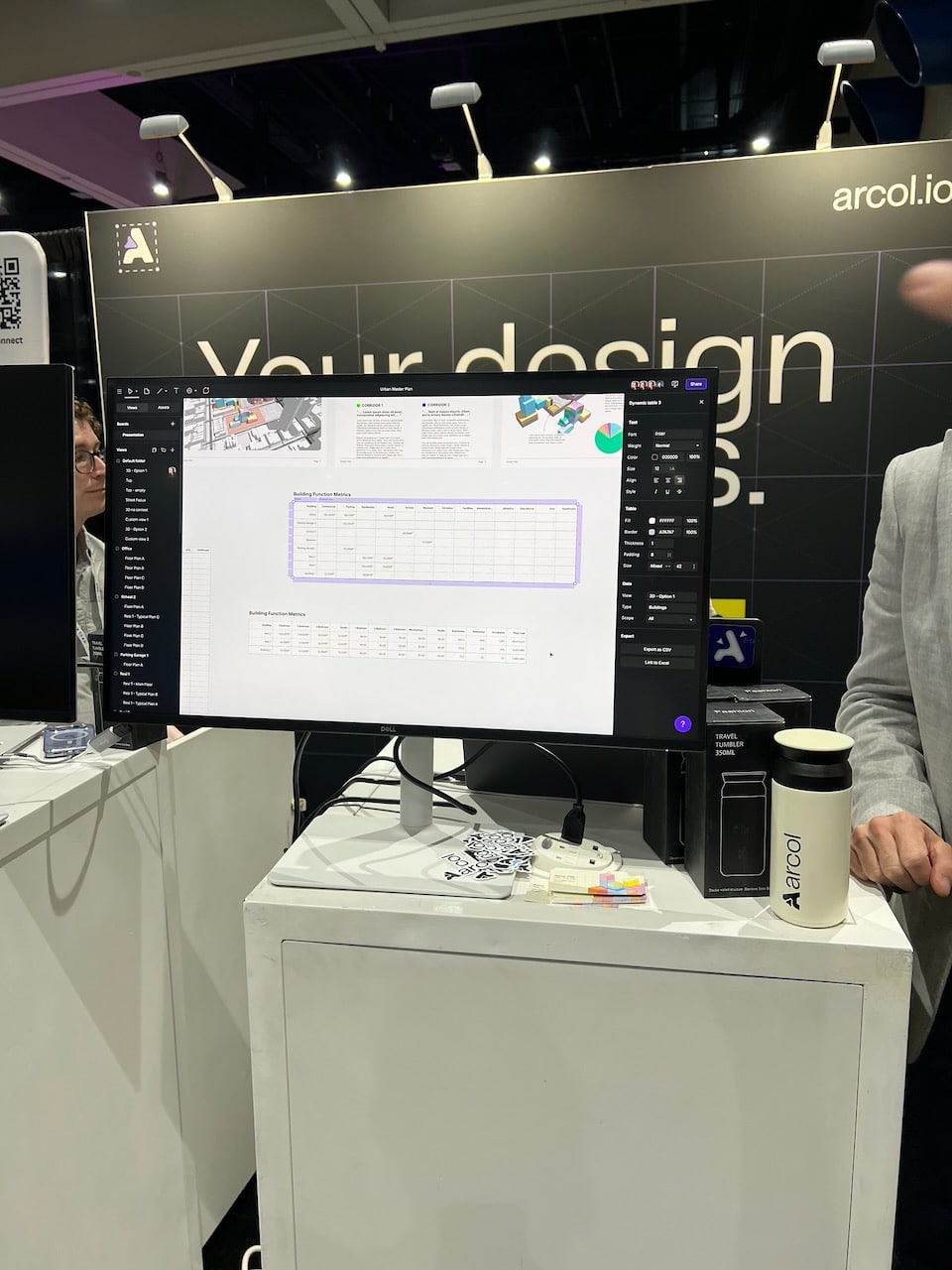
Arcol is showing its new integration of spreadsheets that can be bi-directionally synced with Excel files. This feature was highly requested by general construction and development companies so they could link building metrics with their own cost data.
As part of Arcol’s embrace of the construction industry (it is still focused on architects as well), the BIM 2.0 company added interconnections to spreadsheets (Excel) so that early-stage designs can be paired with cost data from large general contractors doing real estate development.
BIM 2.5?
We often write about BIM 2.0. But originally BIM 2.0 didn’t begin with AI in mind like we currently are thinking about AI. When firms like Spacemaker.AI (now Forma), Digital Bluefoam, TestFit, Arcol, and Snaptrude began their journey, it happened before the OpenAI explosion, and the public had no idea about such AI tools yet. But now that we are on the other side of this critical invention, what if someone built an AEC software ecosystem with agentic AI in its DNA from the ground up?
Newcomer (neoBIM), with its buildingOS system, is doing exactly that.
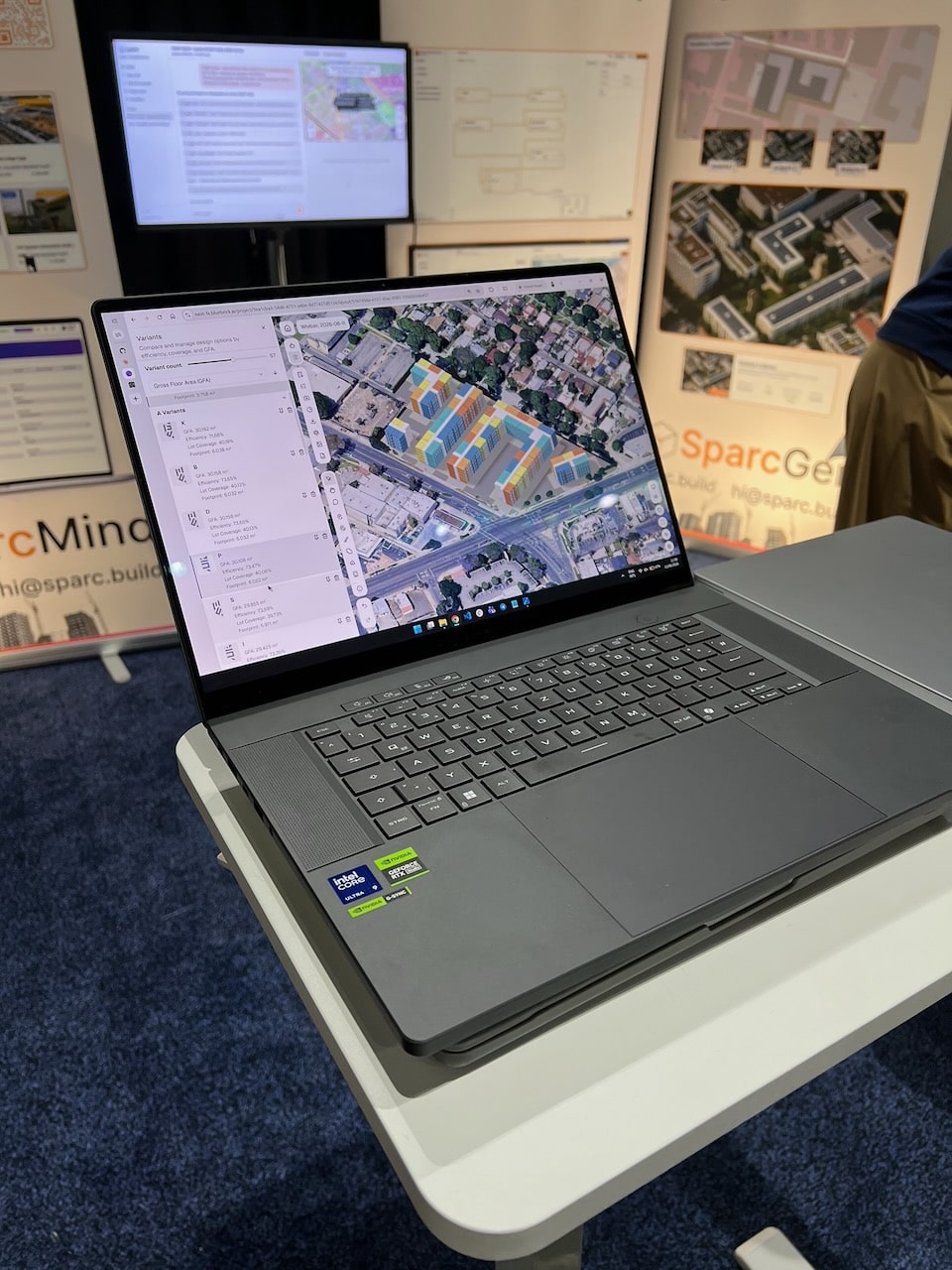
NeoBIM GmbH is a new German AEC software company aiming to reshape the industry with the industry’s first AI-native ground-up software ecosystem architecture. The company and its buildingOS system have several discrete tools so far, including a TestFit-like early-stage planning tool called Gen.
NeoBIM has a new AI-centric application system architecture for the complete building lifecycle, from early site test fits (shown above) to post-occupancy digital twins. The German software firm’s founder is Moritz Luck, who was co-founder and GEO of Enscape and is also the founding partner of SilverScale Capital. Their demonstrations at AIA26 were impressive, and so NeoBIM GmbH is definitely a company on our radar this year, and we look forward to learning more about what they are doing.