SOME PROJECTS TEST NOT ONLY THE LIMITS OF DESIGN but the limits of communication—those moments where a developer’s vision, an architect’s intent, and a visualization studio’s interpretation must all converge in a single, coherent story. The Avenue, a new mixed-use development rising along Naples’ storied Fifth Avenue, is one such project.
Developed by APREA, The Avenue aims to bring urban sophistication into conversation with the calm of the Gulf Coast—a kind of “urban ease, coastal spirit” fusion that Naples has never quite seen before. It’s a walkable enclave framed by galleries, restaurants, with palm-lined “alleys” and a retail base that opens generously to Naples’ public streets. Yet beyond its architectural ambition lies an equally compelling story about how visualization shaped the project’s trajectory—transforming a simple animation request into a powerful design and marketing narrative.
A Vision Evolving in Real Time
When APREA first approached Panoptikon, the European visualization studio led by Tudor Vasiliu, the initial brief was for a single film—just enough to convey the project’s mood and architectural language. But as early imagery came to life, the process began to expand.

The Avenue in Naples, Florida, is an upscale new development. World-renowned visualization studio Panoptikon shares how their work and process impacted the project and led to developer success in a town that doesn’t take new large-scale development easily. (Image: Panoptikon) (Click on image for larger view)
“What started as one animation became a full suite of 68 visuals,” Vasiliu tells me. “We developed exteriors, interiors, and atmospheric studies that helped not only market the project but also refine it. The visuals actually fed back into the design.”
The Avenue offers something unprecedented in Naples. A fully activated retail ground floor, with interior alleys and courtyards turned into retail experiences. It’s an urban gesture that adds to the typology of the city rather than disrupts it.
That back-and-forth is not unusual today, yet in The Avenue’s case, the feedback loop became essential. The developer, deeply involved in shaping both the brand and the architecture, began to use Panoptikon’s draft renders to guide adjustments with the design team. Material choices, façade tones, and courtyard detailing were refined directly in response to what the visualization revealed.
“He would see something in a draft image,” Vasiliu explains, “and go back to the architects saying, ‘Let’s change this metal,’ or ‘That light feels wrong.’ It was a live collaboration—what we visualized became part of the design decision chain.”
The Naples Context
To appreciate the project’s impact, it helps to understand Naples itself: an affluent, Florida coastal city more known for Mediterranean motifs and manicured charm than urban experimentation. The developer, an industry veteran branching out on his own, was intent on challenging that pattern.

The Avenue from the sky fits into Naples, Florida, so well that it is hard to spot it at first. In this image, the arched block buildings are on the wide avenue running from lower left to upper right. (Image: Panoptikon) (Click on image for larger view)
“The Avenue offers something unprecedented in Naples,” says Vasiliu. “A fully activated retail ground floor, with interior alleys and courtyards turned into retail experiences. It’s an urban gesture that adds to the typology of the city rather than disrupts it.”
This sensitivity—to both place and narrative—is what distinguishes Panoptikon’s approach. Their film for The Avenue could have been a standard architectural walkthrough. Instead, they proposed something more cinematic—a mood piece that captured Naples in transition: elegant, approachable, quietly confident.
“It wasn’t about showing every apartment or corridor,” Vasiliu recalls. “It was about emotion—the light, the atmosphere, the sense of calm sophistication.”
A Classical Foundation Meets Contemporary Tools
Vasiliu’s sensitivity to story is rooted in his training. “Architecture is in my family’s blood,” he says. “Both my parents are architects, my siblings too. I was raised in studio hallways. I’m a classically trained architect—in the pre-computer sense. Pencils and airbrushes before the pixels came.”
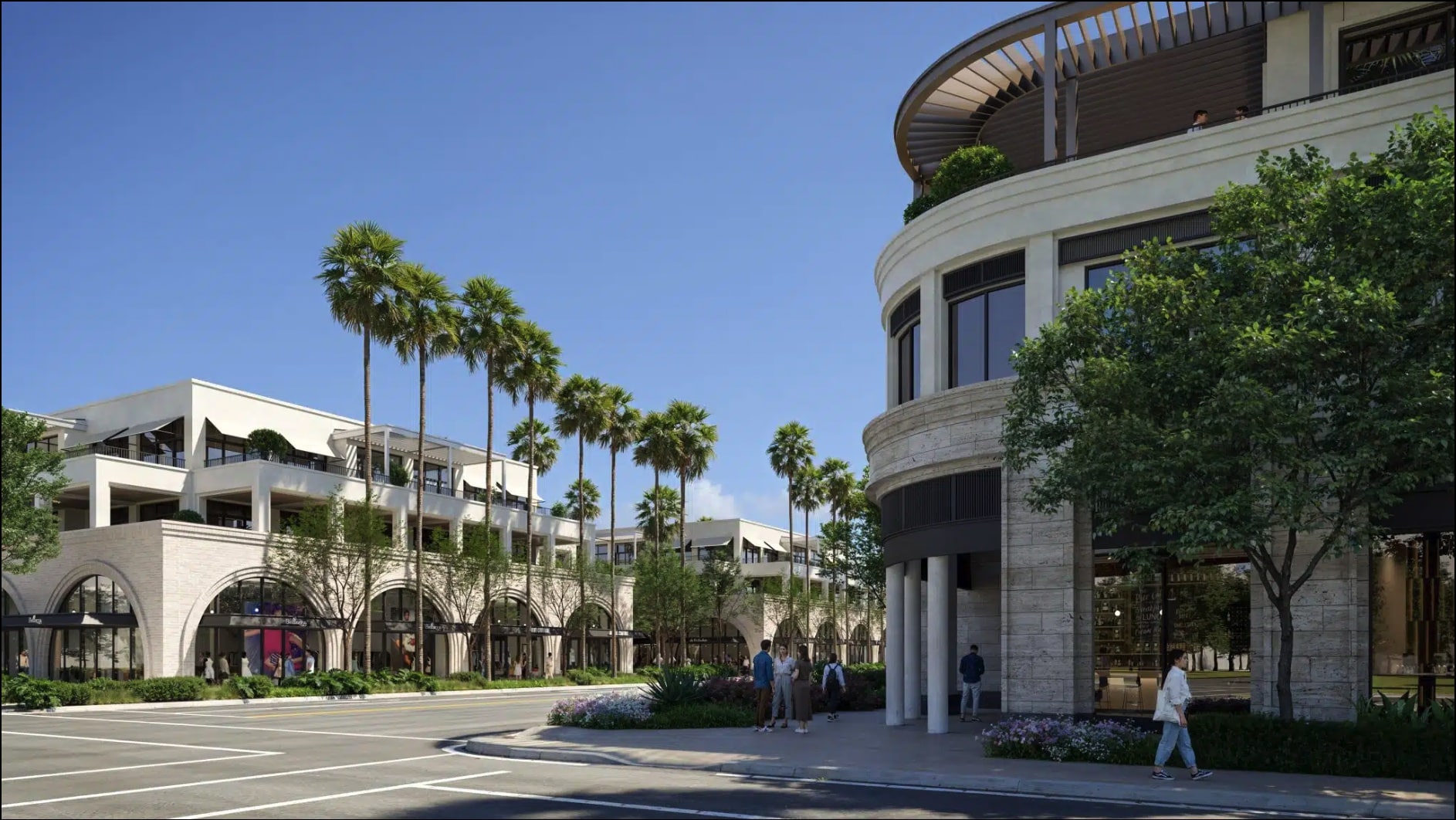
The Avenue features a prominent pedestrian-friendly streetscape where Naples residents will find unique and name-brand retail shops, cafes, and restaurants. (Image: Panoptikon)
That analog background gives Panoptikon’s work a compositional depth that distinguishes it from algorithmic hyperrealism. The studio’s images balance photographic precision with painterly restraint, allowing architecture to feel tactile and human.
Yet their workflow is anything but nostalgic. For The Avenue film, Panoptikon relied on Chaos Vantage, a GPU-based real-time renderer tightly integrated with 3ds Max and V-Ray. “Vantage gave us the speed we needed,” Vasiliu explains. “We could update our Max scenes and instantly see the changes in real time. Compared to V-Ray alone, it saved us enormous render time.”
In an industry increasingly obsessed with turnaround speed, that matters. “Almost everyone is in a rush,” he admits. “Developers want visuals yesterday. Real-time tools like Vantage make it possible to deliver high-quality faster, without breaking the creative flow.”
The Art of Empathy
Still, technology is only one side of the equation. What emerges most clearly in conversation with Vasiliu is his insistence on empathy—the human understanding required to translate between architects, developers, and audiences.

Projecting and selling a lifestyle is a key component of value to visualizations for developers. (Image: Panoptikon)
“When clients outsource visualization abroad, they sometimes think they’re just buying images,” he says. “But what they really need is a partner—someone who understands design, who can sit patiently through iterations, and who knows that the changes architects request often come from their own clients. We see ourselves as part of that process, not outside it.”
When clients outsource visualization abroad, they sometimes think they’re just buying images. But what they really need is a partner—someone who understands design, who can sit patiently through iterations, and who knows that the changes architects request often come from their own clients.
That empathy is grounded in Panoptikon’s origins in the European market, where visualization studios often step in to resolve unfinished interiors or underdeveloped design details. “In some countries,” Vasiliu notes, “exteriors are beautifully resolved, but interiors lag behind. We had to step in creatively, helping to define lighting, materials, and even layouts. It trained us to think as designers during our visualization work.”
That blend of design literacy and visualization craft positions Panoptikon uniquely in an era when architects themselves increasingly produce high-fidelity renderings. “Yes, architects can now do what used to require a specialist,” he says, “but what they often don’t have is time. That’s where we add value—speed, consistency, and the storytelling sensibility that comes from architectural training.”
Collaborative Design by Visualization
For The Avenue, that sensibility shaped not just the images but the process itself. Panoptikon worked closely with MHK Architecture and interior designer Nainoa to visualize interiors rooted in spatial continuity—open thresholds, filtered light, and materials that flow between inside and out.
“Materiality, flow, and light merge in a series of spaces designed for both retreat and connection,” the project’s narrative reads, and the visuals reflect that ethos. Soft coastal palettes dissolve into shaded courtyards; terraces blur into living rooms under the Gulf breeze.
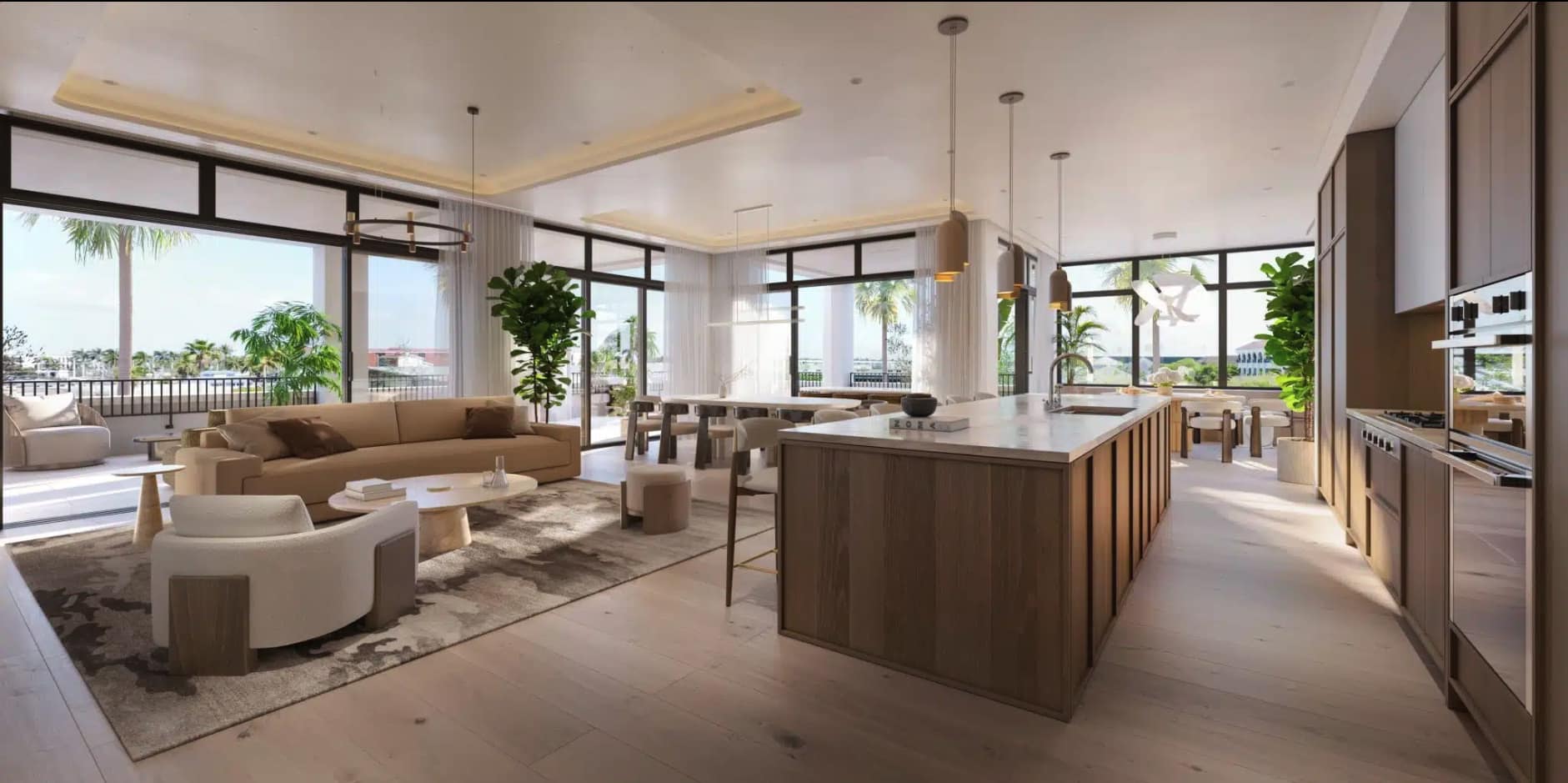
An interior view of one of the residential units at The Avenue, Naples, Florida. (Image: Panoptikon)
In this way, visualization became an extension of design authorship—a medium through which architects could see the implications of their own decisions before committing them to construction. “Good architecture sells itself,” says Vasiliu. “When a design already says something powerful, our job is easier. But when a design lacks that clarity, visualization can help uncover it.”
Tools, Workflows, and the Changing Landscape
Panoptikon’s toolset remains firmly rooted in Autodesk 3ds Max, despite its quirks. “It’s both a source of power and frustration,” Vasiliu laughs. “But companies like Chaos understand the psychology of artists—they’re building ecosystems that simplify workflow.”
He cites Chaos Cosmos, an integrated library of 3D assets, as one example. “It saves time and unifies standards. We’re paying for a lot—dozens of software subscriptions across rendering, collaboration, AI, and project management—but these are professional tools. Studios need to recognize that investment as part of their craft.”
But companies like Chaos understand the psychology of artists—they’re building ecosystems that simplify workflow.
That emphasis on quality and professional ethics is part of why The Avenue resonated with its stakeholders. The project not only impressed Naples’ design and development community but also catalyzed new opportunities. “The agency managing the project started recommending us left and right,” Vasiliu says. “It showed that our partnership approach works.”
The Broader Reflection
What The Avenue demonstrates is the shifting nature of architectural visualization itself. Once a passive act of representation, visualization is now a dynamic instrument of design feedback, stakeholder communication, and emotional storytelling. It’s where architecture becomes both understandable and aspirational.
For developers, visualization unlocks the lifestyle they’re selling. For architects, it tests the coherence of form and material. And for visualization studios like Panoptikon, it’s the stage where empathy meets technology—a space where design intelligence and narrative instinct merge.
“The landscape is changing,” Vasiliu reflects. “The old rules no longer apply. We have to be quick on our feet, ready for anything. But it still comes down to partnership—people who understand, who express ideas beautifully. That’s the essence of architecture itself.”
For developers, visualization unlocks the lifestyle they’re selling. For architects, it tests the coherence of form and material.
In The Avenue, that essence is tangible. What began as pixels on a screen has become a physical place that Naples hadn’t imagined before—one that embodies its coastal grace while quietly rewriting its urban story. And behind that transformation lies the evolving art of visualization: the craft of seeing before it’s built.
Editor’s Notes
Tudor Vasiliu is an architect turned architectural visualizer and the founder of Panoptikon (https://thepanoptikon.com/), an award-winning high-end architectural visualization studio serving clients globally. With over 18 years of experience, Tudor and his team help the world’s top architects, designers, and property developers realize their vision through high-quality 3D renders, films, animations, and virtual experiences. Tudor has been honored with the CGarchitect 3D Awards 2019 – Best Architectural Image, and has led industry panels and speaking engagements at industry events internationally, including the D2 Vienna Conference, State of Art Academy Days, Venice, Italy, and Inbetweenness, Aveiro, Portugal – among others.