GRAPHISOFT IGNITE 2026 delivered 90 minutes of dense, forward-looking presentations, streamed live worldwide, signaling a major evolution across Graphisoft’s software ecosystem. From brand-new cloud applications like Nemetschek Creator and the Nemetschek Open Collaboration Platform (OCP) to flagship mainstays like Archicad 30 and MEP Designer, the event laid out a coherent vision for the future of building design technology. (You can watch them here.)
Introduction
Graphisoft framed its latest software developments around the concept of “design intelligence,” paired with an unwavering commitment to elevating the core “design experience.” Crucially, executives emphasized that effective technology must absorb complexity rather than delegate it back to the user—a philosophy driving the company’s newest cloud frameworks and AI implementations. For Archicad practices, IGNITE 2026 offered a compelling roadmap: early-stage conceptualization in Nemetschek Creator, unified cloud reasoning via OCP, and a deeply intelligent, agentic modeling environment in Archicad 30.

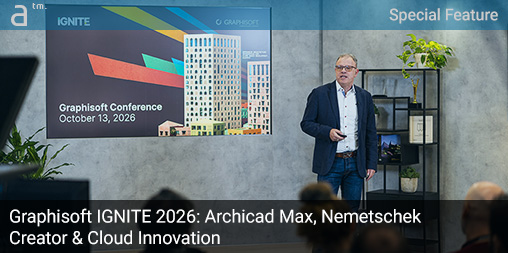
Graphisoft CEO Daniel Csillag opened Graphisoft IGNITE 2026 with enthusiasm, which was understandable given the sheer number of new products and technologies being introduced. (Image: Graphisoft)
Opening the event, Graphisoft CEO Daniel Csillag anchored the company’s technological ambitions in human purpose, reminding the audience that “buildings matter.” Beyond providing shelter, he noted, “they are where we live, where we learn, and where we recover.” Framed by this responsibility, Csillag addressed the industry’s evolving relationship with artificial intelligence:
When I think about the future of design technology, it is not only about speed. Technology should give you more room to think and apply judgment. This is where AI becomes vital. Our goal is for AI to eliminate repetitive, mundane tasks so architects can focus on what truly matters: creativity, responsibility, and authorship.
Csillag urged the audience to view all upcoming announcements through those three core pillars—creativity, responsibility, and authorship—before handing the stage to Chief Product Officer Márton Kiss and Graphisoft’s product leadership team to detail the road ahead.
Nemetschek Creator — In Brief
Architosh recently published an in-depth feature on Nemetschek Creator—arguably Graphisoft’s most significant software release since BIMcloud in 2014. Creator differs from other BIM 2.0 cloud applications because of its later market entry. While a late start often signals a disadvantage, strategic patience this time offers distinct benefits.
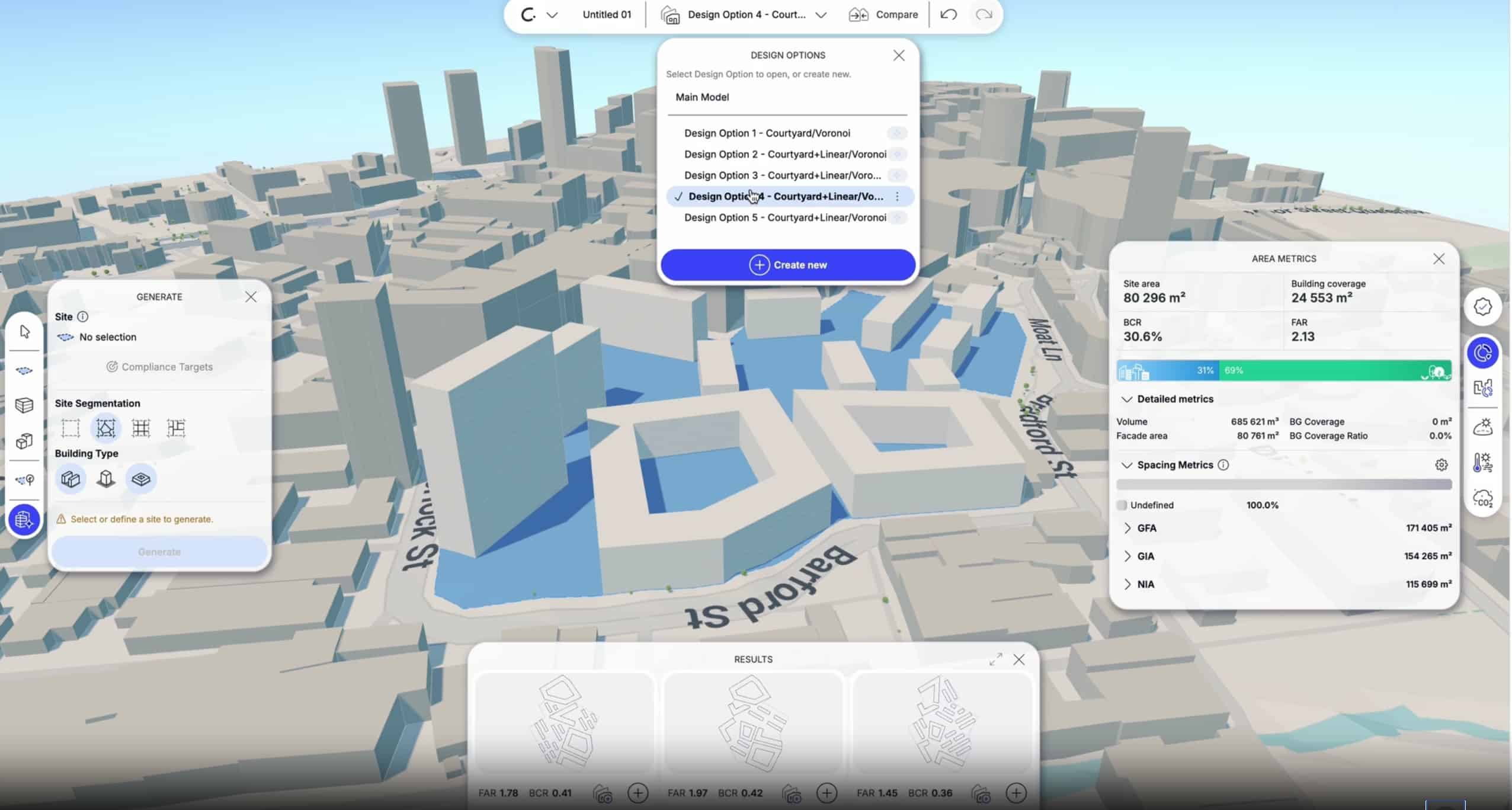
A detailed screenshot of the new Nemetschek Creator cloud application, built from day one with Agentic AI in mind and element-level AI reasoning at its database core.
Consider Apple’s deliberate approach to AI—a company the Hungarian BIM pioneer often admires. Fast-paced shifts in the AI landscape can lead developers down costly dead ends. Like Apple, Graphisoft can afford to be patient compared with legacy competitors and cloud startups. CPO Márton Kiss notes that Archicad’s modular codebase already provides proven geometric math, B-Rep algorithms, and parametric solvers, avoiding the need to write new code from scratch. Furthermore, Graphisoft has historically led the AEC industry through major computing shifts, and it is now leveraging group-wide Nemetschek synergies rather than working in isolation. Combined with an unusually loyal user base, these factors give Graphisoft a unique strategic advantage. (see: Architosh, “IGNITE 2026: Nemetschek Creator and the Agentic BIM Architectural Shift,” 19 Oct 2026)
Deeper Dive on Creator: IGNITE 2026: Nemetschek Creator and the Agentic BIM Architectural Shift
Crucially, Creator isn’t positioned to replace desktop software; unlike Autodesk, Nemetschek and Graphisoft aren’t telling Archicad customers that Creator is the future and Archicad is the past. Instead, Archicad remains the heart of Graphisoft, leveraging desktop computing for its unique advantages and pairing it with new cloud tools that leverage the cloud’s unique advantages. The message was clearer and more reassuring, helping customers see their journey going forward.
Core Capabilities and Creator Ecosystem
Nemetschek Creator targets early-stage decision-making by integrating cost, carbon, energy, and microclimate analysis directly into early workflows. By replacing the traditional “model-export-analyze-rework” loop with centralized creative and analytical tools, design teams can prototype quickly and adapt directions while concepts remain flexible.

Your Architosh editor-in-chief asking questions about Rhino integration with Nemetschek Creator. While the presentation didn’t cover it, Graphisoft said integration with Rhino 3D is already on the Creator roadmap, enabling architects to use Creator’s analysis and AI on more geometrically advanced Rhino-generated building models. (Image: Graphisoft)
Beyond automated site context models, Creator imports DWG, DXF, and OBJ files. Built as an open ecosystem, it brings external data and regulations into the cloud platform through partners like Cetopo, SSK Sky Rate, Google Earth, and the Nemetschek Open Collaboration Platform. And deeper internal integrations will extend to dRofus, MEP Designer, AI Visualizer, and Morpholio.
Pictures from the Graphisoft IGNITE 2026 event in Budapest. (Images: Graphisoft)
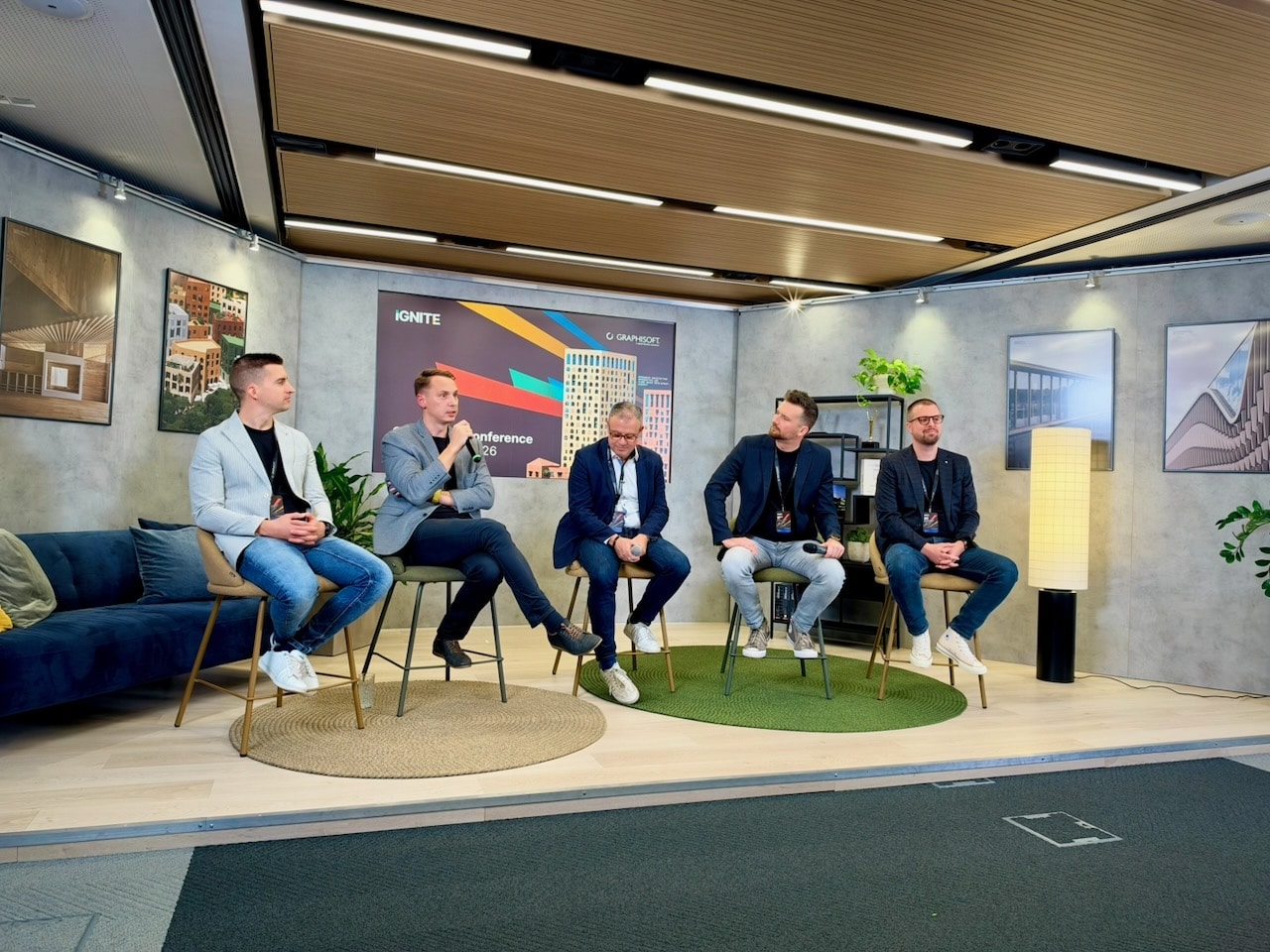
Graphisoft executives. Media Q&A.

(L) Saskia Tödler, Baunetz Wissen, (R) Soo Kim, Newsweek

Ivanna Papushenko, Fraulein_Architektin
Morpholio Trace—recently acquired by sister company Vectorworks—featured prominently at IGNITE 2026. With over one million users, including high-profile designers at Zaha Hadid Architects, Morpholio Trace creates a powerful halo effect for Creator, bridging initial freehand sketches directly into early-stage massing workflows.
During media Q&A, Graphisoft confirmed Creator will remain highly extensible, highlighting dRofus programming integration and an upcoming Rhino integration to run Creator’s analysis tools on complex 3D forms. Creator enters early access on October 28 for Archicad Max and Collaborate subscribers.
Nemetschek Open Collaboration Platform (OCP)
Nemetschek Creator wasn’t the only cloud milestone unveiled at IGNITE 2026. The new Nemetschek Open Collaboration Platform (OCP) debuted as a complementary cloud framework designed to span the entire project lifecycle—whereas Creator targets pre-design and early-stage workflows.
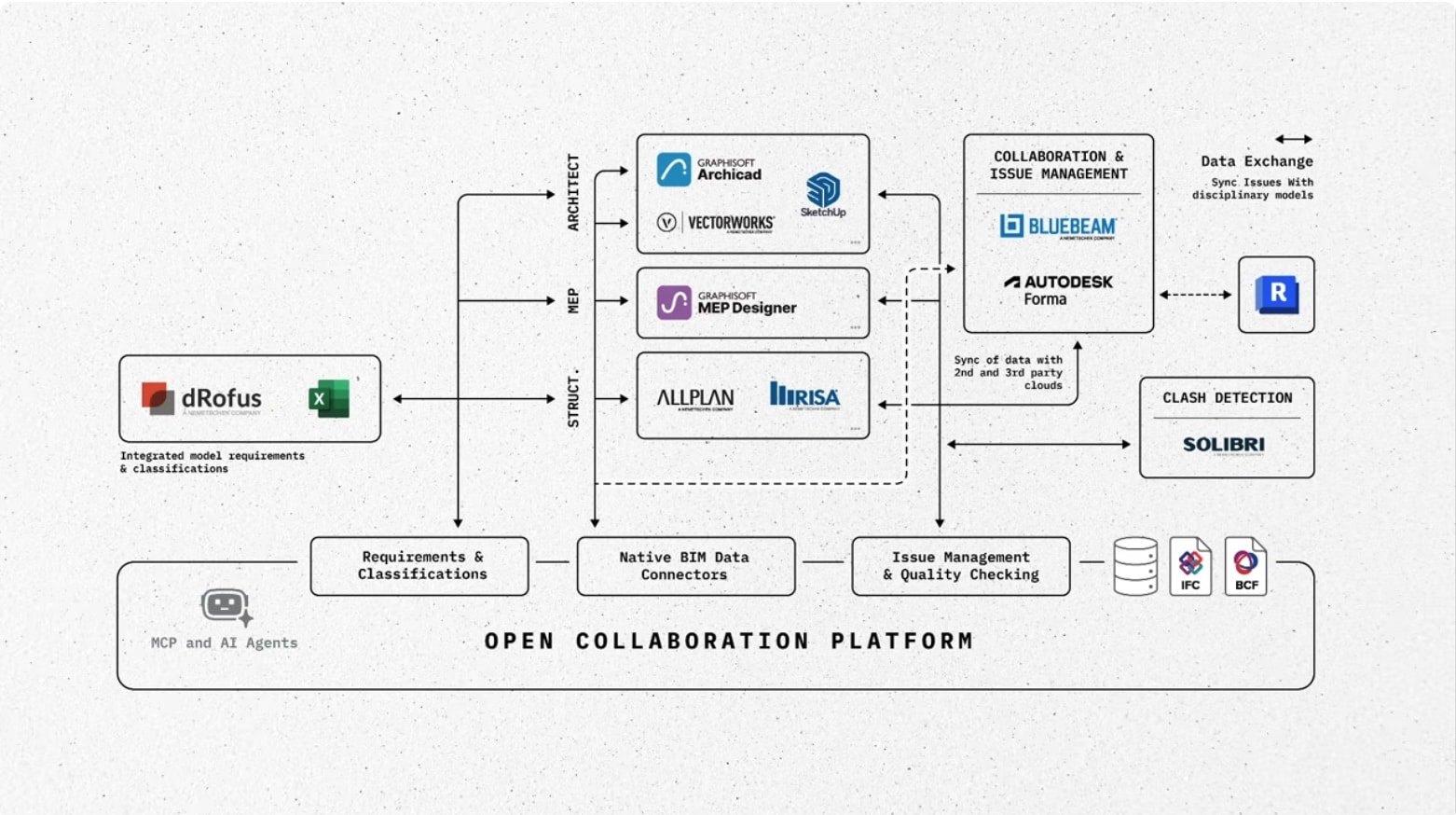
Nemetschek’s grand design intelligence strategy in one chart showing the Nemetschek Open Collaboration Platform (OCP) as an agentic AI intelligence layer that connects tools and platforms, including third-party ones across a project’s entire pre-design and construction phases. (click for larger view)
In private 1:1 meetings, Graphisoft executives emphasized that OCP is not merely another Common Data Environment (CDE). Instead, it operates above existing CDEs to provide a more comprehensive data umbrella. According to Sylwester Pawluk, Vice President of AI & Data, OCP shifts the industry away from file-based handoffs to real-time, element-level data streaming while keeping stakeholders in their design tools of choice.
A Metaphor for True Openness
To set OCP apart from proprietary competitor platforms, Nemetschek is anchoring the platform on open integration. During the keynote livestream, Graphisoft Senior Product Marketing Manager Marcell Hillier who is educated as a bridge engineer, offered a compelling metaphor:
Bridge design teaches you one thing very early: it never asks either bank to move. It respects both sides and carries the load between them without ever thinking about it.
That philosophy drives OCP’s open-ecosystem approach. While the Nemetschek Group has championed OpenBIM and IFC for decades, cross-platform data exchanges remain cumbersome. OCP addresses this gap by acting as a unified “intelligence layer” connecting tools, data, and teams.
Under the hood, OCP leverages Graphisoft’s award-winning BIMx viewing engine and will feature native integrations with Group tools like Solibri and dRofus—alongside third-party connections like the Archicad-to-Forma Connector to link OCP data directly into Autodesk Forma workflows.
Powered by Agentic AI
OCP’s intelligence layer utilizes a Model Context Protocol (MCP) server. Rather than parsing monolithic files, the system enables plain-language queries across models, drawings, and documents:
- Element-Level Reasoning: AI can analyze individual components—such as doors, properties, or geometry—rather than entire file containers.
- Instant Data Streaming: Background publishing streams specific data views in ~5 seconds, bypassing heavy IFC or Revit uploads.
- Automated Quantification: Users can query the AI Assistant to pull real-time material takeoffs, object counts, and volume calculations.
- Cross-Tool Interoperability: Native bridges connect Archicad, Revit, and Solibri to query unified data across multi-software environments.
While presentation materials pointed to Claude as a core engine, Graphisoft confirmed an open, adaptable approach to underlying LLM technologies.
Strategic Timing in the Agentic Era
While competitors like Autodesk and Trimble launched cloud platforms years ago, Nemetschek’s timing aligns with the emergence of agentic AI. Because legacy platforms are currently undergoing complex re-engineering to support agentic capabilities, Nemetschek and Graphisoft are building natively for this new paradigm.

IGNITE 2026 presenters included (L-R) Pelin Haynes, Yasmin Herden, Sára Pintér, and Mercell Hillier, all of Graphisoft. (Image: Graphisoft)
Development has moved remarkably fast: work began in February 2026, reached customer beta in August, and is slated for a broad 2027 release with embedded AI workflows. By pairing strategic patience with group-wide synergy, Nemetschek is carving out a distinct position in the next generation of AEC cloud infrastructure.
Graphisoft Archicad and New AI
“Design intelligence” sits at the core of Graphisoft’s latest strategy. As its CEO emphasized at IGNITE 2026, while Archicad remains central, “design starts before a model exists and decisions continue long after modeling is done.” Rather than adding platform complexity, Graphisoft is expanding the Archicad ecosystem through open integration and strategic group synergies.
Headline changes begin with Archicad Max, a new subscription tier tailored for data- and AI-driven practices of any size. Built to support global, multi-office operations with full language pack support, Max bundles advanced AI tools—including the beta MCP (Model Context Protocol) server, upgraded AI Assistant, AI Spaces, and updated visualization models (Nano Banana 2 and Pro).
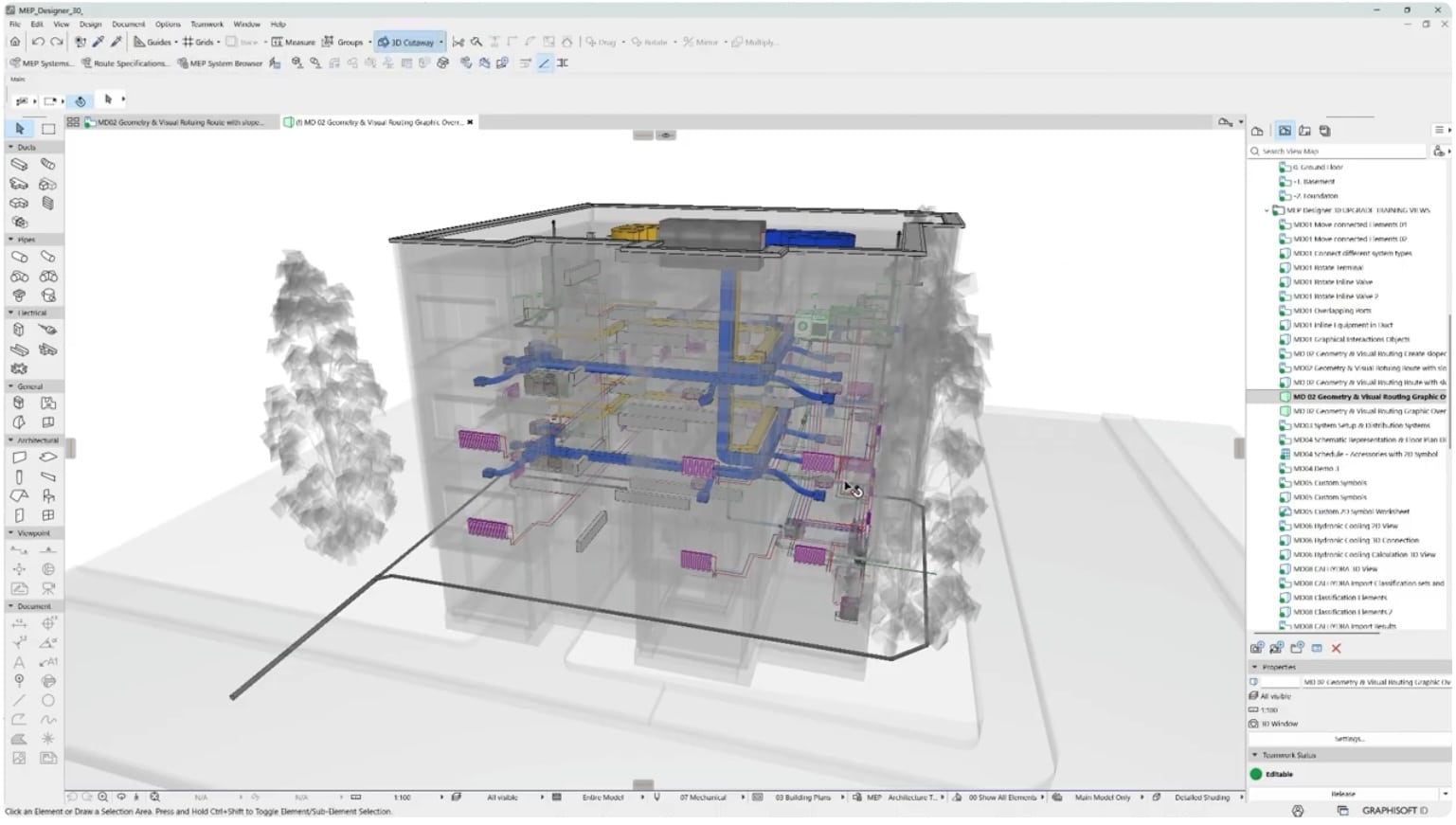
MEP Designer now includes an easy, transparent architecture model feature that renders only MEP elements as solid.
Beyond headline offerings, Archicad 30 introduces critical system refinements:
- UI & Data Management: A fully customizable Project Info dialog with smart search, custom folder creation in the Project Map, revamped attribute handling, and native Windows Dark Mode.
- Visualization & Extensions: Enhanced PBR rendering, updated Redshift engine tech, and the inclusion of “Pro Kit” add-on capabilities.
- MEP Designer: Updated with reliable routing and BIMx integration, MEP Designer now features an Autodesk Forma Connector for multi-platform cloud coordination. Unlike regional offerings like DDSCad, MEP Designer provides a state-of-the-art, global BIM solution—and remains the market’s only 3D MEP BIM system native to macOS.
Agentic Intelligence & Connected Workflows:
AI in Archicad 30 moves beyond simple generation to actionable model interaction via the new MCP-powered AI Assistant and AI Spaces:
- Model Automation: Through the agentic AI Assistant (MCP), users can query elements, execute model filters (e.g., isolating load-bearing columns), or alter renovation statuses via natural language. To prevent accidental overrides, the MCP server provides action previews prior to execution.
- Model Optimization: AI identifies structural or data issues within the BIM model and generates step-by-step resolution guides.
- AI Spaces: Users can index external project data—briefs, local codes, and office standards—into persistent, account-linked “Spaces.” The AI Assistant cross-references this documentation against the active model to flag non-compliant elements, such as non-conforming stair runs.
- Extensible Ecosystem: Graphisoft’s controllable MCP architecture allows external models like Claude and ChatGPT to interface directly with Archicad models, enabling users to trigger UI shortcuts and query project data directly from third-party AI interfaces.
Media Q&A and Architosh Analysis
Several key takeaways from our media Q&A and 1:1 interviews further clarify Graphisoft’s trajectory. First, Chief Product Officer Márton Kiss confirmed that Rhino model support in Nemetschek Creator is already on the roadmap. Second, on AI openness, Graphisoft reinforced that flexibility is central to its posture—supporting private LLMs and firm IP datasets. VP of AI & Data Sylwester Pawluk emphasized that small language models (SLMs) will be critical to AEC’s future.
Relatedly, while acknowledging the promise of on-device AI and Apple’s M-series unified memory for off-grid job sites, Graphisoft has not yet made any formal announcements on local AI compute.

Graphisoft spends quality time with selected media and influencers, giving them ample time to understand the company’s products and direction in both formal and informal settings, such as post-live event Q&A, private 1:1 interviews, and information conversations like the one captured here. (Left: Architosh’s editor, Center: Daniel Csillag, Graphisoft CEO, Right: Sywester Pawluk, Graphisoft VP) (Image: Graphisoft)
Our broader takeaway from IGNITE 2026 centers on strategy and timing. Graphisoft and Nemetschek introduced two major cloud initiatives—Nemetschek Creator and the Nemetschek Open Collaboration Platform (OCP). Branding both under “Nemetschek” signals cross-brand interoperability and a unified, group-wide posture. Without AI, these tools might seem like tardy cloud entries.
However, in the era of agentic AI, existing AEC software must be re-architected at the data layer to support agentic workflows. So these tools aren’t really late; they’re timely. Pawluk noted that data generated between 2020 and 2026 is projected to be ten times that of the preceding two decades (2000–2020). Because AI efficiently navigates both structured and unstructured data—mountains of it—the “I” in BIM is finally poised to realize its full potential—a sharp turnaround from Architosh’s landmark 2010 BIM report, which found that maximizing information was often too labor-intensive for architects to justify. The era of agentic AI will make this far easier and, critically, of more value for architects and their clients.
With element-level reasoning baked directly into Nemetschek’s new cloud architecture, these platforms’ timing makes profound sense. As AEC/O professionals adopt these tools, the industry finally gets the capabilities it has long wanted.