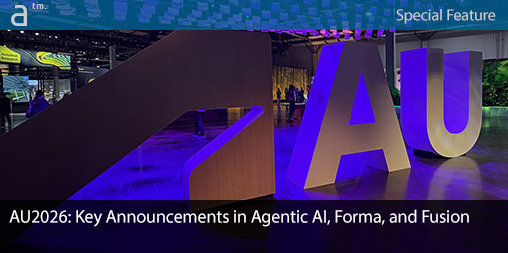
AUTODESK UNIVERSITY RETURNED TO THE Venetian Resort Convention Center in Las Vegas with powerful momentum and inspiration for more than 10,000 attendees looking for solutions to improve their business workflows.
Autodesk CEO Andrew Anagnost spoke with sincerity and passion about his commitment to creating connected solutions that increase productivity and ease of use while cutting unnecessary costs. The aim is to unlock capacity to be more productive, creative, and innovative beyond current desktop pipelines.
One of the coolest moments during the Autodesk keynote was when he spoke about how an Autodesk-backed organization, the Foothill Catalog Foundation, was helping rebuild and restore communities that have lost their homes to fires, floods, or other natural disasters, such as those that affected Altadena and Pacific Palisades. It has a collection of preapproved home designs to help displaced residents rebuild quickly and affordably while preserving their community identity and local architectural character. This helps residents get back into their homes sooner.
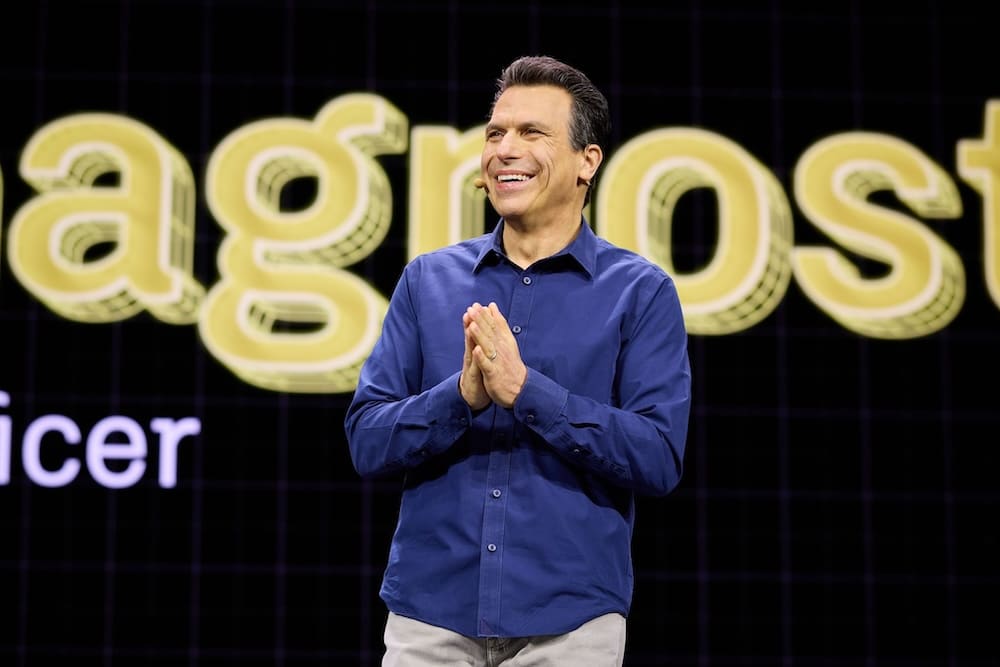
Andrew Anagnos, CEO of Autodesk, delivers his keynote address on Day 1, AU2026.
Stellar Creative Labs was bringing zombies to life for Marvel in its television series. It used AI for established IP to help complete episodes faster. A company from India, Kheyti, is helping farmers adapt to climate change. Kheyti creates low-cost farming solutions that help farmers reliably grow more. The company hopes to reach one million farmers in the next year.
2027 State of Design & Make Report
Autodesk released its 2027 State of Design & Make Report, introducing us to Pacesetters—a small group of professionals who stand apart from the curve. They are better prepared for macroeconomic and geopolitical disruptions to their businesses. They are early adopters of technology, making the digital transformation that helps them retain clients and maintain a productive workforce. AI execution is becoming a competitive advantage in retaining clients and projects. You can download the report here.
The Autodesk Design and Make Platform, with its three industry clouds—Forma, Fusion, and Flow—spanning AEC to media and entertainment, unifies workflows through AI and a data-driven platform to simplify work. While we have heard about it for years and have wondered, today convergence is real and happening on the Autodesk Platform.
Autodesk Forma
Autodesk opened its keynote by showcasing the latest version of Forma, which creates a connected environment for the AEC industry, with new capabilities across design, engineering, and construction. Autodesk is expanding Forma across much of the AEC workflow lifecycle. Forma may replace Revit in a decade or so (see this new Architosh article for more on that). This connectivity gives everyone working on a project the ability to see it from start to finish and contribute seamlessly, often at the same time as their teammates.
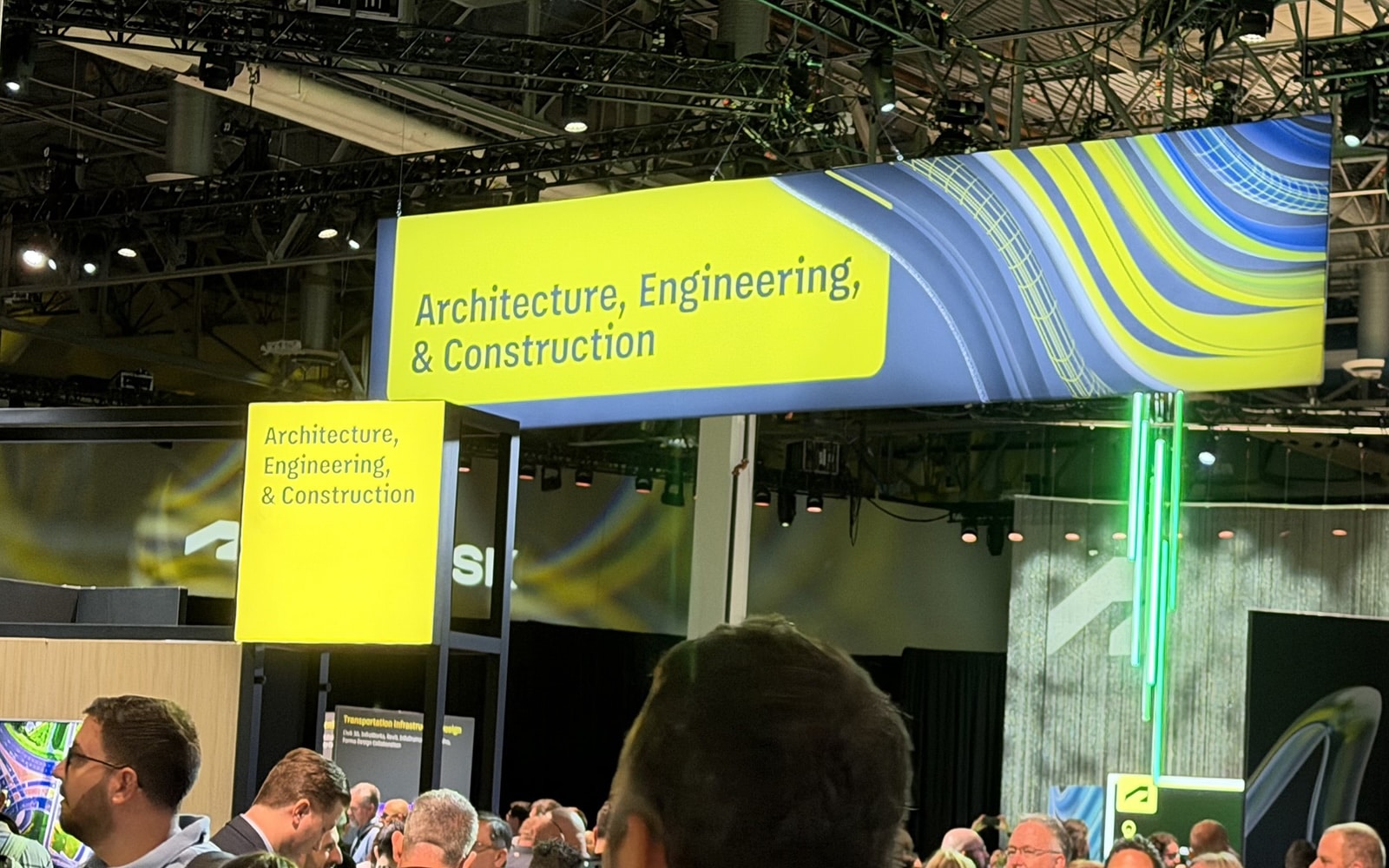
Forma is the cloud centerpiece of Autodesk’s AEC strategic direction for the global construction industry. Its booth at AU26 was jam-packed with attendees looking at how the Forma platform delivers new capabilities that traditional desktop-era software cannot, plus showing new AI and automation features across tools, including Autodesk Revit.
Amy Bunzel, EVP of AEC, spoke at the second keynote about the importance of real-time collaboration throughout a project’s lifecycle. She discussed defining the roles people will play using AI. Context gives every decision substance. Forma is transforming collaboration: it allows you to move from files to granular data and hyper-collaboration. This changes what BIM can become outside the model, with data and AI. Autodesk is also making significant investments in infrastructure, as briefly discussed in Architosh’s AU26 news coverage here. (see: Architosh, “AU2026: Autodesk expands Forma and leverages AU,” 16 Sep 2026)
Autodesk connected Revit and Forma to make collaboration easier. It is easier to collaborate with Forma Board, a BIM-connected board. Forma Board stays current, revealing changes and the reasons for them to all teams involved in the project. New AI tools will become part of construction. A new viewer supports more complex models, complex information, sheets, and geospatial data in model-based workflows. Workflow Studio, integrated within Forma, helps coordinate the different aspects of jobs, making it easier to communicate changes and inspect work before installation to ensure things line up before execution. With Daily Log Agent, a superintendent can give a voice memo, and the AI agent can transcribe it. Details are captured without typing notes. AEC software will be driven by agents in the future to boost productivity and collaboration.
This changes what BIM can become outside the model, with data and AI. Autodesk is making big investments in infrastructure.
Civil engineering, via Autodesk Civil3D, will become the newest connected client on Forma. It will support new infrastructure workflows as teams move from planning and design to the complexities of engineering a project. You no longer need to wait to see how plumbing, water lines, and sewage relate to your design.
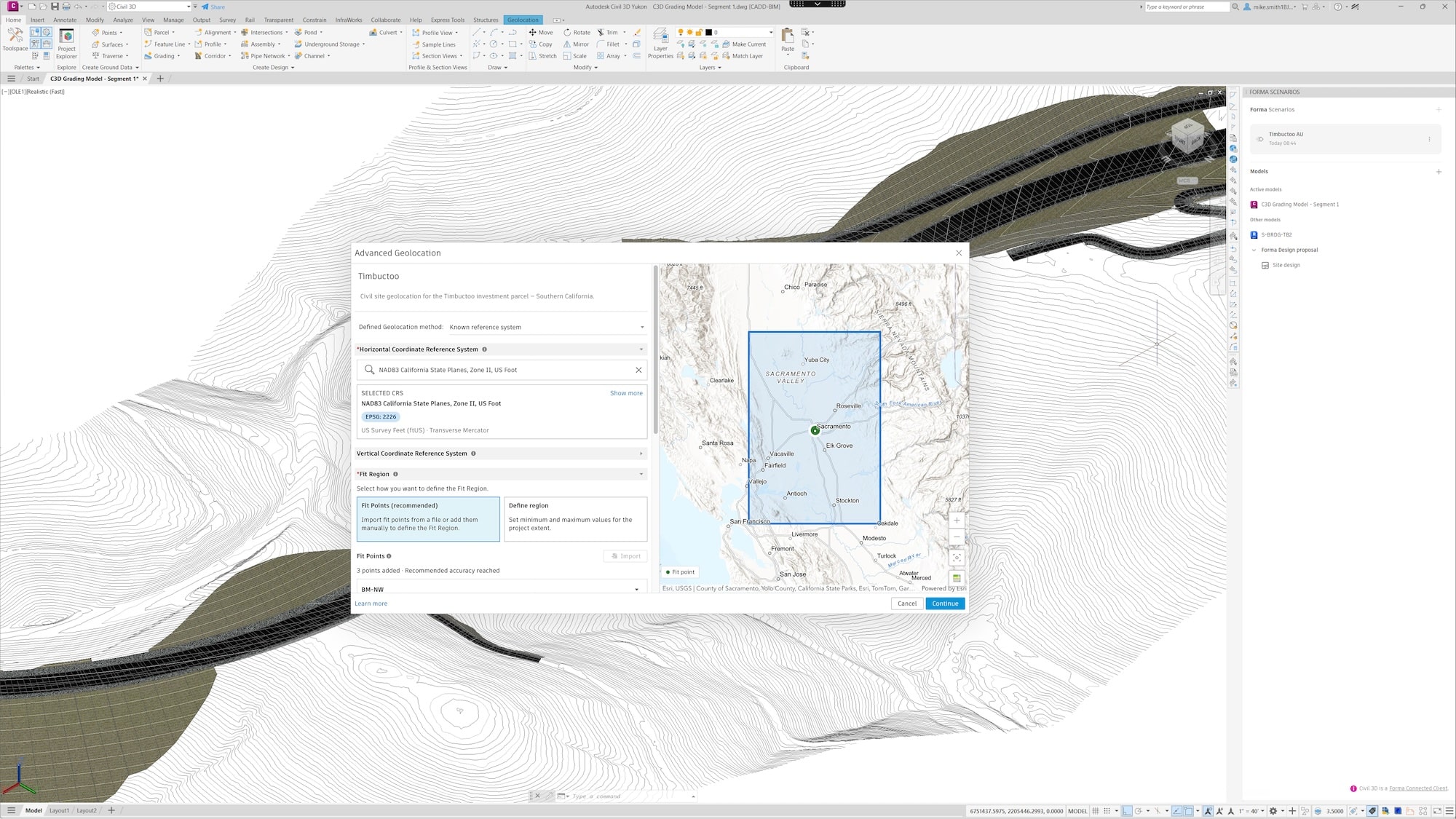
Shared geolocation engine in Civil 3D, shown in this screenshot. Read below for more information.
Forma Street Design enables transportation planners to explore land configurations, traffic flow, intersections, and transit routes alongside building projects. Street Design can give you a 2D view with sections and let you adjust problems on the spot, early in the design.
Forma and Revit, connected through new AI capabilities, will enable architects to explore their ideas and reduce repetitive tasks in design documentation, helping teams work better together and focus on priority decisions. As Architosh touched on earlier in this report, new AI capabilities can surface drawing information that may indicate issues across a range of common problems in building design and documentation, such as missing dimensions.
MORE: AIA26: Kestrel Labs — Native BIM Compliance Platform
Forma is bringing more preconstruction, coordination, and field workflows into this connected environment to help carry a project through execution. A unified geolocation engine coordinates workflows across Forma, Revit, and Civil 3D, ensuring location information is consistent across all teams and reducing manual transformations or model misalignment. Esri and third-party collaboration are already built in.
Autodesk is also expanding a set of specialized AI-powered construction agents to support document search, submittals, drawing review, and bid processing. This can save time while keeping decisions with the people doing the work.
The ‘O’ in AEC/O
The letter “O” in AEC/O is for operations and Autodesk has been keenly aware for how operations data can virtuously cycle back to the beginning of the design process in building design and renovation projects, as well as help owners and building tenants maximize human comfort, performance, and health in all forms of building structures.
Back in June, Autodesk bought MaintainX for $3.6 billion to create a new business unit called Autodesk Operations Solutions. Stephen Hooper, formerly VP of cloud-based design and manufacturing solutions, will run it.
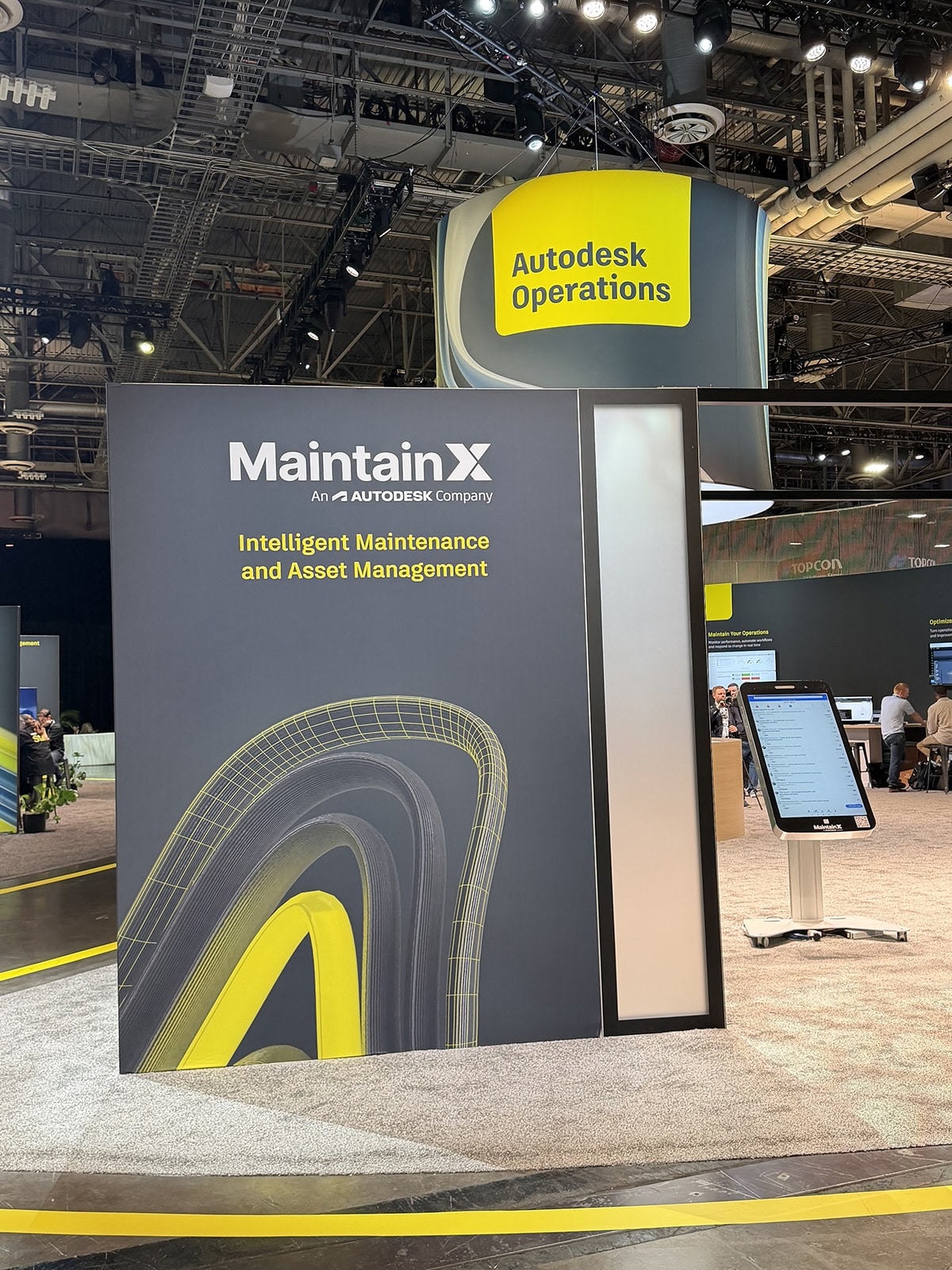
MaintainX is a new acquisition by Autodesk.
MaintainX can help coordinate and manage maintenance events such as equipment failures, repairs, and performance improvements. Hooper spoke about three types of convergence in the keynote:
- Industry Convergence creates a digital twin from data you already have.
- Digital & Physical Convergence brings the digital twin into the real world.
- Lifecycle Convergence helps the design evolve through changes.
Tandem defines, maintains, and optimizes the product lifecycle. Tandem can access BIM data to create a complete digital twin with live operational data. Tandem and FlexSim have been brought together to provide a full solution. Richard Bude, Principal Experience Designer, spoke about bringing operational data to life. He uses simulation models to make changes to improve efficiency. He showed how he used this method to improve the flow of travelers through an airport. Tandem can identify a problem in advance and create a ticket to replace a part or product before it fails. Tandem follows the process from beginning to end: locating the problem, creating a ticket, assigning it to someone to replace the part, and replacing the part without interruption.
Artificial Intelligence (AI)
Autodesk Assistant is Autodesk’s AI chatbox technology, which continues to grow and evolve from a basic in-app prompt chatbot into an agent that can provide information from your project data and help find solutions across its cloud-connected product line.
Some of these features may not be available yet. Autodesk Assistant is bringing project intelligence into customers’ workflows so they can connect, understand, plan, and make decisions quickly throughout the product lifecycle. Autodesk President and CEO Andrew Anagnost stated that Autodesk Assistant will soon be available as a standalone, agentic-first experience that can reach across its products. The standalone Assistant is not available yet, but we should hear about timing, pricing, and terms in 2027.
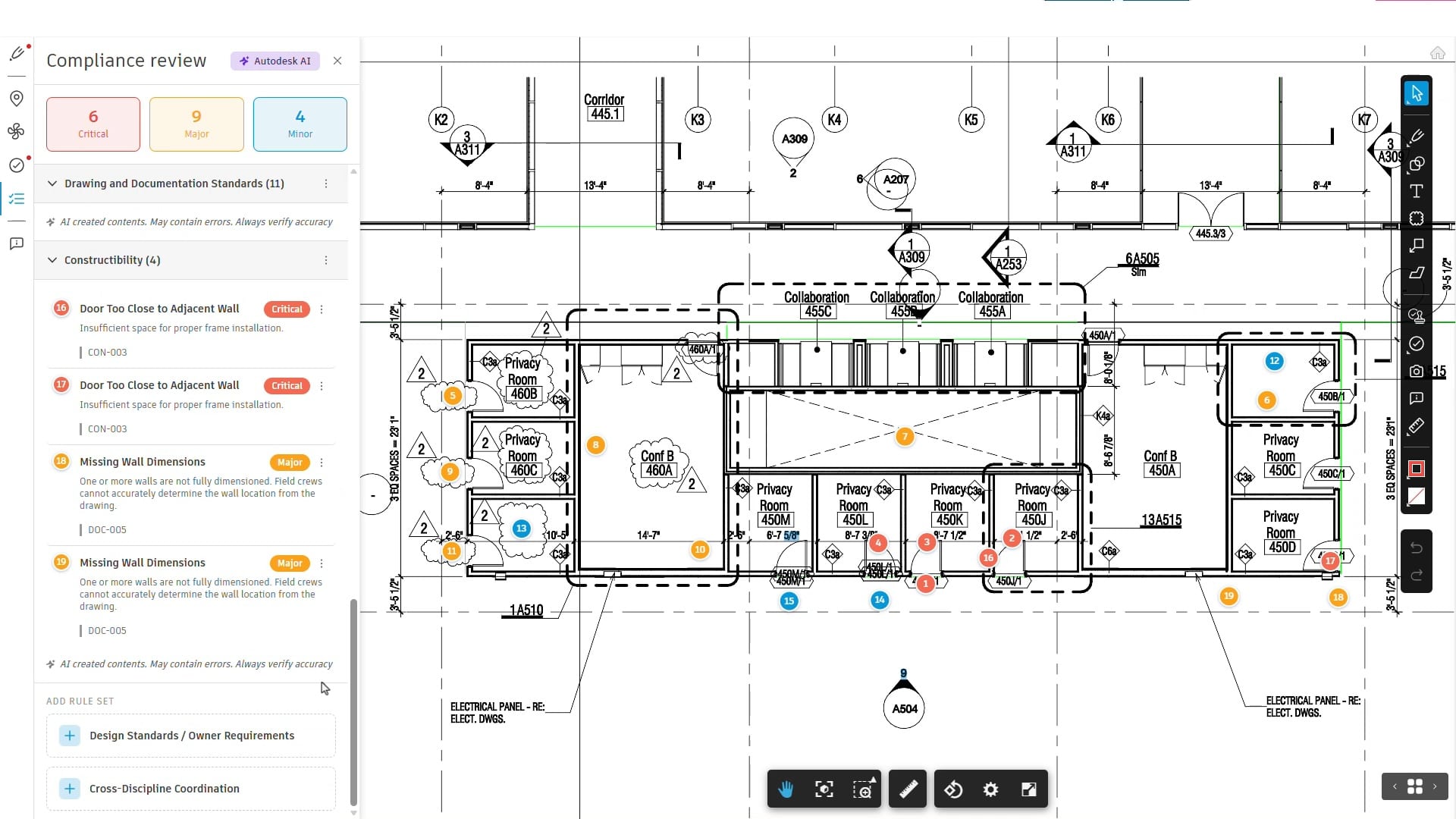
Drawing Compliance uses AI to surface drawing information for possible issues, such as walls too close to adjacent walls, missing wall dimensions, etc. Users can also add rules for design standards, owner requirements, and cross-disciplinary coordination. To learn see our earlier AU2026 report here.
In its second keynote, Autodesk covered Flow and Fusion in more detail, revealing how they are helping creatives use AI to work more effectively throughout a product lifecycle and reduce costs significantly. Flow and Fusion are Autodesk’s non-AEC industry clouds for the Media & Entertainment and Design & Manufacture industries, respectively.
Even though Architosh is centered principally on the AEC/O industry, I will provide a brief summary of Autodesk Flow and a bit more detailed coverage of Autodesk Fusion. Fusion naturally touches manufacturing and has crossover into the AEC/O industries, as buildings, in particular, are made up of manufactured products and filled with manufactured products, plus manufacturing technologies bear upon industrialized construction.
Autodesk Flow
Diana Colella, EVP of Media & Entertainment, spoke about how Flow’s new AI tools can save time during the conception of a movie. She talked about a film project, “Robots of the Wild West.” Nikola Todorovic, the visual effects supervisor and co-founder of the AI filmmaking company Wonder Dynamics, demonstrated how Flow was used to create his movie, starting by generating a 3D model with Nano Banana, refining it with prompts, and creating a model that fit the movie’s needs.

Autodesk Flow Studio production still, showing the movie called “Robots of the Wild West,” which was crafted using Autodesk Flow.
You can also generate a rig using AI rigging and use Flow to capture an actor’s performance. Then you can use the 3D editor to put all the pieces together on a Wonder Human (first, apply the animation, and swap the Wonder Human for the model you generated earlier. Now you just need a background. Marble was used to generate a saloon background. Motion Maker in Maya was used to animate a horse quickly, with the ability to make changes on the fly. Once all these elements are put together, you have a short film.
Autodesk Fusion
Jeff Kinder, EVP of Design & Manufacture, spoke about Fusion and how its new AI tools empower product designers to create better products and find quick solutions for design and engineering. AI turns an idea into a better product with thousands of parts. Companies using Fusion for design include JDD Furniture, Wet Sounds, and O’Neal. Thomas Saier, CEO of O’Neal, stated that they use Fusion from product conception through design visualization to create helmets that save lives. He feels it is about the people who wear them and how to protect them.
The three principles of the work process in Fusion are:
- For individuals: AI to Design and Make
For companies: Digital Thread with Data
Product ecosystem: Agentic PLM
Richard Stubley, a Fusion expert, gave an example of how Fusion works for a lawnmower design. He used two Autodesk agentic AI tools:
- AutoAssemble
- Auto Timeline Generator
AutoAssemble is great for putting together all the parts quickly, in minutes rather than the few days it might take a person. AutoAssemble analyzed the model, found the locations for parts, and placed them where they belonged. You can test the parts to make sure everything works properly. Later, while reviewing the design, the team found that a different part did not have enough clearance for the consumer of the product.
Auto Timeline Generator fixed the part in a few minutes by redesigning it. It created drawings, specifications, and everything needed to make sure the part worked effectively and would not impede the manufacturing process.
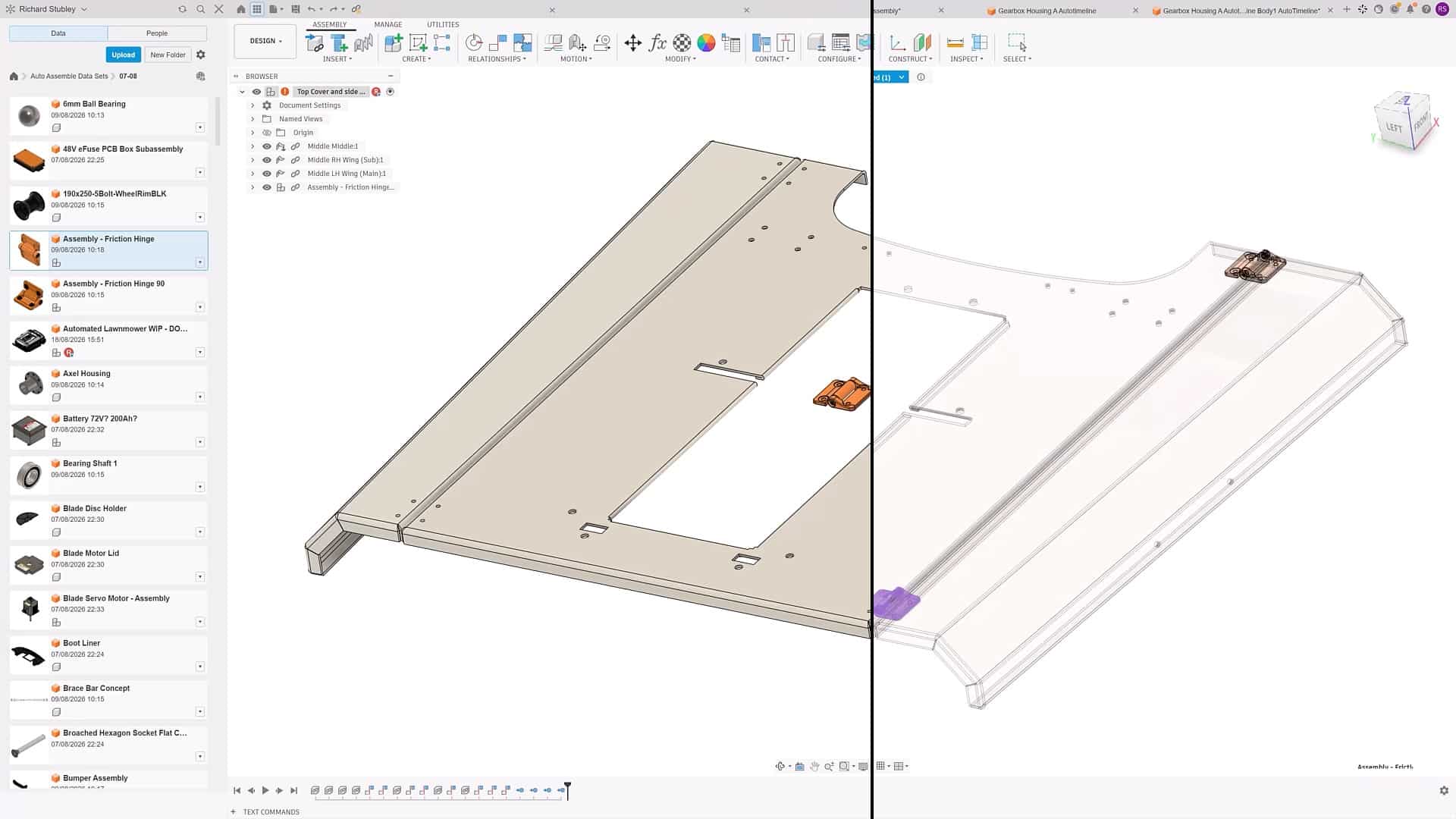
Autodesk Fusion is shown here with AutoAssemble Split, an automation feature new in Fusion.
Autodesk Assistant in Fusion uses natural language to leverage the breadth of Fusion’s capabilities. A new way to create configurations with Assistant will generate variations for you, with fully editable geometry in Fusion. You can send this straight to the shop floor.
Daniel Graham, VP of Manufacturing, stated that he trusts Richard’s work but wants to validate it for manufacturing. Autodesk System Modeler, a visual tool, uses its Graph Editor to adjust the model. He used an automated sheet metal graph to find and update all the components. He used the nesting capabilities to put these pieces together.
Having AI handle repetitive tasks across the product lifecycle helps productivity. You will be able to find existing designs to update and evolve your project.
Hybrid Platform with New Connections
Autodesk Fusion is a hybrid platform. While it serves conceptually and operationally as Autodesk’s unified cloud platform for D&M, the software itself installs and runs locally as a desktop product on Windows and macOS. In fact, at one point, Andrew Anagnost, CEO of Autodesk, told Architosh that this specific hybrid nature could be a possible future of Revit. (see: Architosh, “What’s Beyond Revit—Anagnost on Autodesk AEC Futures,” 1 Oct 2020). And while Autodesk did get more specific than ever at this AU2026 about the future of Revit versus the Forma platform, if you read the details of how Anagnost talks about Fusion serving as a development and data-model template for the future of Revit, back in 2020, one can still imagine Fusion as a useful model.
New this year, Inventor and Vault are the first Fusion Connected Clients, in much the way Revit was the first Forma Connected Client. I saw a demo from Haworth showing how they were designing spaces in their online 3D build software and then working inside Autodesk Inventor to develop the design further, giving them the ability to work seamlessly on both desktop and online.
Stephanie Canora, Director of Product Management, and Mike Alcazaren spoke about handling tasks efficiently in real time, introducing the Agentic Task Board. The Agentic Task Board provides integrated task management. Autodesk Assistant helps manage a task as it passes from one person to the next in real time, making the process fast and effective while reducing mistakes. The agentic experience increased productivity by making part replacement faster through the Agentic Task Board.
Product lifecycle management (PLM) has been reimagined with Agentic PLM. You will be able to connect unstructured conversations to make decisions. Agentic PLM will connect to third-party systems to accelerate the product-making lifecycle and make it feel invisible. It is an open and extensible platform. An MCP service can make connecting to Claude easier.
The Fallingwater Exhibit
Fallingwater, created and designed by Frank Lloyd Wright, receives the highest standard of care in historic preservation as a UNESCO World Heritage site. The restoration project for the landmark in Pennsylvania is now complete. Autodesk technologies were used in the restoration process.
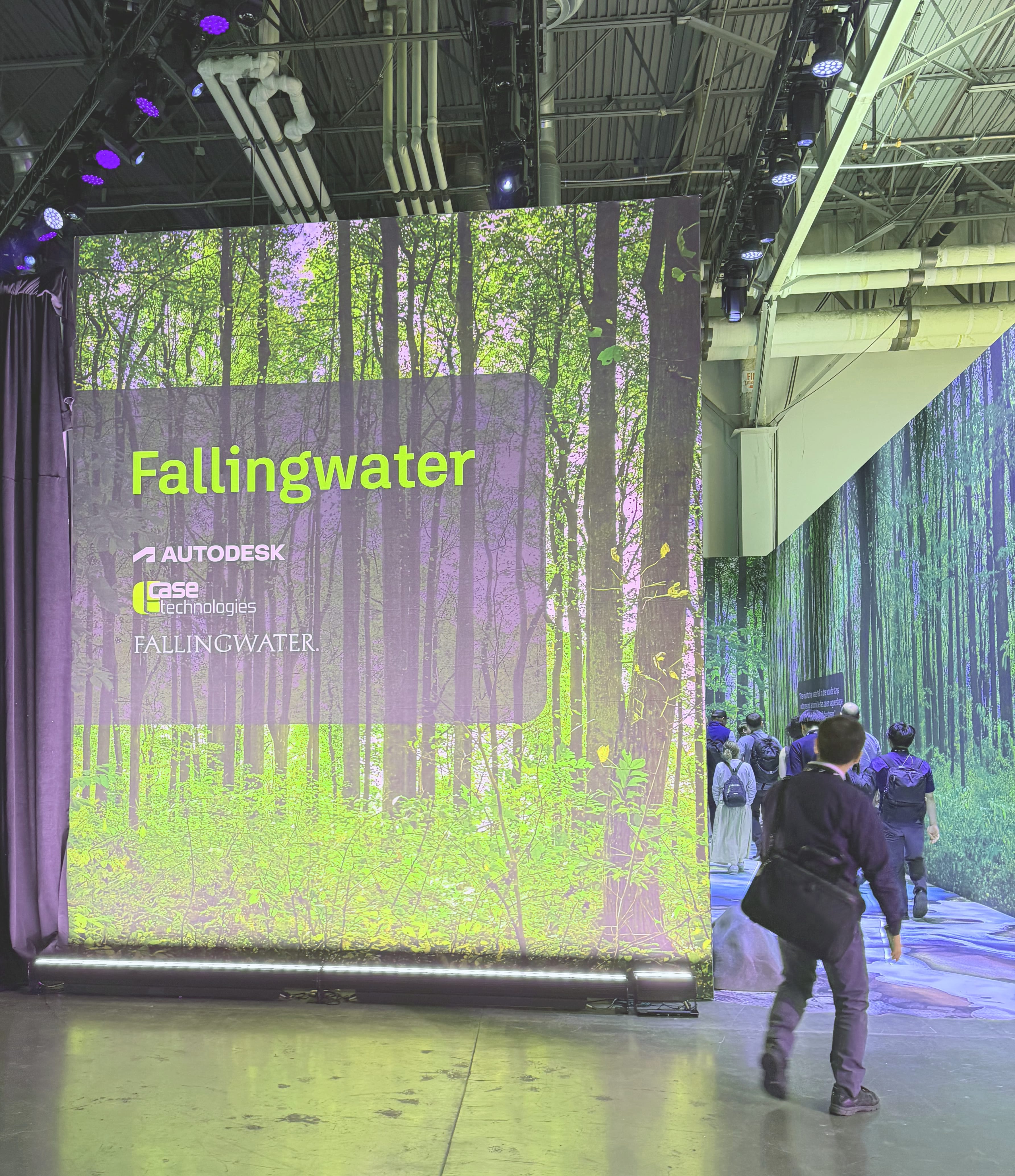
The Fallingwater exhibit entrance at Autodesk University 2026.
Case Technologies scanned the entire site using laser technology, producing 6.8 billion points in a point cloud, with each point less than 2 millimeters apart, to help create a digital twin of the site and the home. After importing the laser scans into software called ReCap, Case Technologies uploaded the entire project into Autodesk Revit. Revit takes the data and turns it into a 3D model. Case Technologies completed the visualization process by using a game engine to create Fallingwater’s digital twin in Twinmotion.
Third Party Exhibitors
As usual, we struggle to find enough time to meet vendors on the show floor, but we did manage to meet some and discuss what they were showing at AU2026 this year.
IMAGINiT Technologies spoke about its new product, Clarity. (see: Architosh, “IMAGINiT Technologies unveils Clarity 2025,” 30 May 2024, for our last detailed coverage of this tool here.)
Clarity enables Revit and AutoCAD customers to accelerate their workflows by automating manual, repetitive tasks, developing custom software to address unique business needs, and preparing data and technology environments for AI.
IMAGINiT’s workforce development and education programs help clients adopt new capabilities and automate redundant tasks. Clarity is useful for Revit and AutoCAD users who want to automate tasks such as creating sheets, printing, and creating PDFs. IMAGINiT says its software has saved more than 5 million working hours in the past year.
Chaos Group showed off recent versions of V-Ray and Enscape, along with the Chaos ecosystem, at AU. Enscape was running in real time with impressive, realistic visualizations that you could change instantly, from the time of day to objects and textures. Enscape offers more flexibility than Twinmotion for textures and custom objects.
Lenovo Access is simplifying remote workstation access. Lenovo Access claims to change the traditional approach by centralizing remote workstations while ensuring predictability and performance. Lenovo Access places individual ThinkStation P-series desktop workstations into racks, then layers on management tools to access and manage the files. Users feel as though they are using robust local workstations, but the workstations operate as a single managed solution. Lenovo demonstrated how Lenovo Access works at AU.
Global eTraining (GeT), an AI-powered digital adoption platform trusted by AEC firms worldwide, shared its AI-powered innovations. Some of those innovations include:
- AI Knowledge Banks & Challenges
- AI MCP Server Integrations
- AI-Generated Custom Workflow Courses
- AI Analytics & Insights for ROI
- AI Dynamic Search Assistant
- AI Contextual Translations
This brings together human intelligence and agentic AI workflows across the AI-enabled tech stack, creating a connected knowledge infrastructure that continuously learns from company workflows, project standards, and organizational expertise.
HP is improving automation in SitePrint and Build Workspace. HP discussed new capabilities for its SitePrint robotic layout system and the Build Workspace construction drawing management and collaboration platform, focusing on faster document workflows and fewer on-site revisions.
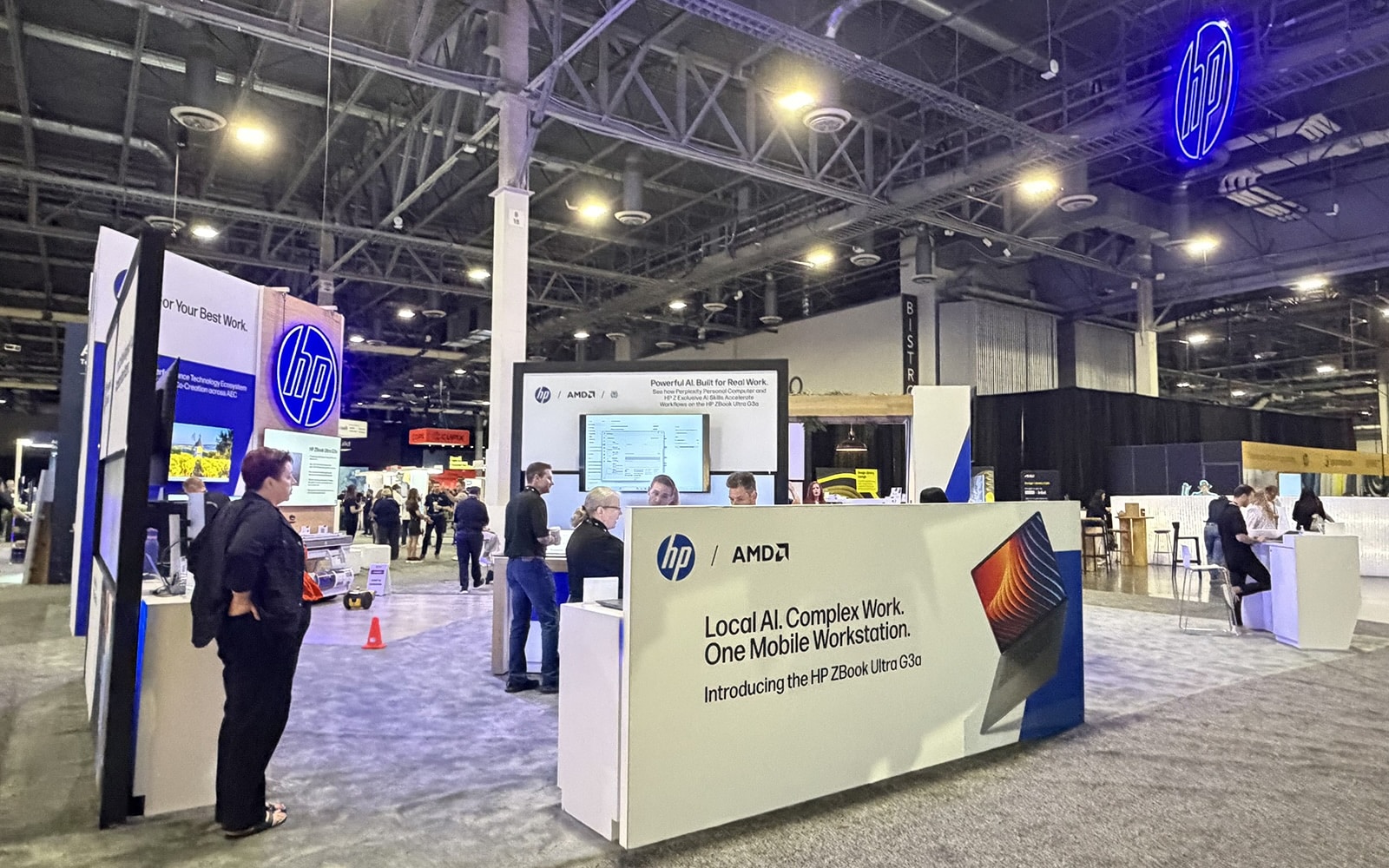
HP and AMD in the booth together promoting multiple solutions, including AI, and One Mobile Workstations like the HP ZBook Ultra G3a
The headline addition to HP SitePrint is a new cloud-based CAD editor built directly into the platform. In the past, you had to prepare layout sheets in separate CAD applications. Now users can edit and prepare layout files in the cloud using tools and automation to streamline prelayout setup. This allows on-site crews to make changes or corrections instantaneously. At the construction site, SitePrint gains a new smart navigation feature. The robot uses cameras to locate unmapped obstacles on the floor and automatically replans and adapts its route without user intervention. This helps in real-world conditions where materials, equipment, and temporary work could block the originally planned path.
AMD announced the new HP ZBook Ultra G3a 16-inch mobile workstation PC featuring AMD Ryzen AI MAX PRO 100 series processors.
- Up to 192 GB of unified memory (160 GB can be dedicated to the GPU) to support 300-billion-parameter local AI models
- Options such as 5G Starlink satellite service
- A 2.8K OLED or 4K DreamColor display
- Thunderbolt 4 support
AMD Ryzen AI Max Pro 100 series processors feature a unified memory architecture similar in many respects to Apple’s M-series processors. A key benefit of the Ryzen AI chip is its ability to run localized AI models, offering on-device inference, AI privacy, and sheer AI performance advantages compared to high-latency-bound AI cloud inference.
AU2026 Closing Remarks
Autodesk laid out its plans for the future of AI in its products and how they will help people connect and collaborate in real time. The phrase “unlocking capacity” was used often to describe how AI will increase productivity by automating some redundant tasks and simplifying others.
Autodesk will help those who design and make work more effectively while saving the costs of redundant tasks. When you consider the price of hardware these days, cloud solutions using AI make perfect sense. Autodesk products are completing their convergence with these new updates.
Autodesk Assistant plays a very important role in the future alongside other agentic AI tools. The upcoming standalone version of Autodesk Assistant will help integrate Autodesk’s product line with clients’ data, saving time and streamlining project management throughout the product lifecycle.
If you are still working with legacy software, you may want to consider migrating in the next few years to gain access to these tools as they become mainstream. I think referencing some of the companies using the software provides real-world context for what is being designed and built with AI and the cloud in Autodesk’s latest software solutions. The era of desktop software solutions is behind us, as hybrid tools and cloud-first solutions infused with connected data and agentic AI promise transformative automation and aligned workflow objectives.
The Fallingwater exhibit was very impressive and shows how the right use of Autodesk products can make dreams happen.