Autodesk University 2026 kicked off yesterday, and Architosh’s West Coast editor, Akiko Ashley, is on the ground in Las Vegas with Kevin Cahill, an architect, VFX 3D artist, and her husband. We will therefore have deep insights into AU2026 this year, plus interesting insights from the expo floor and more.
The Forma Platform
This year at AU2026, Autodesk is showing just how much more mature the Forma cloud platform and ecosystem have become in a few short years. Essentially all of Autodesk’s previously disparate and scattered product-named cloud applications have been rebranded under new Forma brand names, helping to unify the significance of Forma for the global AEC/O industry.
Key Takeaways
- Infrastructure Integration — Civil 3D is officially now a Forma Connected Client, and Autodesk introduced Forma Street Design (Beta)
- Next-Gen AI Agents — Autodesk introduces practical AI features across Revit and Forma
- Pre-Construction Forma Advancements — with Forma Bid (integrating BuildingsConnected) and mobile tools like Daily Log Agent convert spoken field updates into structured data
Autodesk has emphasized that commodity AI solutions, while useful in some respects, lack the capacity to serve the AEC industry the way artificial intelligence ought to. Saying in its press release, “the built world sets a high bar,” Autodesk is making the smart point that “AI for the built environment needs the right data, project context, and industry expertise to understand the site, design intent, schedule, requirements, and decisions that shape a project.”
Forma to Replace Revit?
Curiously, Autodesk’s official AU press release asks the rhetorical question of whether Forma is to replace Revit. This is a big subject area of expertise here at Architosh, and one can find a bounty of exclusive reports, interviews, and analysis on this question. Let’s quote Autodesk itself, and then we can add our analysis layer.
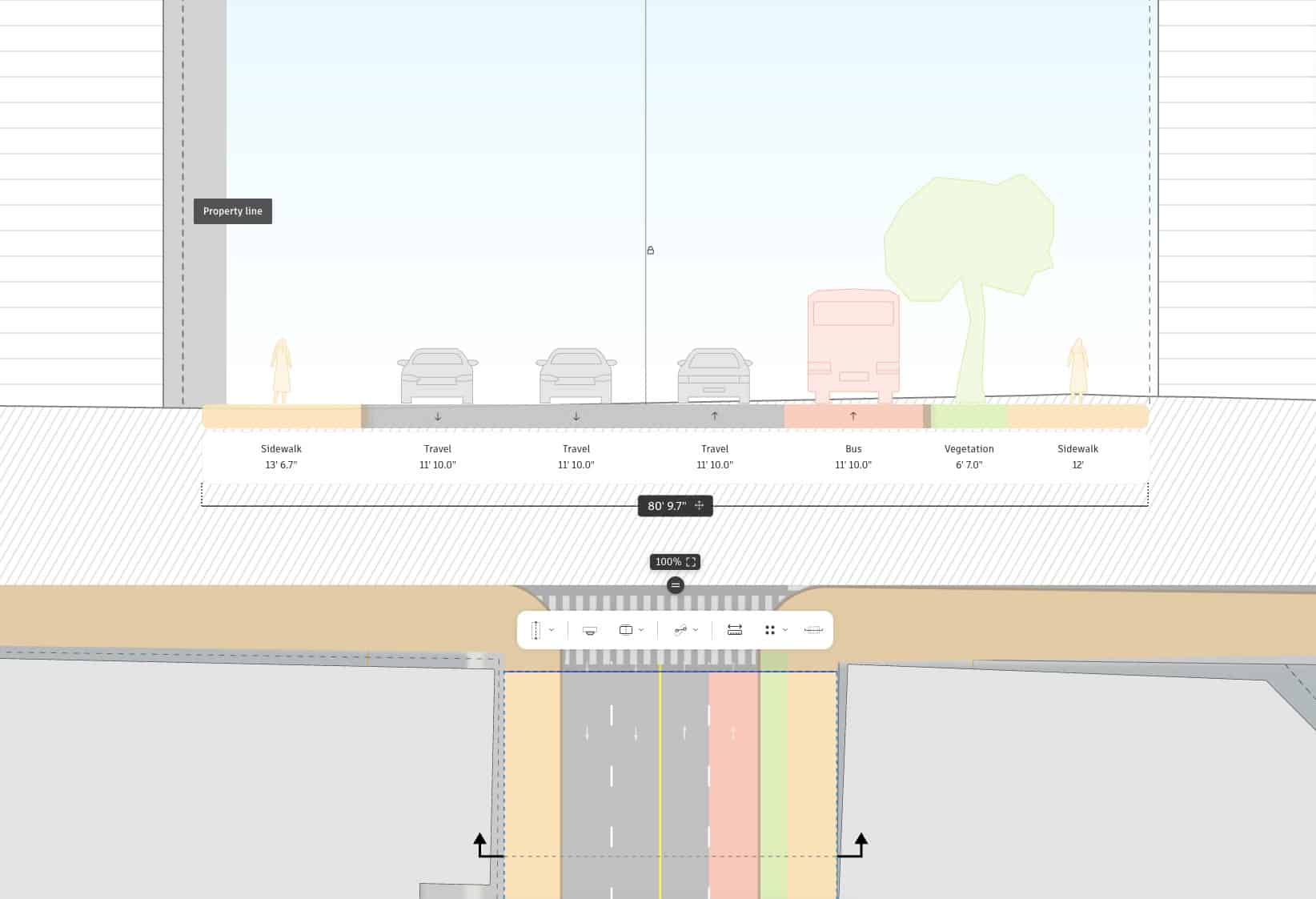
Forma Street Design (Beta) is the latest Forma-branded product and is aimed at early-stage civil design work.
“Over time, yes,” says Autodesk about Forma replacing Revit. “More and more of the work that happens in Revit today will happen directly in Forma,” says Autodesk.
In practical terms, Autodesk Forma Site Design and Forma Building Design are cloud-based solutions designed to support the early phases of a building design project and transfer that data into the desktop (and Windows-dependent) Revit solution everyone knows today. Autodesk is being clear about something, though, and this is critical for its customers to understand:
We will not force a sudden transition, but the direction is clear: more AEC work will happen directly in Forma.
Autodesk continues, “We will continue investing in Revit to give customers a practical path toward that future.”
New AI Capabilities
Autodesk is introducing a range of practical AI features across Revit and Forma, such as Autocomplete Room Elements, Optimized Annotations, and Automated Documentation, framing its AI technologies and features around high-context “Project Intelligence” rather than generic commodity AI.
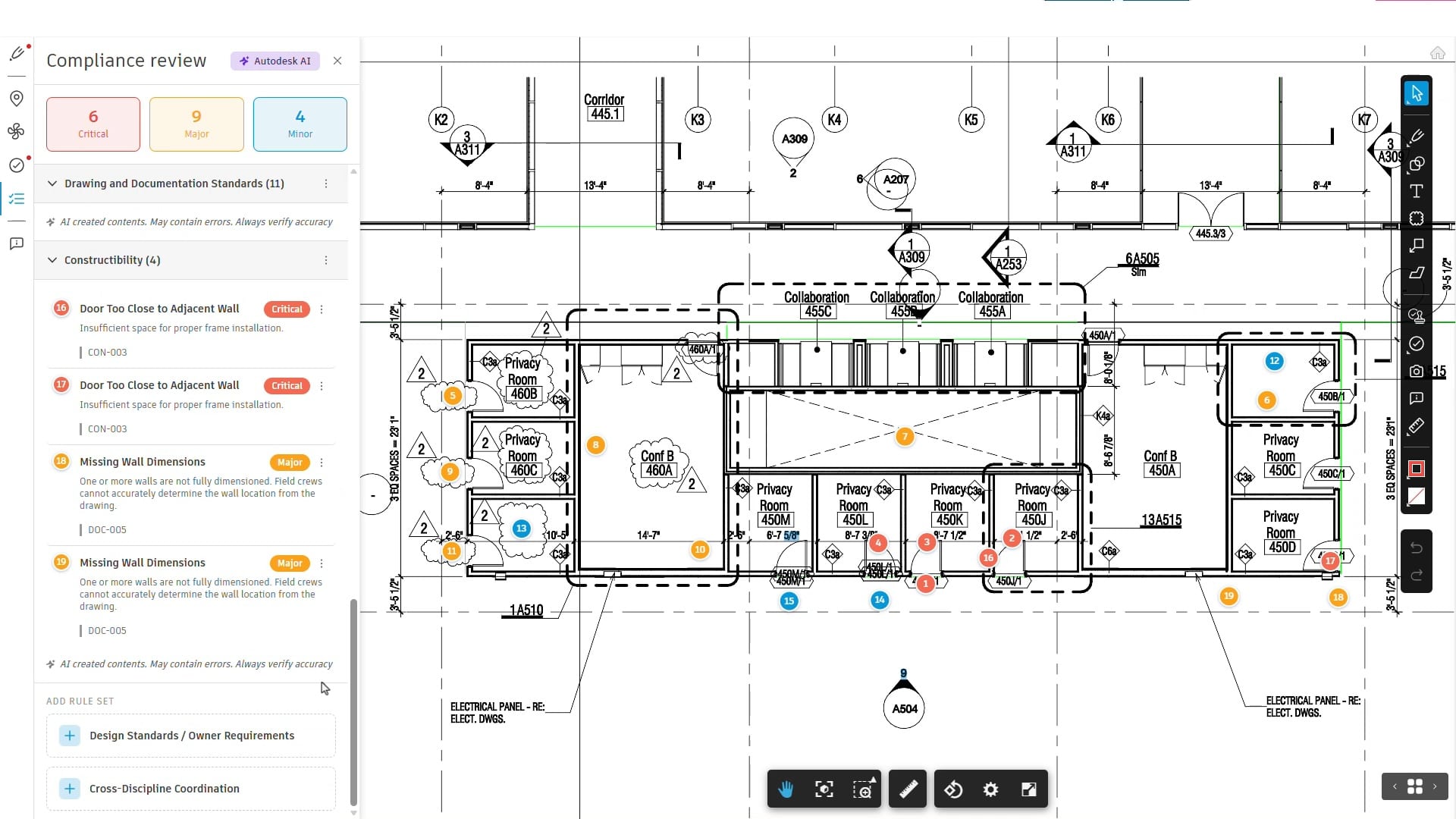
Drawing Compliance uses AI to surface drawing information for possible issues, such as walls too close to adjacent walls, missing wall dimensions, etc. Users can also add rules for design standards, owner requirements, and cross-disciplinary coordination.
Autodesk Assistant (an AI) can search inside drawings and take users directly to relevant sheets, while Drawing Change Analysis (new) helps teams identify meaningful differences between different versions of drawings (revisions).
MORE: Autodesk Construction Cloud (ACC) is now Autodesk Forma
Drawing Compliance Review surfaces potential issues so teams can resolve critical, major, or minor project issues faster. (see image above) Users can build rule sets that instruct the AI to surface drawing information for specific types of issues, such as owner requirements or cross-disciplinary issues.
Forma For Construction
Autodesk is also aiming to make a more connected future for AEC with Forma, linking design phase teams more strongly with building phase and occupancy phase teams and stakeholders. As Autodesk argues in its press release, “Better continuity gives architects more time for design choices, engineers a clearer picture of real-world conditions, and construction teams an earlier view of issues that could affect delivery.”
Autodesk says that over time more work will happen directly in Forma, with project information remaining connected across the AEC lifecycle as noted above. To that end, at AU 2026, Autodesk is previewing the next-generation Autodesk Assistant (AI agent), which brings together specialized AI agents, Autodesk tools, and project information to deliver better outcomes.
Meanwhile, Forma Bid brings BuildingsConnected bidding workflows into Forma. This lets contractors manage invitations, level bids, compare pricing with estimates, and find scope gaps. Forma Bid is available today as a beta.
And in an effort to capitalize on the popularity of AI products like Pocket, Autodesk has unveiled Autodesk Daily Log Agent, which runs on mobile and can turn a superintendent’s spoken update into a structured daily log while the details are still fresh, reducing manual, typed-in daily entry.
This is our first of many upcoming AU 2026 news and feature reports. Stay tuned as we release special items available only to members of the press who attended AU2026.