As of today, Apple now has its most formidable chip competitor for personal computers. Having essentially run away with industry performance leadership in single-core processing and performance per watt, Apple’s M-series (ARM-based) SoC (system on a chip) processors have shown up Intel and AMD X86 processors in industry benchmarks and the world’s top apps.
Now, NVIDIA has entered the same race—the race to deliver the world’s fastest and most capable processor for the personal computer. But unlike Intel and AMD, NVIDIA’s new RTX Spark Superchip runs the ARM instruction set, not the Intel-X86 instruction set, and thus joins Apple and Qualcomm (not to mention MediaTek) in the ARM architecture’s pursuit of taking over the PC landscape.
Death to Intel X86?
So, does this news mean doom for Intel X86? We have certainly discussed this possibility in great detail before in our critically received feature (see Architosh, “End of an Era: How Silicon Will Decide BIM’s Future,” 24 December 2025), first published for our Xpresso-4X newsletter readers. And we originally discussed ARM’s threat to Intel X86 in our even larger, critically received feature (see, Architosh, “Chip Technology, Geopolitics, and the CAD Industry,” 21 Jan 2022).
Key Takeaways
- NVIDIA’s RTX Spark Superchip is based on the ARM architecture and is similar to Apple’s and Qualcomm’s ARM SoCs in that it merges a CPU, GPU, and dedicated AI processing centers all on the same chip with a “unified memory” architecture that is incredibly fast.
- The RTX Spark has no benchmarks at this announcement, but company executives told Forbes editors that it will have all-day battery life and be performance competitive with anything else in the PC market.
- RTX Spark-based computers could massively disrupt sales of Intel and AMD X86-based computers, tilting the entire X86 Windows software ecosystem towards ARM. Leading PC makers will ship RTX Spark-based systems in the fall in premium laptop configurations and run Microsoft’s Prism X86 software emulator as well as support the growing ecosystem of native Windows on ARM software titles.
But before we discuss why Intel X86 may be in real trouble now, let’s dig into the announcement and chip details further.
Jenson Huang, in his talk at Computex, Taipei, today, essentially says:
There is no question that this reinvention of the computer is as big a deal as the reinvention of the phone into what we now know as the smartphone.
Huang goes on to say that with each generation of the new RTX Spark Superchip, there will be a new model for the laptop, the desktop, and the workstation computer. He further says in his talk that he is incredibly thrilled that 100 percent of the world’s PC market has joined Nvidia to reinvent the PC. Of course, Jensen Huang isn’t really capturing 100 percent of the PC industry to come on board and join them in reinventing the PC. Critically, Intel and AMD are not on board because the NVIDIA RTX Spark Superchip is the most existential threat to their PC chip business that they have likely ever faced.
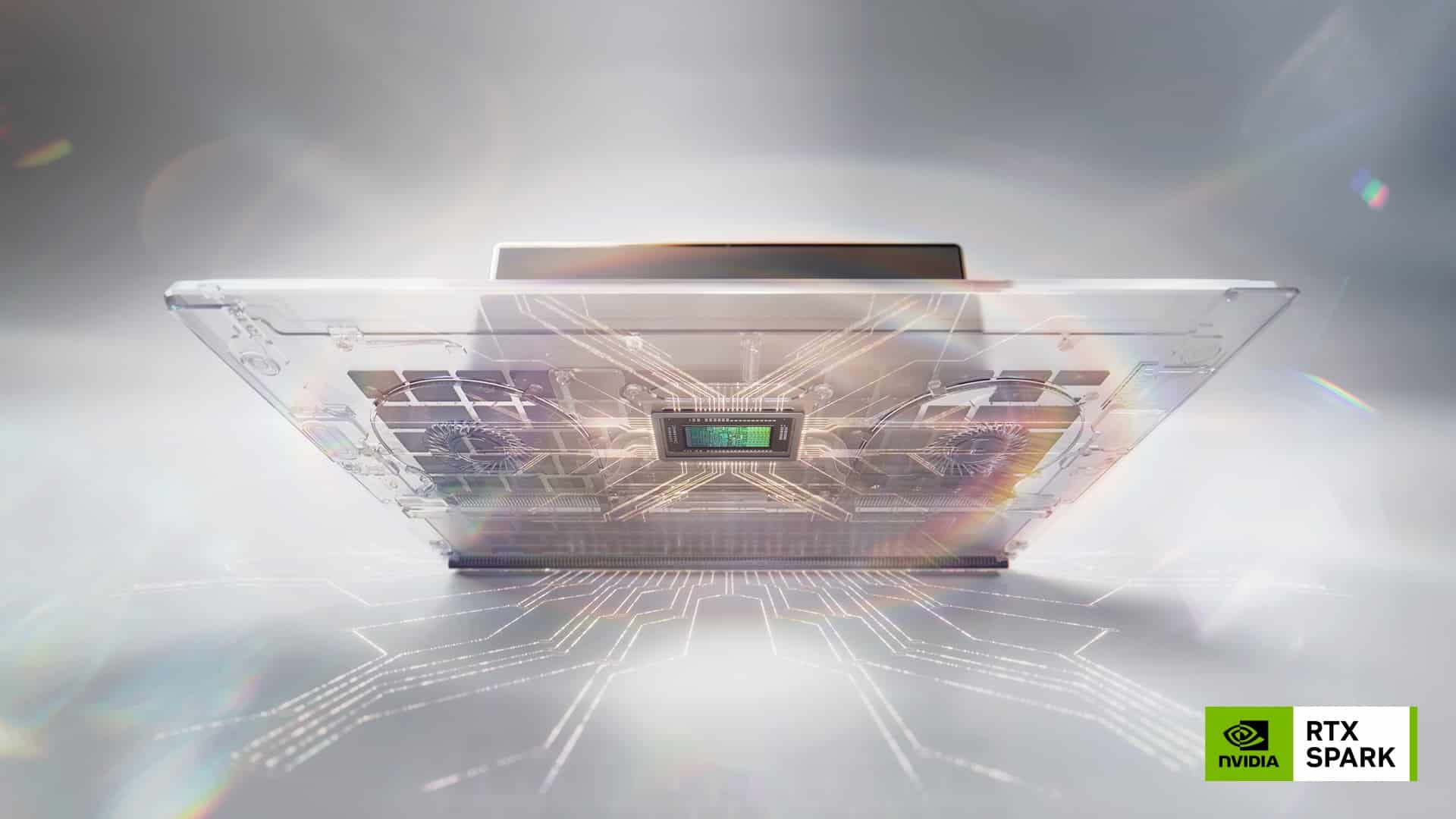
NVIDIA and Microsoft reinvent the Windows PC for the Age of Personal AI. Introducing the NVIDIA RTX Spark Superchip for Windows ARM computers.
Historically, Nvidia relied on Intel and AMD to provide the X86 central processing units (CPUs) that acted as the brains, along with Nvidia graphics cards (GPUs), which ran graphics and specialized parallel processing tasks. Now RTX Spark represents a paradigm shift that targets the core profit engines of the legacy X86 giants through several critical competitive advantages.
RTX Spark Advantages
Namely, these advantages stem from the fact that NVIDIA is breaking the X86 Duopoly in high-end devices in the PC market. The RTX Spark Superchip running Microsoft’s Windows for ARM shatters this exclusivity. Now consumers will face a choice between RTX Spark-based systems from top-tier computer makers, including Dell, Lenovo, HP, Asus, and MSI, and X86-based systems running Intel and AMD processors. Which will they choose and why?
Computer buyers will want to choose NVIDIA’s RTX Spark-based systems for one very important advantage. The Spark Superchip is built from the ground up for what Huang calls the Native AI Agent Revolution. In other words, the leading AI chip company is going to bring its AI chip prowess to your everyday computing.
Let’s look at the NVIDIA Spark Superchip in detail. So what does it consist of?
- CPU Architecture — ARM (NVIDIA and MediaTek co-developed the design)
- CPU Core Count — 20-core (10 Cortex-X925 + 10 Cortex-A725)
- GPU Architecture — NVIDIA Blackwell (up to 6,144 CUDA cores)
- Memory System — Up to 128 GB of LPDDR5X Unified Memory
- Processor Node — TSMC-3 nanometer
The RTX Spark Superchip will fuse two chiplets: a GPU based on NVIDIA’s Blackwell architecture and a 20-core NVIDIA Grace (ARM-based) CPU. Unified memory is what the Spark Superchip has in common with ARM chips from Apple and Qualcomm, but to stand apart from them, the RTX Spark chip supports up to 128 GB of unified memory in configurations that are engineered for heavy desktop-class AI and graphics workloads rather than mobile-first efficiency. Unlike Apple and Qualcomm, the NVIDIA RTX Spark superchip includes NVIDIA’s NVLink memory bandwidth technology, yielding up to 600 GB/s. And the chip also features Blackwell CUDA cores, something that Qualcomm and Apple are locked out of, as this technology is proprietary.
MORE: ARES 2027 Deep Dive: AI, Automation and BIM-to-DWG Workflows
Even if Intel and AMD launched their own unified memory, ARM-based processors to compete with the RTX Spark, they would have to strike a licensing deal to obtain the Blackwell GPU with CUDA cores. CUDA is, indeed, NVIDIA’s strongest leverage in computing in the age of AI.
Architosh will share more on RTX Spark as we learn more details, but in our section below, we explore the industry impact of this new chip announcement. For further details, read here.
Architosh Analysis and Commentary
Early feedback from the computer industry over the NVIDIA RTX Spark Superchip is a mix of massive excitement over the hardware’s capabilities, mixed with a healthy dose of debate over its impact on the Windows X86 software ecosystem. It would be premature to rush to the conclusion that AMD and Intel cannot compete with NVIDIA in the PC market for central processing units. Much depends on the true performance advantages NVIDIA’s RTX Spark can deliver in general and AI computing. However, in general, the very fact that the Spark is out now and is ARM-based sends another powerful signal to the market that the ARM architecture is rising while the Intel X86 architecture is in decline. This begs the question about software ecosystem disruption.
How will Windows software be developed in the future? If software on Windows moves to an ARM-priority-based market, this will actually aid Apple as well, since their hardware is also ARM-based, and emulating Windows on ARM today on MacOS systems is very prevalent and performative.
Furthermore, with NVIDIA focusing on getting Windows gaming developers and graphics app developers moved over to native ARM development for these new RTX Spark-based computers, this also shifts the tools behind the software development in a direction that will likely aid Apple as well. It will be easier for a developer to develop for ARM on both Windows and Mac since they share the same chip architecture and presumably an increasing set of ARM development tools. The question then becomes, how does the CAD industry react to all of this? What will Autodesk and SolidWorks do in response to a possible future where the world’s fastest Windows PCs are running NVIDIA RTX Spark Superchips?