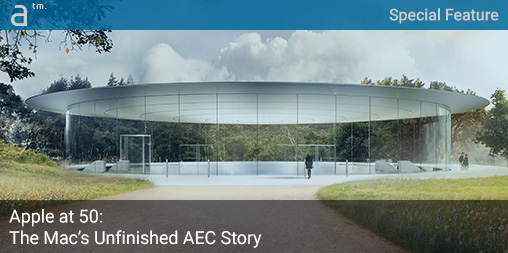
ON APPLE’S 50TH ANNIVERSARY, it is worth revisiting one of the company’s longest and most revealing professional relationships: its uneasy, often tantalizing, never fully resolved place in architecture, engineering, and construction. This is not, strictly speaking, a history of Architosh. It is a history of Apple and AEC—of a company that, for decades, has built machines architects were instinctively drawn to, while too often failing to secure enough of the software their firms could not do without.
Architosh entered that story in 1999, during one of Apple’s darkest periods. At the time, the Mac’s future was still uncertain, and so was its position in architecture. The site was founded for a practical reason: to support architects using the Mac and to challenge two persistent claims—that there was no serious software for architects on macOS, and that serious architecture firms had already abandoned the platform. Both claims were grossly overstated. The Mac was still present in architecture, still valued in design culture, and still deeply relevant in many firms and cities. But the platform’s standing was under pressure, and the software ecosystem gaps were real.
The Mac was still present in architecture, still valued in design culture, and still deeply relevant in many firms and cities. But the platform’s standing was under pressure, and the software ecosystem gaps were real.
That tension has defined Apple’s relationship with AEC for decades. Again and again, Apple has produced compelling hardware, excellent graphics capabilities, strong industrial design, and, at key moments, world-class performance. But in architecture and construction, hardware alone has never been enough. AEC has always been shaped by workflows, standards, ecosystem momentum, and above all by the availability of indispensable applications. That has been Apple’s enduring challenge in this market.
The Conditions That Gave Rise to Architosh
When Architosh launched in February 1999, the immediate mission was straightforward: provide a serious resource for architects using the Mac. That mission emerged from direct experience inside practice. In the late 1990s, it was still common to encounter architecture firms running Macs, especially in cities and regions where Apple had stronger market penetration due to adjacent industries such as publishing, academia, media, and the creative professions. Boston, San Francisco, Los Angeles, Austin, and New York all had strong Mac constituencies, and architecture often reflected those broader local conditions.
In Boston, for example, firms like Koetter Kim & Associates (where this author practiced) practiced on Macs, and the city’s concentration of colleges, publishing, and scientific institutions created a natural environment for Apple. Yet even there, by the late 1990s, Apple’s instability had become a source of anxiety. Firms that preferred the Mac increasingly had to ask whether that preference remained sustainable.
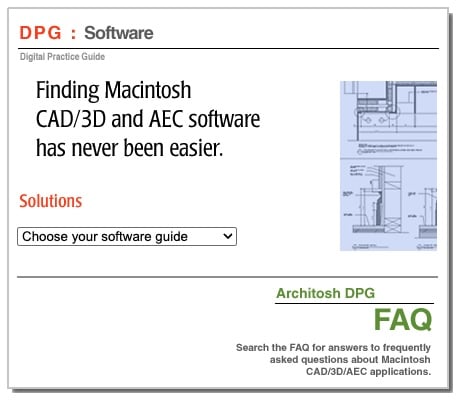
An image of the DPG from Architosh’s older site (still on the web). Though no longer updated, the guide is still available, just click on the image.
Architosh was born out of that atmosphere. Early on, the publication functioned as a rebuttal in practical form. Its Digital Practice Guide catalogued the software and hardware that architects could actually use on the Mac. Its community pages and forum helped document something equally important: there was, in fact, a real international base of architects and firms still committed to Apple’s platform. By 2003, that community included hundreds of firms and thousands of forum participants. Architosh did not invent the Mac in architecture. It simply made visible a community that already existed and argued that its needs were being underestimated.
Apple’s Place in Professional Computing
Apple’s larger history is well known. Founded in 1976, it helped launch the personal computer revolution with the Apple II and then fundamentally reshaped personal computing with the Macintosh in 1984. But Apple’s importance in AEC has never depended on nostalgia. It has depended on whether the company could offer the right combination of usability, graphics capability, performance, and software support for professional practice.
In the early Mac era, Apple’s advantage was never just raw computing power. The Macintosh distinguished itself through user experience, visual sophistication, and a model of computing that was attractive to designers. Even when Motorola-based Macs struggled to keep up with Intel on performance, Apple maintained a strong identity among creative professionals. That mattered in architecture, where affinity for design tools, interfaces, and visual computing has always been stronger than in many other verticals.
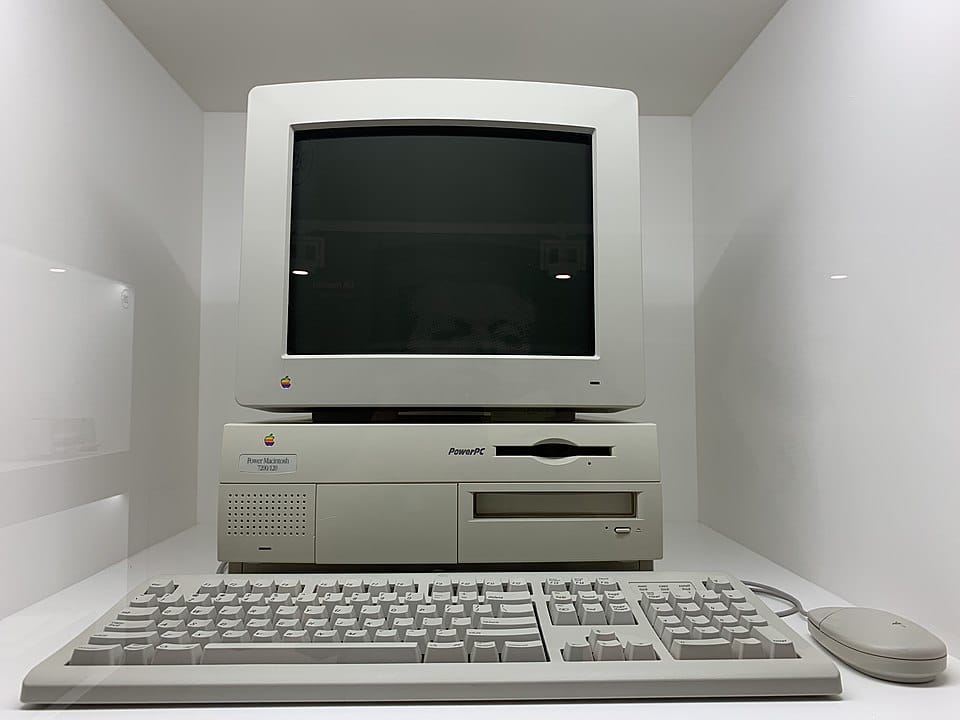
The PowerPC era meant industry-leading performance and PowerPC chips would continually eclipse Intel in a massive rivalry for years to come. The Power Macintosh 7200, shown here, was popular in architecture, engineering, science, medicine, and publishing and graphics. (IMAGE: Wikimedia Commons, Benoit Prieur).
The PowerPC transition in the mid-1990s gave Apple a more credible performance story and renewed professional interest. But the larger industry momentum behind Windows 95 and the exploding Windows software ecosystem undercut that advantage. The rise of the web, the standardization around Microsoft, and Apple’s broader corporate instability pushed the Mac toward irrelevance in many business categories, including parts of AEC.
Steve Jobs’s return in 1997 saved Apple, and the iMac, iPod, iPhone, iPad, and later Apple Watch transformed the company into one of the world’s most powerful consumer technology firms. Yet Apple’s resurgence did not automatically solve its standing in professional computing. If anything, it complicated it. The company became stronger financially while becoming less dependent on the Mac, and many pro users began to feel that Apple’s attention was drifting away from their needs.
Autodesk, AutoCAD, and the First Great Break
No company mattered more to the Mac’s fate in architecture than Autodesk. The abandonment of AutoCAD on the Mac was one of the defining events in Apple’s AEC story.
Autodesk’s departure from the Mac in the mid-90s was not caused by one issue alone, but the timing was especially damaging. AutoCAD Release 12 for the Mac did not arrive under ideal conditions, and the broader transition period around PowerPC did not help. The troubled Release 13 era further weakened confidence. Autodesk eventually consolidated around Windows and abandoned not only the Mac version of AutoCAD but also other non-Windows versions. For architects and firms already under pressure to standardize, this mattered enormously.
No company mattered more to the Mac’s fate in architecture than Autodesk. The abandonment of AutoCAD on the Mac was one of the defining events in Apple’s AEC story.
It is worth asking, in hindsight, whether things might have gone differently. A strong, well-received PowerPC-native AutoCAD could have helped stabilize a substantial Mac user base in architecture at a critical moment. Instead, Mac AutoCAD users were left frustrated, and Windows gained further momentum as the default professional environment.
When Autodesk eventually returned to the Mac with AutoCAD in 2010, the market response was positive. The return validated something Architosh had argued for years: there was still meaningful demand for serious AEC software on Apple hardware, and a Mac version could attract real users rather than merely cannibalize existing Windows seats.
Apple’s Own Failures in AEC
Autodesk was not the only company to misread the moment. Apple also bears responsibility for its longstanding weakness in architecture and construction.
Architosh’s open petition for AutoCAD on the Mac collected thousands of responses, demonstrating substantial demand. Apple understood that critical applications were essential to growing market share in verticals like architecture. Executives knew the problem. The question was what Apple would do about it. In practice, it did too little.
This remains one of the great strategic failures in Apple’s professional history. The company often emphasized the Mac’s design, ease of use, graphics strengths, and later performance benefits, but it consistently underestimated how much market power resided in application ecosystems. In AEC, users do not choose platforms in a vacuum. They choose workflows, file compatibility, standards, consultants, contractors, and hiring pools. When a few essential applications dominate the industry, superior hardware is not enough, “technical interrelatedness” becomes a dominant market force. (see, Architosh, “The Revit Open Letter Through the Lens of QWERTY-Nomics,” 20 Oct 2022)
Apple should have spent more, pushed harder, and taken a longer view in helping bring critical professional software to the Mac. Instead, it too often behaved as though the platform’s inherent strengths would be persuasive on their own. In architecture, they were not.
Three recurring weaknesses hurt Apple’s position in AEC.
The first was cost. Apple did not always appreciate how closely professional buyers scrutinize price-performance ratios. Mac systems were often attractive and sometimes faster, but they were frequently more expensive at the high end, especially in ways that mattered to firms managing many seats.
The second was flexibility. Apple’s best systems were often elegant but constrained. Upgradability, GPU options, and broader hardware configurability mattered in pro markets, and Apple was not always willing to meet those needs halfway. Its long-running distance from Nvidia and CUDA only reinforced the perception that Apple prioritized its own product philosophy over the practical demands of pro workflows.
The third—and by far the most important—was ecosystem blindness. Apple repeatedly failed to grasp that without critical applications, the Mac’s industrial design, performance, and management advantages would never translate into broad adoption in architecture. In AEC, ecosystem gaps are not minor inconveniences. They are deal-breakers.
Misreadings Beyond Apple
Others also misread the Mac opportunity. In 2003, Architosh and Cyon Research jointly released a white paper advocating for AutoCAD’s return to the Mac. Yet the conclusions associated with that effort underestimated the growth potential of a renewed Mac AutoCAD market. The argument that a port would make little financial sense if existing users could already run Windows software on Apple hardware now looks too narrow.
The flaw in that thinking was a failure of imagination. It focused too heavily on whether Autodesk would merely retain existing users rather than expand into adjacent markets. But that overlooked the possibility that a modern Mac AutoCAD could open new seats, new design-oriented user segments, and new areas such as corporate architecture, interiors, and brand-driven retail design. In the years that followed, Autodesk’s own experience suggested the Mac version did indeed find new users and succeed on its own terms.
That miscalculation was part of a larger pattern. Time and again, key players in the industry treated the Mac as a legacy niche rather than a platform capable of renewed relevance under the right conditions and capable of software license expansion, not just Windows seat cannibalization.
Architosh’s Own Evolution
Architosh also changed course over time. Once Apple’s survival was no longer in doubt, in 2008, the publication moved away from its original community-centered advocacy role and toward broader, vendor-neutral coverage of AEC technology. That shift made sense editorially. The site grew into a widely respected publication covering the global AEC software landscape across platforms, devices, cloud applications, and emerging workflows.
But something was lost in the transition. As Apple receded from explicit focus, so too did the sense that there was a visible, organized Mac community in architecture worth serving and defending. In hindsight, Architosh’s move away from community-building may also have signaled that the long fight for the Mac in architecture had entered a quieter phase, or perhaps a less hopeful one.
Time and again, key players in the industry treated the Mac as a legacy niche rather than a platform capable of renewed relevance under the right conditions and capable of software license expansion, not just Windows seat cannibalization.
Still, that evolution mirrored the market itself. By the 2010s, the most important AEC story was no longer whether the Mac had a constituency. It was whether Apple could remain relevant while the software center of gravity in the industry moved decisively elsewhere.
The Rise of Revit and the New Strategic Problem
That elsewhere was Revit.
If AutoCAD’s departure was the first major break in Apple’s AEC story, the rise of Revit was the deeper long-term challenge. While Apple was succeeding brilliantly in consumer electronics—and while the iPad was becoming enormously influential on construction sites—Revit was consolidating its place as the dominant BIM platform across much of the industry.
This mattered more than any single hardware cycle. By the early 2010s, architecture and construction were increasingly being shaped not just by drafting tools but by BIM-centered workflows, and Revit sat at the center of that shift. A Windows-only application was becoming the defining platform of modern AEC production.
Revit’s importance also reshaped the Mac debate. The question was no longer simply whether Apple could recover lost ground through general design affinity or improved hardware. The question became whether the Mac could remain strategically viable in architecture without native access to the industry’s most important BIM environment.
Even Autodesk seemed aware of the pressure. Revit was long one of the most requested Autodesk applications for the Mac. When the Open Letter controversies emerged in 2020, Architosh became a central publication covering the fallout and the wider questions about Revit’s future. Although those debates were not primarily about the Mac, they once again exposed an important truth: the long-term future of AEC platforms could not be discussed without also discussing Apple.
The “Pro” Problem at Apple
Unfortunately, these years also coincided with one of Apple’s weakest periods in professional desktop strategy. From 2013 to 2019, pro users endured the notoriously compromised “trash can” Mac Pro or were pushed toward less ideal alternatives such as iMacs. Many creative professionals came to believe that Apple had forgotten the needs of high-end users entirely.
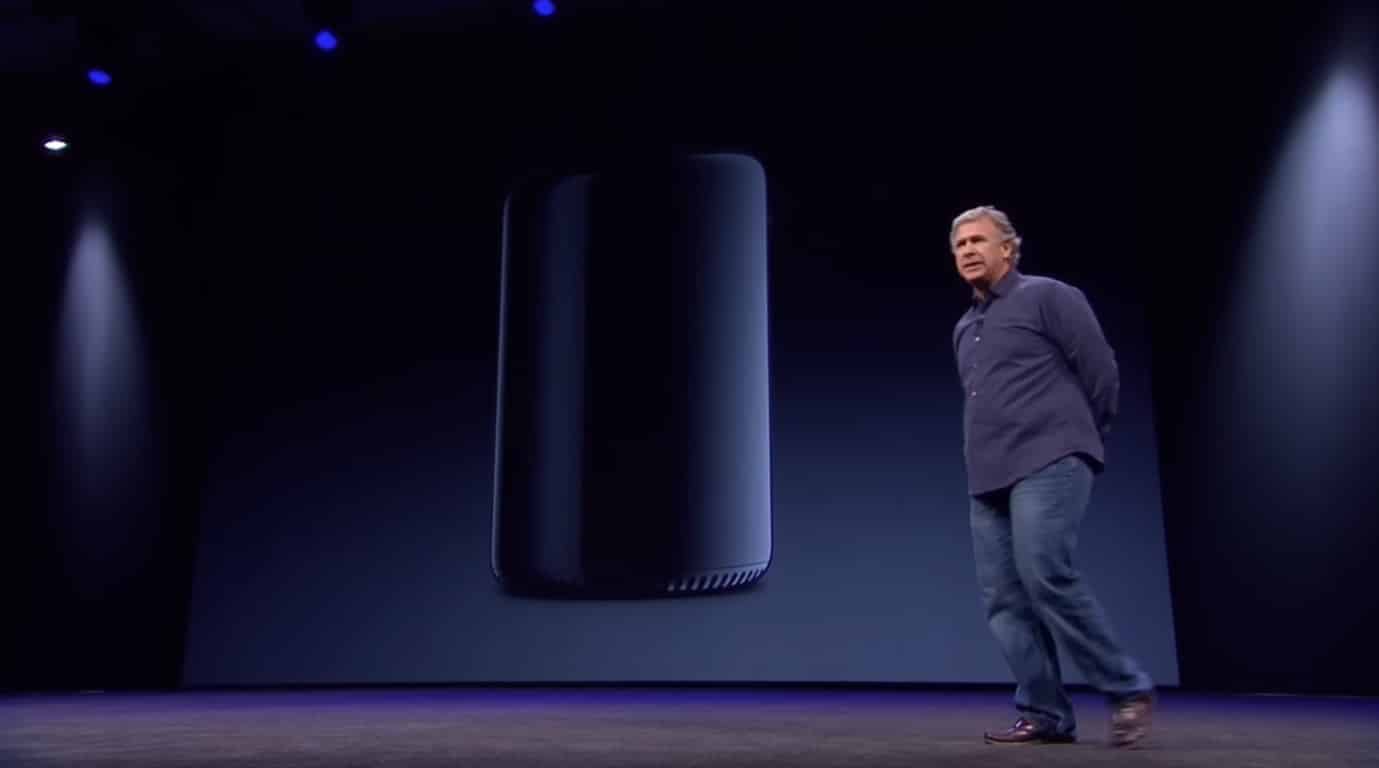
The famous Phil Schiller moment when he said “can’t innovate anymore my ass” during the 2013 launch of the ill-fated Mac Pro.
That criticism was not limited to AEC, but architecture felt it acutely. CAD and BIM users care deeply about responsiveness, reliability, graphics, and raw compute performance. They also care about stability and about confidence that the platform vendor actually understands professional demands. During this period, Apple did little to reassure them.
Then Apple Silicon arrived.
Apple Silicon and the Return of Possibility
The transition to Apple Silicon in 2020 changed the conversation more dramatically than anything Apple had done for the Mac in years. Once again, Apple forced developers through a processor transition. But this time the shift was welcomed because the underlying technology was so compelling.

One More Thing. The special event in November 2020 when Apple introduced Apple Silicon for the Mac.
Apple Silicon brought exceptional performance per watt, outstanding integration, and industry-leading single-core performance. For AEC users, that last point matters enormously. Nearly all CAD and BIM workloads continue to benefit heavily from strong single-threaded responsiveness even in a multicore world. For the first time in a long time, Apple did not merely have an elegant or attractive machine for architects. It had a machine with a serious and sustained technical advantage in the kind of performance many design applications value most.
This created a new strategic opening.
The first possibility is ecosystem convergence through ARM. As Microsoft and the broader Windows ecosystem push more deeply into ARM, software vendors may find it easier to bring applications to macOS because the architectural gap between platforms narrows. In that scenario, the Apple Silicon era could become something like a second chance for the Mac in AEC—similar in strategic importance to the Intel transition, but potentially larger in consequence.
MORE: End of an Era: How Silicon Will Decide BIM’s Future
The second possibility is more paradoxical. Apple Silicon has become so powerful that running Windows applications in virtualization can be surprisingly viable. In some cases, the Mac’s raw performance advantage can offset the virtualization penalty enough to make Windows software usable at an impressive level. That raises a provocative question: if Windows applications already run well enough on powerful Macs, will some vendors decide there is still no need to port?
That tension captures the current moment. Apple now has the strongest technical case for the Mac in years, perhaps ever, yet the software question remains unresolved.
Performance, Trajectory, and Meaning
There is a temptation to reduce Apple Silicon’s significance to benchmark bragging rights, but the larger point is more practical. Apple now has something it has rarely possessed so clearly in its competition with Wintel: not just design appeal or efficiency, but a credible claim to sustained leadership in the performance characteristics that matter to many professional users.
Single-core gains are not abstract in CAD and BIM. They are felt decisively in responsiveness, regeneration speed, modeling fluidity, and the general sense that software is reacting instantly rather than grudgingly. In the world of design tools, that matters immensely.
Apple now has the strongest technical case for the Mac in years, perhaps ever, yet the software question remains unresolved.
Apple’s performance trajectory in recent years suggests that the company may maintain a meaningful advantage for years, particularly if future chip generations continue to widen the gap or even simply preserve it. If so, the historical contradiction at the center of this article becomes harder to ignore. The Mac may now offer some of the most compelling hardware in the world for certain AEC workloads at precisely the moment when the industry’s most essential software remains largely tied to Windows.
That is not just ironic. It is strategically unsustainable.
The Question at 50
At 50, Apple has the strongest silicon story in the history of the Mac and, in many respects, the best hardware case it has ever had for serious design and professional computing. Yet in AEC the central contradiction remains. Some of the most attractive hardware for CAD, 3D, and BIM still lacks native access to some of the industry’s most important software.
This has been Apple’s long struggle in architecture. The company has never had much trouble convincing architects that the Mac is desirable. It has repeatedly struggled to convince the software industry that the platform is too important to ignore.
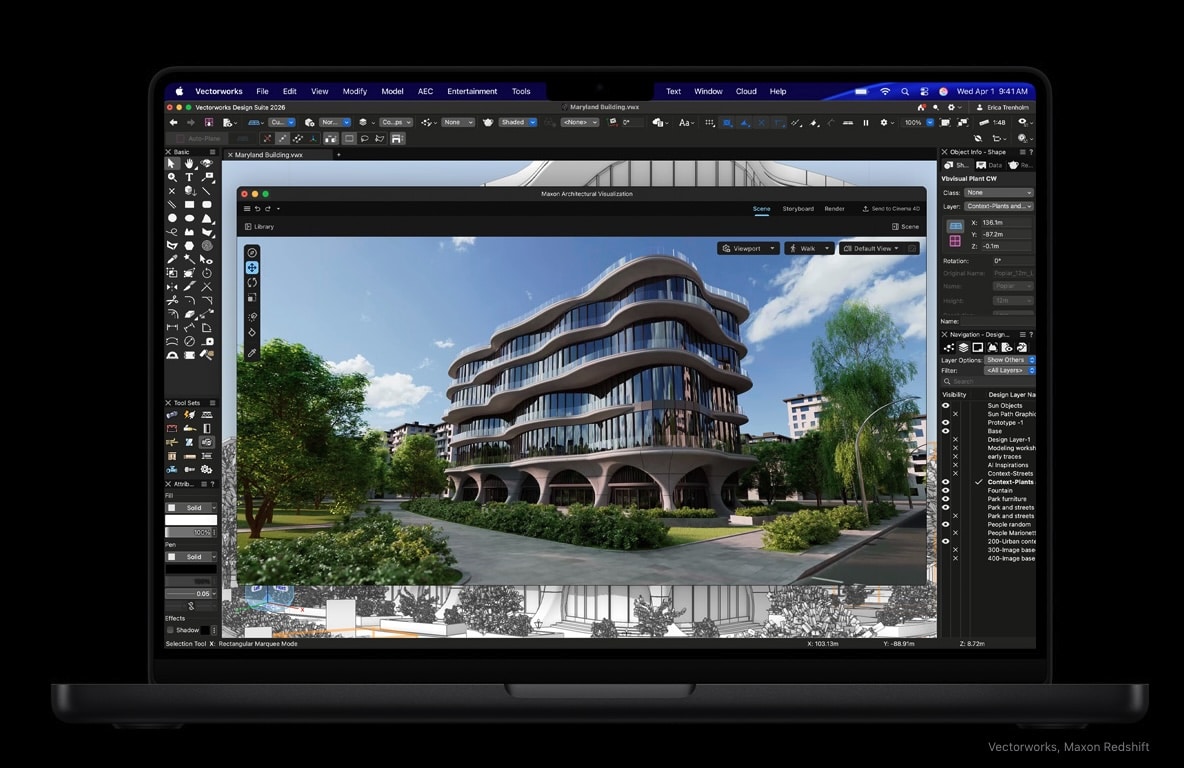
The MacBook Pro features the latest Apple Silicon M5, M5 Pro and M5 Max, offering the computer industry’s leading single-core processing speeds, ideal for CAD and BIM applications. In this image we can see Vectorworks Architect 2026 fully native for macOS and leveraging Apple Silicon accelerated technologies.
That challenge has defined every major phase of Apple’s relationship with AEC—from the early Mac years, to the loss of AutoCAD, to the rise of Revit, to the current Apple Silicon era. The details have changed, but the basic conflict has not: Apple keeps building machines that make sense for designers, while the industry’s software center of gravity remains elsewhere.
If that finally changes, Apple’s next era in architecture could look very different from its first 50 years. If it does not, Apple will remain what it has so often been in AEC: the maker of extraordinary machines standing just outside the industry’s most important doors.
Postscript
A final note is necessary here. To speak of Apple’s long software struggle in AEC is not to say that the Mac lacks serious architectural tools. It does not. Archicad and Vectorworks, both part of the Nemetschek Group, have for years stood as powerful native alternatives on macOS—competitive with Revit, and in important respects ahead of it. They remind us that the Mac story in architecture is not only a story of absence and missed opportunity. It is also a story of enduring strengths, loyal developer support, and software makers that recognized long ago that architects on the Mac were worth building for.
That point extends beyond BIM authoring tools alone. The Mac has long been exceptionally well served in 3D modeling and visualization, with leading solutions across those domains running natively and running well on macOS. These remain among the most important parts of the design pipeline: the tools that help win work, shape design intent, and carry projects toward final resolution. Even many Revit-based firms rely heavily on such tools in these phases, especially Trimble SketchUp and McNeel’s Rhino and Grasshopper, the latter of which remain deeply embedded in architecture schools and design-forward practices around the world. All of these tools run beautifully on the Mac.
Beyond desktop software, the AEC landscape has also shifted toward the cloud. Numerous leading solutions now operate largely through the browser, including common data environment and collaboration platforms from some of the industry’s biggest players, Autodesk among them. That evolution matters because it reduces the degree to which professional practice is tied to a single desktop operating system.
It is important to add this postscript because the feature above does not sufficiently credit the many AEC developers that have supported the Mac faithfully and well. To leave them unnamed risks flattening the story and overstating the role of what is missing. The larger point of the article remains unchanged: the Mac’s AEC story is still unfinished, especially when seen through the lens of Architosh’s origin story and the editorial and community ambitions that defined its first nine years. But unfinished does not mean unbuilt, and it certainly does not mean unsupported.
We hope companies such as Nemetschek, Trimble, McNeel, and others understand that editorial choice in context. This feature is only the first in a broader Apple at 50 series on Architosh. In the next installment, we speak with an architect who has done a great service to the Mac-based architecture community, especially in the years after Architosh broadened its editorial focus beyond exclusive Mac coverage. And there is more to come in the months ahead.