This month, Denver-based Kestrel Labs has added major new features to its native building code compliance platform. The update now includes integration with Autodesk Forma, browser-based 3D review, scheduled cloud compliance checks, and broader state-code coverage, among other features.
Kestrel Labs Update
Since its launch at the AIA National conference in June of 2026, the award-winning new AI application has seen nothing but positive momentum and reception in the industry. Unlike most AI code compliance tools, Kestrel Labs embeds its compliance check directly inside Autodesk Revit, where architects work.
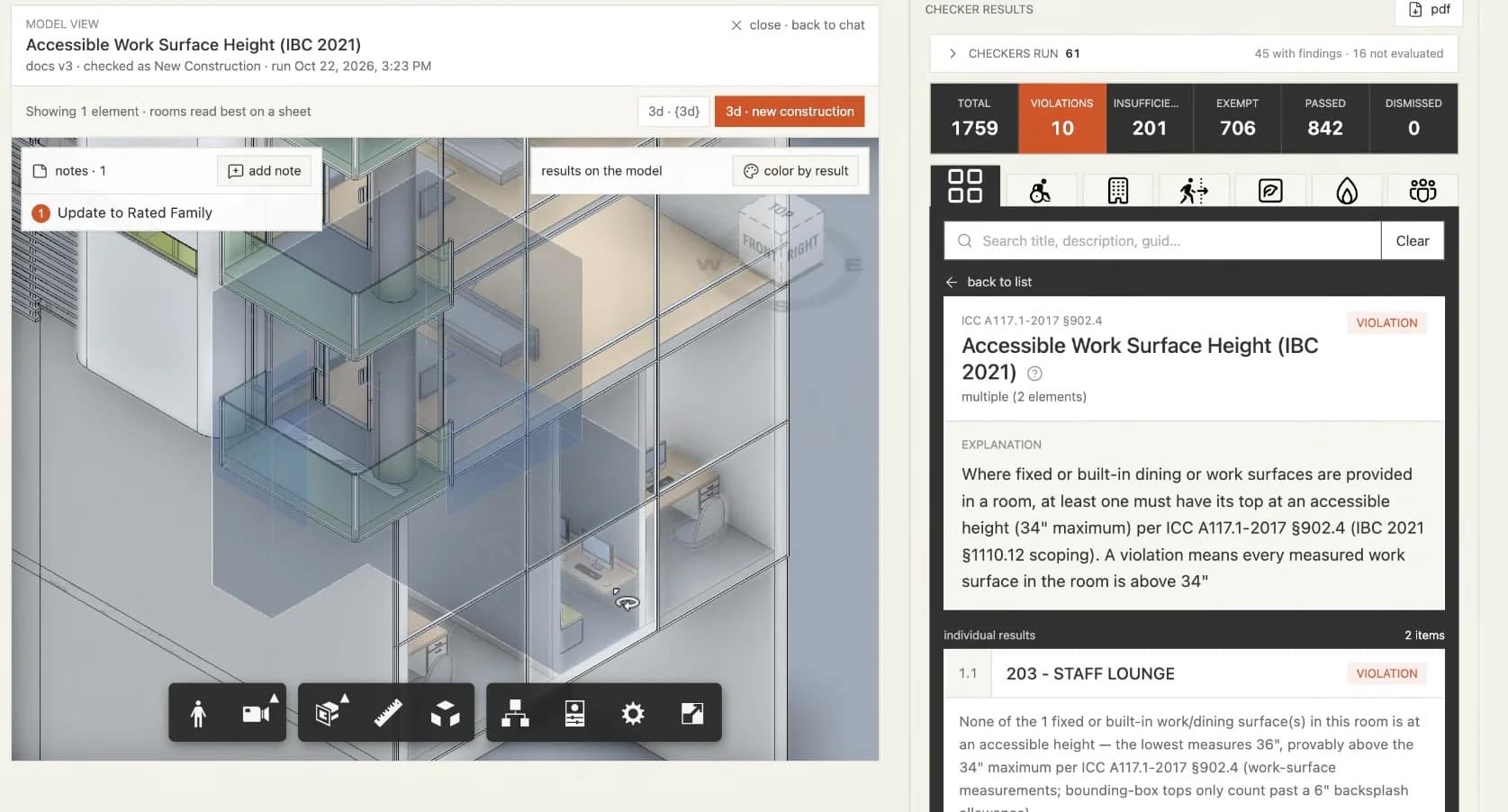
Browser-based 3D review in Kestrel Portal shown in this image.
This latest update brings compliance beyond Revit.
Key Takeaways
- Kestrel Labs is now integrated with Autodesk Forma, providing a pathway to scheduled, recurring cloud compliance checks
- Kestrel Portal brings an interactive browser-based 3D review of the building and its flagged issues, enabling non-Revit users to perform quality assurance/quality control workflows independent of staff architects working in the Revit model.
And that matters because architects are now working in the earlier design phase in Autodesk Forma rather than Revit, as Autodesk leads its customers onto its cloud platform for AEC/O. Forma was created for pre-design and early-stage design workflows and is computationally and outcome-driven. The new Kestrel Labs to Forma integration means that whatever architects generate in Forma, from the earliest stages of design, can also be tested for code compliance.
Marissa Ritchen, AIA, NCARB, chief industry officer of Kestrel Labs, says:
“In my years leading complex design teams, I saw how often code guidance arrived after key design decisions had hardened. Kestrel puts the specific issue, the affected model element, and the governing requirement in front of architects while they can still act.
“Scheduled checks and browser-based 3D review give project leaders a continuous record of what has been checked, resolved, and still requires professional judgment under the architect’s responsible control,” she adds.
Kestrel Labs Brings 3D Checks to Web
The new update gives Kestrel Portal an interactive browser-based 3D view of the building model and its flagged issues. The Forma integration lets teams link a shared BIM model and run Kestrel checks in the cloud without opening Revit. Reviewers—such as those who don’t use Revit, like project managers, principals, and technical directors—can navigate to the affected element, read the applicable code citation, access contextual guidance, and track each issue through resolution.
Kestrel also supports scheduled and recurring cloud checks, in addition to running checks on demand. The system alerts parties responsible for design quality and QA/QC workflows and logs what is new, resolved, and returned. Kestrel customers can take advantage of these new features immediately.
Better Compliance Engine
Kestrel is planning to add support for the following state building codes in December: California, Florida, and Virginia. Kestrel uses AI to process building code text licensed from the International Code Council (ICC). The checks are fully deterministic: the same model data and code yield the same cited results.
Kestrel today evaluates building size, occupancy, fire ratings, egress, and accessibility conditions in the BIM model. It has the capability to distinguish violations from passes, exemptions, and missing model information, instead of treating every unknown as a failure. The goal is less noise and more signal about what is actually a true code issue.
About Kestrel Labs
Kestrel Labs is a Denver-based technology company serving architecture, engineering, and construction teams. Its code-compliance tools integrate with Autodesk® Revit® and extend through cloud workflows, drawing on authoritative building-code data through a collaboration with the International Code Council (ICC). Learn more at kestrellabs.com.
Architosh Analysis and Commentary
Kestrel Labs functions as a plugin integration with Revit and a cloud integration with Autodesk Forma. It is also integrated into Trimble Connect, and planned future connections include Nemetschek’s Bluebeam and Trimble SketchUp. The integration with SketchUp is of particular interest because SketchUp is not a BIM platform, and so we are curious about how the system understands 3D models (ie: what is a door? what is a slab, a stair, and so on?)
We think what makes Kestrel Labs especially strong is also its philosophy of code compliance on a project—living with and staying attached to the project across tools. This gives the platform an independence and durability that lives beyond its primary Autodesk Revit integration. This pairs well with its accessibility focus via the Kestral Portal, where code compliance management in the broadest sense yields value to firms, enabling non-BIM users to perform quality assurance and quality control roles for their firms independent of BIM and 3D modeling tools.