At Autodesk University 2026 in Las Vegas, Autodesk dropped a major preview detailing the next evolution of its artificial intelligence strategy. Moving aggressively beyond static, single-app Q&A chatbots, the CAD titan showcased an ecosystem driven by specialized “agentic AI” deployed across its unified industry clouds: Autodesk Forma (AEC), Autodesk Fusion (Manufacturing), and Autodesk Flow (Media & Entertainment).
The primary vehicle for this transformation is a massive, multi-year overhaul of Autodesk Assistant. While the current, first-generation Assistant operates locally inside standalone applications, the next-generation iteration acts as a cross-platform, proactive orchestrator. It spans teams, data ecosystems, and tools to synthesize what the company brands as “project intelligence”. Slated to debut as an expanded standalone platform in 2027, the rollout signals a critical industry pivot: the era of entering prompts into a side panel is giving way to autonomous AI agents that quietly manage downstream engineering workflows in the background.
Orchestration, Personal Pulse, and Open Spaces
Three core operational pillars anchor Autodesk Assistant’s future direction, as the agentic AI technology gets more impactful across all workflows:
- What Needs Attention — A new feature called Personal Pulse acts as a personalized dashboard, proactively flagging design issues, clashes, or anomalies across projects. At the same time, Assistant Spaces establishes focused, shared sandboxes where project teams and AI agents can collaboratively isolate structural problems and run automatic impact analyses
- Act Across Workflows — Leveraging natural-language and voice interaction, the Assistant connects discrete design and engineering engines. It translates user intent directly into physics-validated, reviewable geometric outputs without forcing the user to manually switch software suites
- Your Own Intelligence — Crucially, an environment known as Assistant Builder allows enterprise clients to plug in proprietary AI models, internal databases, or third-party automated tools. These external agents can be commercialized and deployed via a dedicated “Design & Make Marketplace.”
Powering this entire experience is the Autodesk AI Orchestrator. Instead of leaning on a singular, massive foundational model to solve every task, the Orchestrator acts as a traffic controller. It continuously evaluates smaller, specialized sub-models based on accuracy requirements, processing speed, security limitations, and cost, choosing the leanest tool for the job at hand.
Connecting the Dots on Autodesk’s AI Arc
Regular Architosh readers will find this development familiar. For years, our coverage of Autodesk’s structural evolution has tracked how the vendor has systematically dismantled legacy file-format silos in favor of granular, cloud-native data environments. When Autodesk initially rolled out Autodesk AI, the focus centered primarily on localized automation—such as automated rapid site studies within Forma or generative design constraints inside Fusion.
MORE: Autodesk Cloud-based Platforms and AI/ML Aim to Help Solve the Biggest Problems We Face
What we are witnessing at AU 2026 is the logical convergence of these isolated initiatives. Agentic AI requires fluid, non-proprietary data pipelines to function successfully. Autodesk’s multi-year engineering migration toward common cloud data schemas—especially the web-native backbone underneath Forma—was never just about real-time file sharing or replacing Revit’s file infrastructure. It was a long-term play to build a clean data foundation that an autonomous AI layer could read, reason through, and manipulate. By introducing an AI Orchestrator that connects these clouds, Autodesk is shifting the user paradigm. The software is evolving from a passive digital drafting board into an active, predictive participant in the studio workflow.
Why Agentic Matters and the Battle for Geometry
To evaluate this announcement critically, we must separate marketing buzzwords from architectural reality. The industry is currently experiencing some form of “AI fatigue.” As AI technologies rush into the industry, dozens of new software solutions put AI at their center, promising both automation and workflow speedups. Generative text and image models are notorious for producing hallucinations, which limits their utility in professional AEC environments. As Autodesk CEO Andrew Anagnost pointed out in the announcement, in the real world of bricks, steel, and tightly regulated building codes, being “probably right” equals a failure.
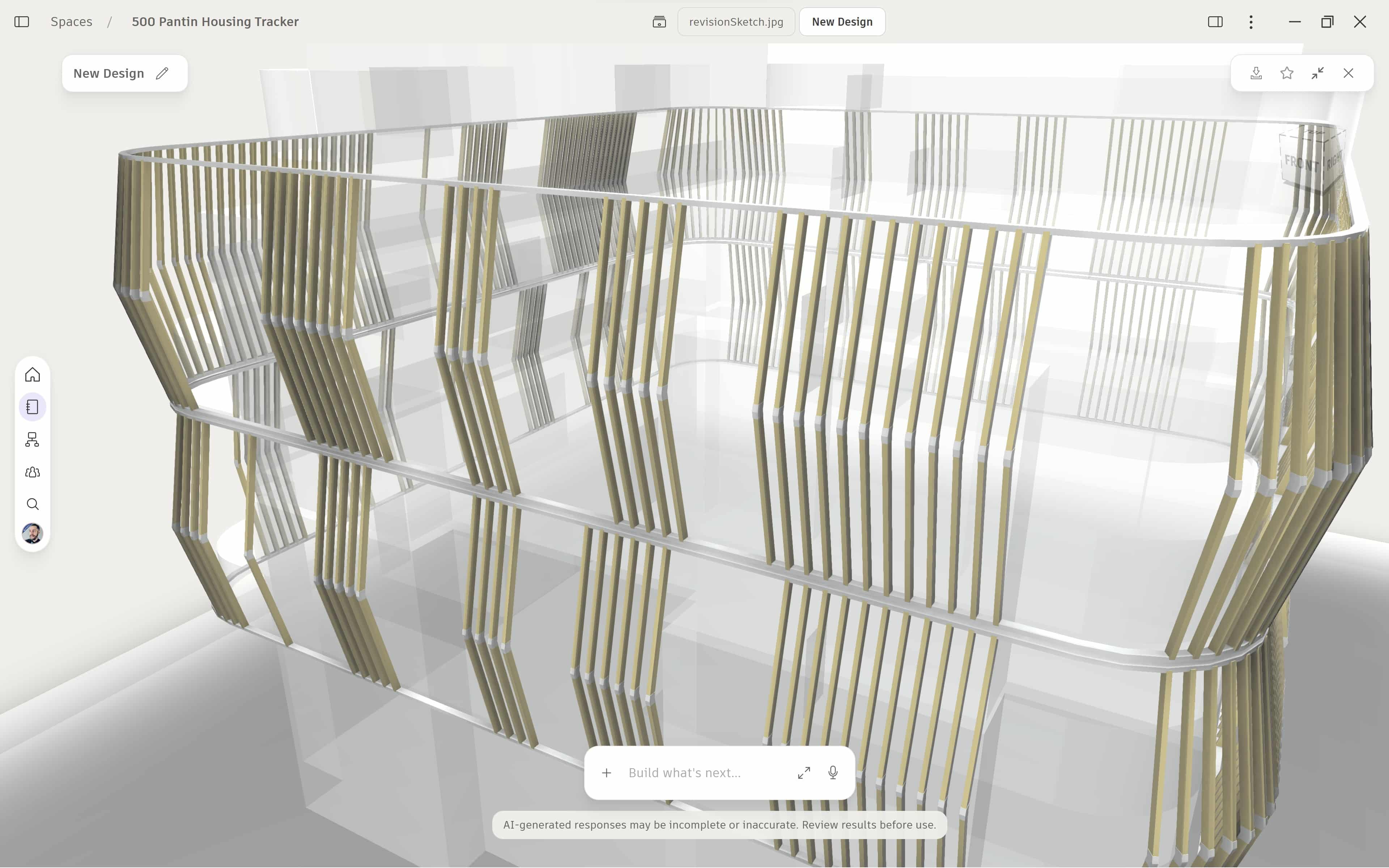
Autodesk Assistant in its upcoming iteration shown here.
General-purpose Large Language Models (LLMs) struggle with spatial reasoning because they understand tokens, not physical tolerances. Autodesk’s competitive defense strategy relies entirely on “grounding”. By anchoring their AI models within the explicit geometry, physical constraints, manufacturing processes, and deep histories of four decades of CAD metadata, they aim to build an intelligence layer that respects real-world physics. If a user requests a structural adjustment via the Assistant, the system doesn’t just sketch a visual revision; it evaluates downstream impacts on fabrication detailing, construction scheduling, project costs, and sequencing.
Legacy AI (First-Gen Chatbots)
Capability Dimension:
- Operational Boundaries = Restricted inside a single app (e.g., Revit/Forma)
- User Interaction = Reactive: Responds directly to explicit prompts
- Model Architecture = Single model processing
- Ecosystem Openness = Closed, vendor-controlled tools
Next-Gen Agentic AI (2027 Framework)
Capability Dimension:
- Operational Boundaries = Cross-product, cross-project, and cross-team orchestration
- User Interaction = Proactive: Surfaces issues via Personal Pulse
- Model Architecture = Multi-model routing via AI Orchestrator
- Ecosystem Openness = Open extensible framework via Assistant Builder
This architectural shift addresses a critical macroeconomic reality: the professional capacity crisis. Autodesk’s own 2027 State of Design & Make Report notes that 70% of industry leaders expect AI to mitigate staffing constraints by absorbing repetitive, administrative data management. Agentic AI directly targets this friction. By automating the mundane tasks of coordinating data between design phases, it frees up architects to focus on spatial judgment, material creativity, and client relationships.
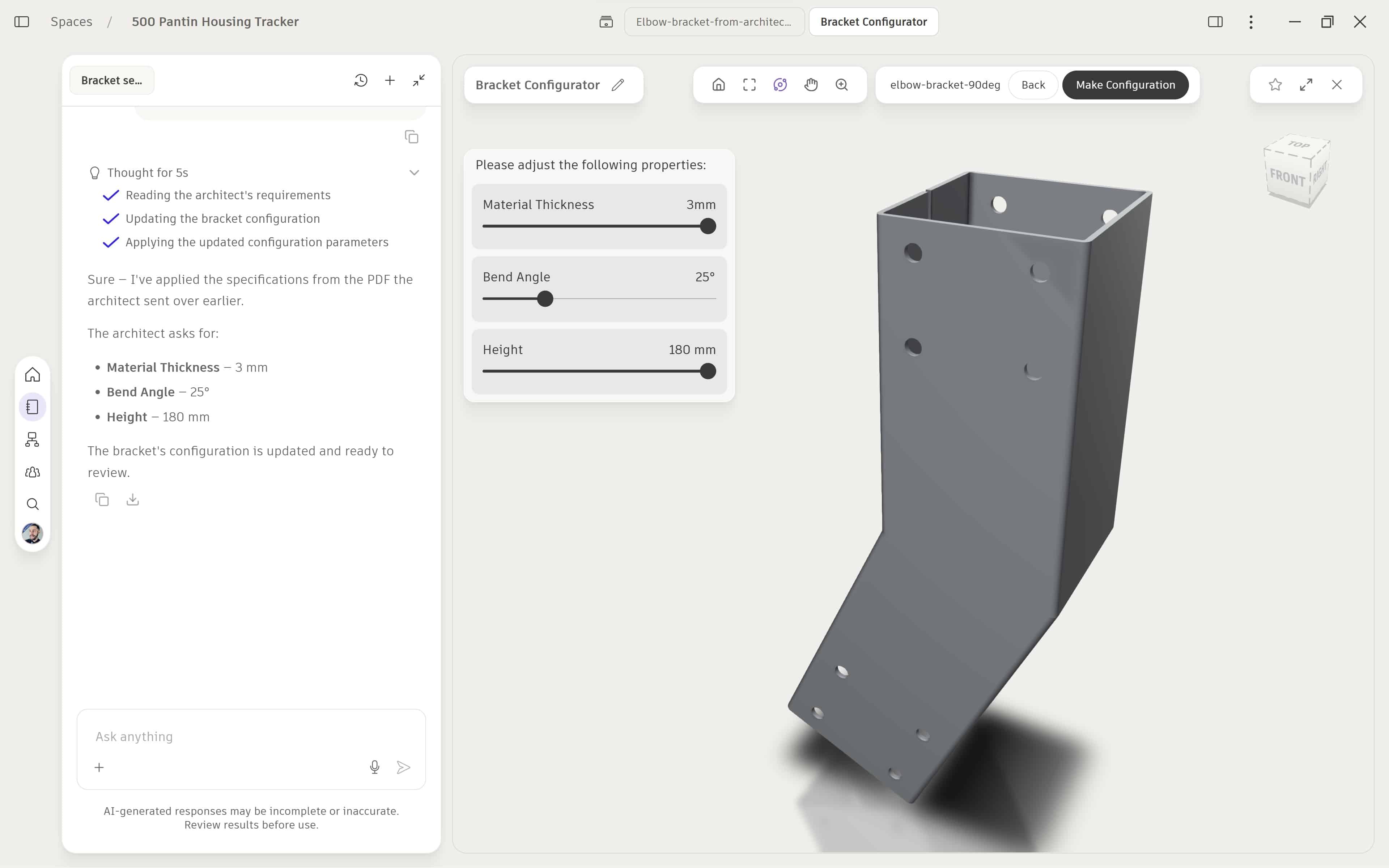
Another image showing the new Autodesk Assistant in action.
However, the “Bring Your Own Intelligence” strategy is perhaps the most significant competitive maneuver here. By enabling firms to connect custom AI agents via the Assistant Builder, Autodesk is positioning itself as the operating system for design tech. Rather than fighting off nimble, AI-native AEC startups entering the market, Autodesk is building an infrastructure—complete with a marketplace—designed to absorb them.
Architosh Analysis & Commentary
While the vision displayed at AU 2026 is compelling, architectural firms must look closely at the implementation timeline. These advanced cross-cloud agentic capabilities are previews. Autodesk explicitly notes that the expanded next-generation experience is not yet generally available, with pricing models, regional rollouts, and exact licensing terms under wraps until 2027.
Furthermore, data privacy, security, and liability remain major question marks for firms handling sensitive client data. Autodesk’s commitment to publishing “AI Transparency Cards” to detail training origins and limitations is a step in the right direction. Yet, as autonomous agents begin modifying building geometry and checking code compliance in shared “Spaces,” firms will need to establish strict protocols regarding where the AI’s recommendation ends, and professional liability begins.
Ultimately, Autodesk has drawn a clear line in the sand for the future of CAD. The focus is no longer on making drawing tools faster—it is about orchestrating project data intelligently so that architects can solve complex spatial problems without being bogged down by the tools themselves.