In this latest ToolTalk story, we introduce our readers to the construction administration (CA) software platform PART 3 (PART 3 Technologies Corporation).
The company was founded recently in 2020 and is based in Toronto, Ontario, Canada. As a six-year-old AEC software firm, the company has grown from a niche startup to a venture-backed software platform after early pilots with over 100 leading architecture firms. In terms of their funding, prominent VC firms Graphite Ventures and the 519 Growth Fund helped PART 3 secure a major USD 2.8 million seed round.
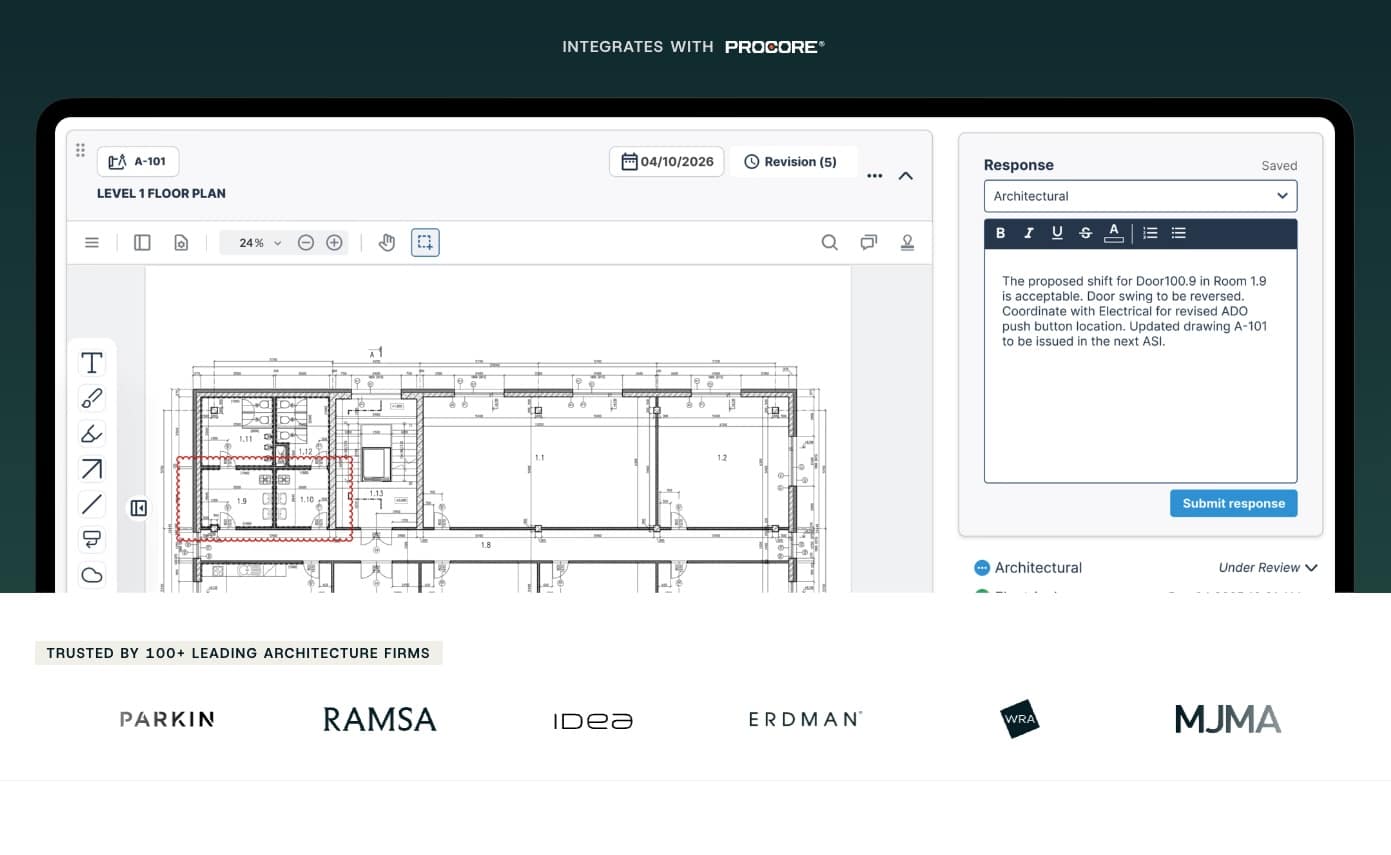
A screenshot of PART 3 from their website showing part of their interface. PART 3 can hold all construction drawings, specs, and manuals as your single source of truth and can handle automatic sheet number numbering, ordering, and linking. It also does versioning.
The company has three co-founders: Jack Sadler, Jessica Luczycki, and Corey Stanford. Each of them has a different background, but Jessica’s background has involved years of working in construction administration.
PART 3 Is Different
What is immediately important to say about PART 3 is that the software platform has been developed for architects or whoever is the prime consultant on a construction job. It is the prime consultant who acquires and pays for the PART 3 platform, while all other stakeholders (general and subcontractors, clerk of the works, owner’s reps, the owner, and MEP and structural engineers) work as “collaborators” in the system for free.
Key Takeways
- PART 3 has been developed for architects because they deserve better tools for the CA phase of projects.
- Only the prime consultant (usually the architect) pays for PART 3, while project “collaborators,” including engineers, contractors, owners, and reps, are free members of the system.
- PART 3 fully integrates with Procore so that if the general contractor uses Procore as their common data environment (CDE), the two systems work well together across various construction-stage workflows.
PART 3 has a full suite of CA phase workflows and tools—from addressing the RFI and Submittals processes to managing and addressing Tasks and Assignments and Field Reports.
It also addresses project files like the construction drawings, so there is a single source of truth (SSoT) for the entire project team. The system can also handle version control, and users can also upload project manuals and specifications. To help organize things, there is a flexible folder structure in PART 3’s system.
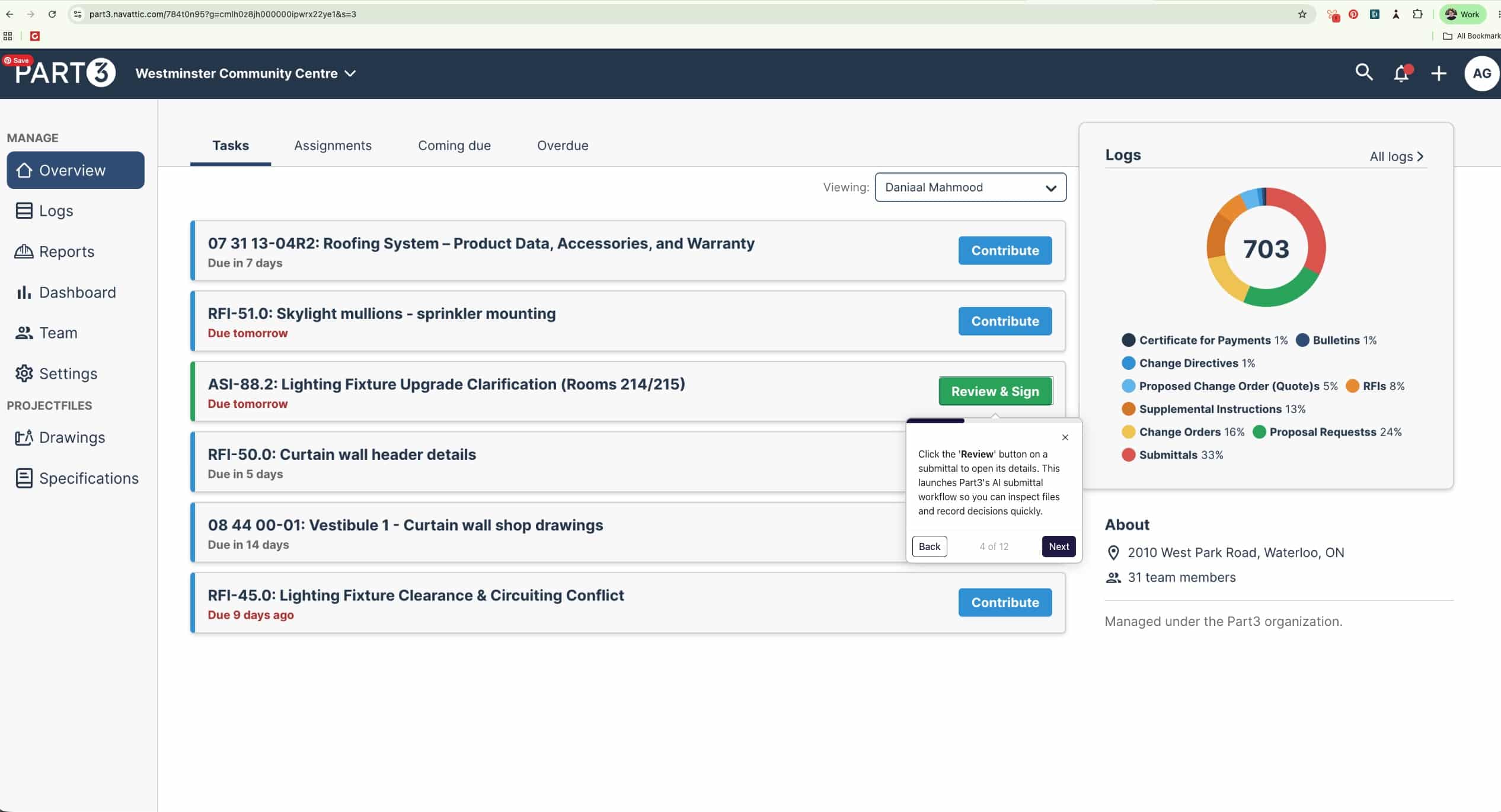
View of PART 3’s UI when looking at the Overview screen.
The ProjectFiles system also allows markup tools for drawings, submittals, RFI packages, and product cut sheets. PART 3 also notes that the reason why architects should want to manage their drawings inside of PART 3 rather than Procore when working on a Procore project is for complete control and visibility of the single source of truth.
On Procore integrated projects, RFIs and Submittals are automatically imported into PART 3, and you prepare your responses to both in PART 3, and those get sent to Procore.
Mobile and AI
PART 3 doesn’t have dedicated mobile apps that you download from the Apple or Google Store; instead, it operates as a Progressive Web App (PWA). Users load their browser on the mobile smartphone and go to app.part3.ca and tap the three dots in the top right and select Install App or Add to Home Screen. PART 3 is designed specifically for architectural site visits and fieldwork, and there is an offline mode so you can continue working. You can drop pins for issue locations, take field notes, log observations, and snap photos to go with. And you can distribute firm-branded PDF field reports directly from the smartphone app right from the job site.
Artificial intelligence (AI) is embedded in PART 3, where it powers the Submittal Assistant, surfacing issues before you begin your review.
Architosh Analysis and Commentary
One of the most critical things about AE professionals using the general contractor’s CDE solutions for project and CA phase management is the “disconnection factor” that typically comes down the line. At some point, the architect loses access to Procore or some other rival platform CDE. So PART 3 is fundamentally addressing that by delivering a CA platform for the architect first and foremost. All the critical work, like RFIs and submittals, happens in PART 3, and all that data remains there, even though copies are pushed to Procore.
In a quick review of the product walk-through online, we also like PART 3’s simplified user interface and UX. This system seems very approachable, and for architects, especially those in the high-end residential market, who may not be managing all aspects of the CA phase, the critical elements they always must address—RFIs and Submittals and a single source of truth for construction drawings—appear to be managed extremely well in this system.