Architosh senior associate editor Akiko Ashley attended SIGGRAPH 2026 a few days ago and reported back that there is a brand new GPU maker focusing their products specifically on the 3D rendering, animation, and simulations markets, along with similar scientific and visual graphics industries. That would include AEC.
Zeus Platform
Bolt Graphics is based in Sunnyvale, California, and is an emerging semiconductor startup. They design graphics processing units (GPUs) tailored specifically for four key industries: (1) Architecture & Design, (2) Film and Television, (3) HPC, and (4) Gaming.
Founder, CEO, and CTO Darwesh Singh teamed up with an interior designer to build a brand-new GPU architecture from scratch, and the company officially launched in 2020, securing funding rounds in 2021-2022 and revealing its patent-pending ray-tracing architecture in 2023-2024. The “Zeus” chip architecture was introduced in early 2026.
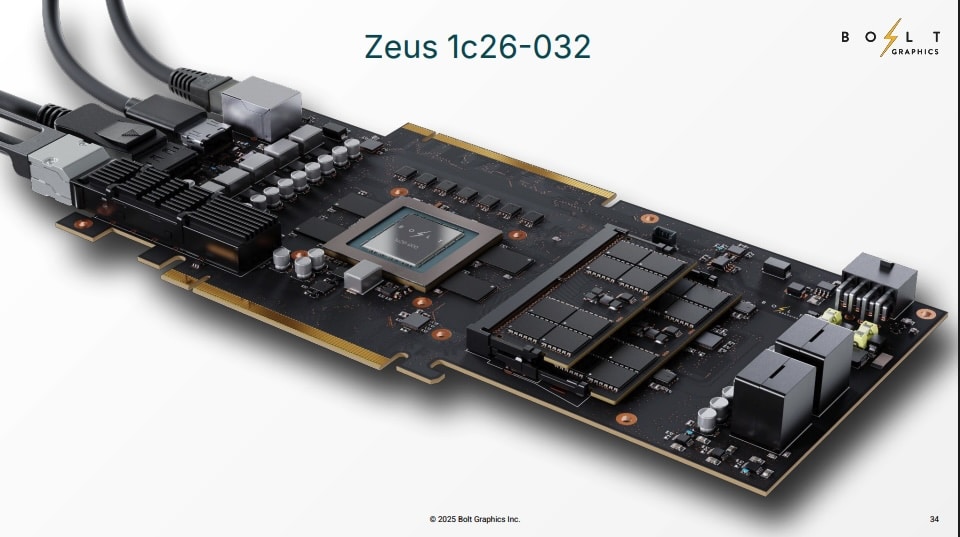
Bolt Graphics’ upcoming Zeus GPU architecture will come in multiple configurations and setups, including cloud and server options.
Zeus utilizes a RISC-V command processor and an in-house designed SIMD layout. Notably, the company shuns AI upscaling shortcuts, focusing purely on raw path-tracing silicon power to cut rendering costs by up to 17x.
The company completed its first physical tape-out of its first 12nm Zeus test chip in April 2026, and they were prominently at SIGGRAPH 2026 touting their new GPU.
Performance and Details
The Zeus architecture utilizes path tracing, a more advanced form of ray tracing that more accurately simulates light. Path tracing is computationally more expensive than ray tracing but needs more rays to converge on clean results (reduce noise). Today’s GPUs don’t have enough performance to compute enough rays for real-time path tracing. That is Bolt Graphics’ consensus.
Bolt Graphics claims that one needs 28 Zeus GPUs to achieve real-time path tracing, compared to 280 Nvidia RTX 5090 GPUs. The Nvidia RTX 5090 is Bolt’s reference card. So the Zeus 1C is 2.5x faster than the 5090 in path tracing performance, while the Zeus 2C is 5x faster, and Zeus 4C is 10x faster.
The Zeus GPU comes in three different versions, including other stats:
- Process: 12nm
- Bolt Zeus 1C, 2C and 4C
- Board Power: 120W, 250W, and 500W, respectively
- FP64: 5, 10, 20 TFLOPS
- FP16 Vector: 20, 40, 80 TFLOPS
- On-Chip Memory: 128, 256, 512 MB
- Memory: 32-160 GB, 64-384 GB, 256-2,304 GB
- Path Tracing: 77, 154, and 307 gigarays
Bolt Graphics notes that currently adding ray or path tracing features in real-time applications (games, real-time renderers, metaverse experiences, etc) lowers performance by more than half. Games without ray or path tracing enable achieving greater than 60 FPS, but the same game goes to less than 30 FPS when ray-traced shadows and reflections are turned on.
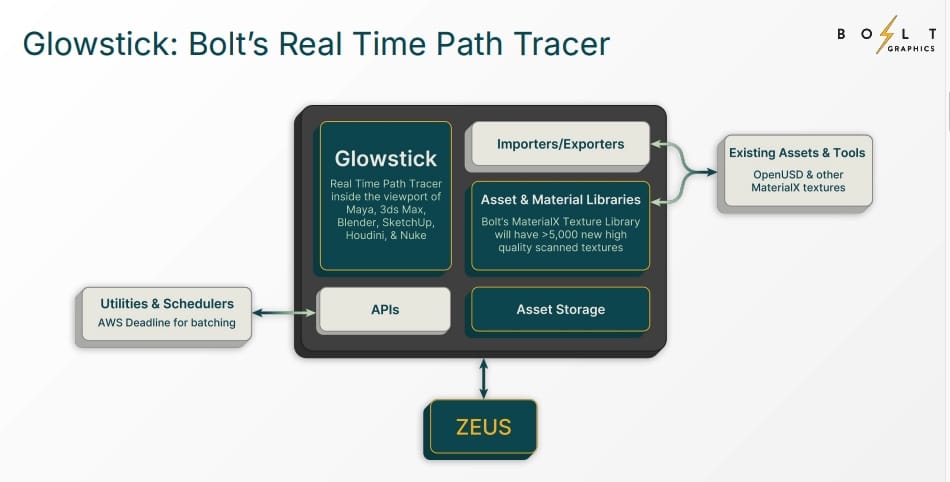
Bolt Graphics’ Zeus architecture with Glowstick real-time path tracing technology.
Glowstick is Bolt’s real-time path tracer and is aiming to provide that technology inside the viewports of Autodesk Maya, 3ds Max, Blender, SketchUp, Houdini, and others.
Of course, we haven’t written about other technical issues, like material textures, USD integration (which Bolt’s Zeus has), and how programmable the Glowstick shading pipeline is (quite programmable, indeed). On the platform development side, support for tooling on x86, RISC-V, ARM, and Windows (coming soon) is all noted in Bolt’s literature.
To learn more, you can visit their website here.
Architosh Analysis and Commentary
Bolt Graphics is an exciting development, especially given the difficulty the rendering and animation professional communities have had over the past few years with the rise of general AI and the demand-side pressure that has driven up the cost of GPUs and now memory. Bolt’s Zeus GPU architecture promises substantial performance-per-dollar metrics over what AMD and Nvidia are currently delivering. But it is also about power, with substantial performance per watt differentiation, a story akin to Apple’s M-series processor advantages in the general computer market.
Again, we learned about Zeus from SIGGRAPH this year and hope to have much to share about the GPU market in the creative industries of DCC and AEC in an upcoming report. Just to be clear, Bolt Graphics is targeting the Architecture industry with its own page on workflows, with software integrations focused on common architecture tools like SketchUp, Revit, AutoCAD, and Unreal Engine (used in Twinmotion). It goes without saying that we are quite excited to see this development.
Initial hardware delivery for Bolt Graphics Zeus GPUs is targeted for December 2027, so we are more than a year and a half away, and that is after the work of porting its architecture to the TSCM 5nm process node.