Over the past several years, the Trimble SketchUp development team has hosted Architosh for a private meeting to talk about the company’s directions—not just with SketchUp. This year was no different, and like last year, we got a preview of what lies ahead, as well as what is immediately imminent and what is currently new.
Mighty SketchUp
One thing that folks in the architecture world may not be aware of is just how prevalent SketchUp is in the big-contractor construction world. SketchUp is regularly used by major general contractors such as Turner Construction and Taisei Corporation in Japan. Turner uses SketchUp as a 5D VDC tool, for example. The point is that SketchUp has a very large market presence in the construction phase of buildings. And it also has a very large role in the design phases of buildings, used by millions of designers, architects, and interior professionals around the world.
But what about the middle phase?
SketchUp as BIM
This was the question we asked Trimble this year. Will they ever begin to address the middle phase of the work?
The short answer we got is yes. How SketchUp moves in that direction is in the details, and the company is approaching more of that middle workflow phase by deepening its core modeling capabilities, strengthening its SketchUp to Revit workflows, and making improvements with IFC.

The Trimble SketchUp booth at AIA26 was busy showcasing various aspects of SketchUp and Trimble Connect.
Architosh was fortunate to get a preview look at upcoming SketchUp technologies, and while we can’t write about these in any amount of detail, we can summarize a little about what we saw. In general, when we think about SketchUp having this very strong utilization in the early phases of design whilst also having a strong hold on the big general contractor firms, we know that Trimble and its SketchUp team realize that Autodesk Revit holds a very strong grip on the documentation phase within the BIM workflow. Hence, in recent releases, we have seen the SketchUp-to-Revit workflow strengthen. Users should expect that trend to continue.
MORE: AIA26: Architosh 12th ‘BEST of SHOW’ honors for digital technologies at AIA San Diego
A stronger SketchUp-to-Revit workflow isn’t just beneficial to architects; those same large general contractors working with 4D-5D processes utilizing SketchUp and Trimble Connect also benefit from tighter integrations between these two popular AEC applications.
Another future coming to SketchUp will be modeling improvements of a rather larger nature than the company tends to deliver. Without letting the cat out of the bag, we can at least say that we were quite excited and impressed by what the SketchUp team is doing in this domain. For years, SketchUp has been working on speeding up rendering and visualization workflows, but speeding up modeling workflows has fully begun and will surely continue. Some of this will deploy agentic AI (like the Claude integration), and some of it will just be more powerful, parametric-like (or based) modeling updates.
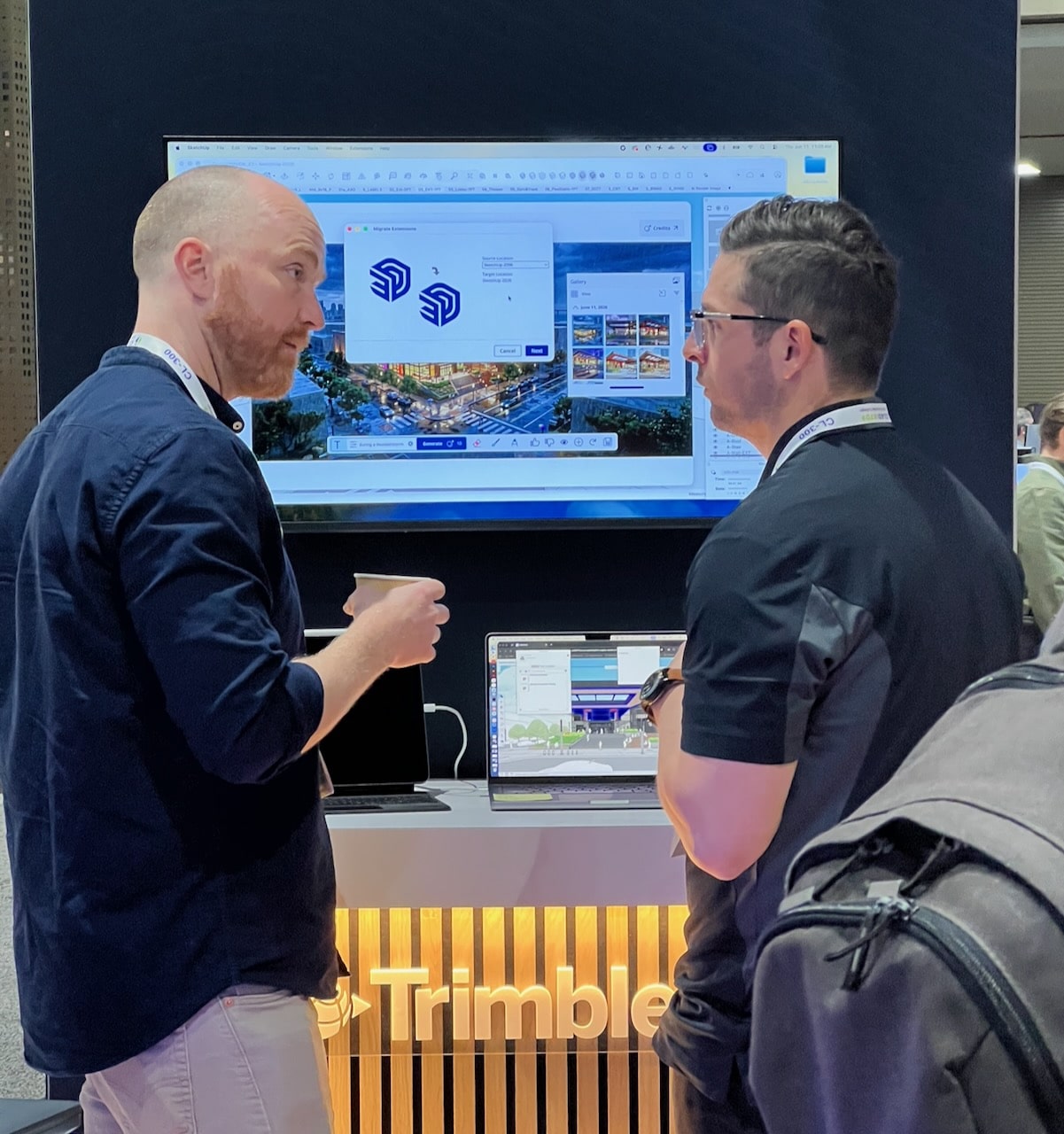
A SketchUp professional talking to an AIA expo attendee about the latest new features in SketchUp 2026.2.
As SketchUp gains more modeling powers in the future, it will mean that—coupled with LayOut advancements—users will be able to do even more all within the program. At the same time, upcoming new features will deepen the value creation in SketchUp-to-Revit workflows in both the front-end and the back-end of the AEC process.
Cloud Collaboration at Trimble
Another view on SketchUp’s journey in the AEC industry and its relationship to BIM workflows is the ongoing transformation toward making SketchUp a multiplayer medium. The release in 2026 has turned SketchUp into a true multiplayer collaboration platform complete with real-time cursor tracking (you can see the live movements of your collaborators’ cursor inside the 3D space, color-coded by user), live camera follow, in-app geometry commenting, and public and private sharing links. As for live camera follow, what that means is a host can force all viewers to look through their exact perspective, or you can follow a colleague’s camera as they orbit a model or scene.
The multiplayer capabilities function once a SketchUp user has invited colleagues to view the model on Trimble Connect, Trimble’s cloud-based collaboration platform. Therefore, Trimble Connect serves as the engine and Common Data Environment (CDE) for the collaboration features, storing the model as well as the multiplayer comments. Connect provides the live stream data for your collaboration session as well as the granular permissions for collaborators.
Analysis Hub
We have been talking about SketchUp 2026 since its first iteration features last fall. The multiplayer technology and multi-user collaboration features were part of the 7 October 2025 release of SketchUp 2026. The latest release is actually SketchUp 2026.2 and brought with it the new building performance and analytical data tools in the new Analysis Hub.
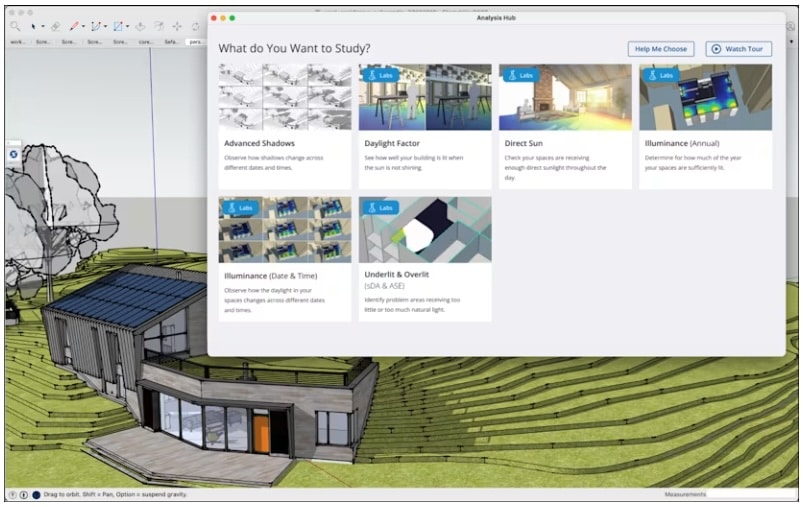
A view of the new Analysis Hub in SketchUp 2026.2.
Analysis Hub is an entirely separate dedicated environment aimed at helping designers study daylight, shadow, and environmental building performance data directly inside of the design workspace. Part of Analysis Hub has SketchUp Labs tools, but one key official feature is Advanced Shadows. This natively supports interior shadow mapping by calculating sun penetration through active section planes. The Labs features include Daylight Factor, Annual Illuminance, and Underlit and Overlit Metrics.
The Analysis Hub features are powered by Trimble’s cloud simulation stack and heavily utilize Sefaira technology owned by Trimble.
Closing Thoughts
Clearly, this year the biggest news about SketchUp is the Claude AI integration, which moved the app into the early round of CAD industry tools connected to agentic AI capabilities. Architosh has already awarded SketchUp an AIA26 Architosh BEST of SHOW honor for digital technologies at AIA San Diego under the Emergent Technologies category. Yes, agentic AI is the most pivotal new emerging technology in 2026, beginning to impact CAD, BIM, and 3D applications as well as other types of applications serving the AEC industry. Being able to use agentic AI to model elements for you is quite transformative even in this very nascent stage of AI development.
But the glossiness of AI transformation can obscure (and perhaps has) SketchUp’s other meaningful evolution related to BIM and collaborative workflows. The multiplayer capabilities are strictly speaking common to the definition of BIM 2.0 technologies. Snaptrude has them; Arcol has them, and so do other new BIM 2.0 apps. So what does that make SketchUp now that it has this multiplayer technology as well since last fall?
We’ll leave you with that question. You can learn more about SketchUp here and here.
Other Show Reports
AIA26: Expo Show Report 1 — Autodesk
AIA26: Expo Show Report 2 — Nemetschek Group
AIA26: Expo Show Report 3 — Trimble and SketchUp
AIA26: Expo Show Report 4 — Chaos
AIA26: Expo Show Report 5 — neoBIM, and other AI apps
AIA26: Expo Show Report 6 — xFigura, CODii, others
AIA26: Expo Show Report 7 — Layer, Arcol, Egnyte and more…