At AIA26 San Diego, Nemetschek’s daughter company, Maxon, announced Redshift for Autodesk Revit and the newly announced Redshift for Graphisoft Archicad beta. Both solutions bring Redshift’s highly acclaimed raytracing technology to these leading BIM solutions, but with tiny differences.
Redshift for Revit
The distinguishing feature of Redshift is the quality of its raytracer technology, and bringing that to real-time BIM authoring solutions gives architects and designers another excellent choice for both real-time design visualization and final-render presentation visualization. Moreover, with a simple click, work in Redshift for Revit or Redshift for Archicad can send your scene forward to Maxon’s award-winning Cinema 4D DCC (digital content creation) software for more sophisticated animations and visuals.
Redshift for Archviz debuted in Vectorworks in March 2026, and Maxon intends to roll out its acclaimed Redshift technology across popular AEC modeling solutions as part of its growing AEC roadmap. Redshift for Graphisoft Archicad is now open for beta sign-ups; click here to learn more.
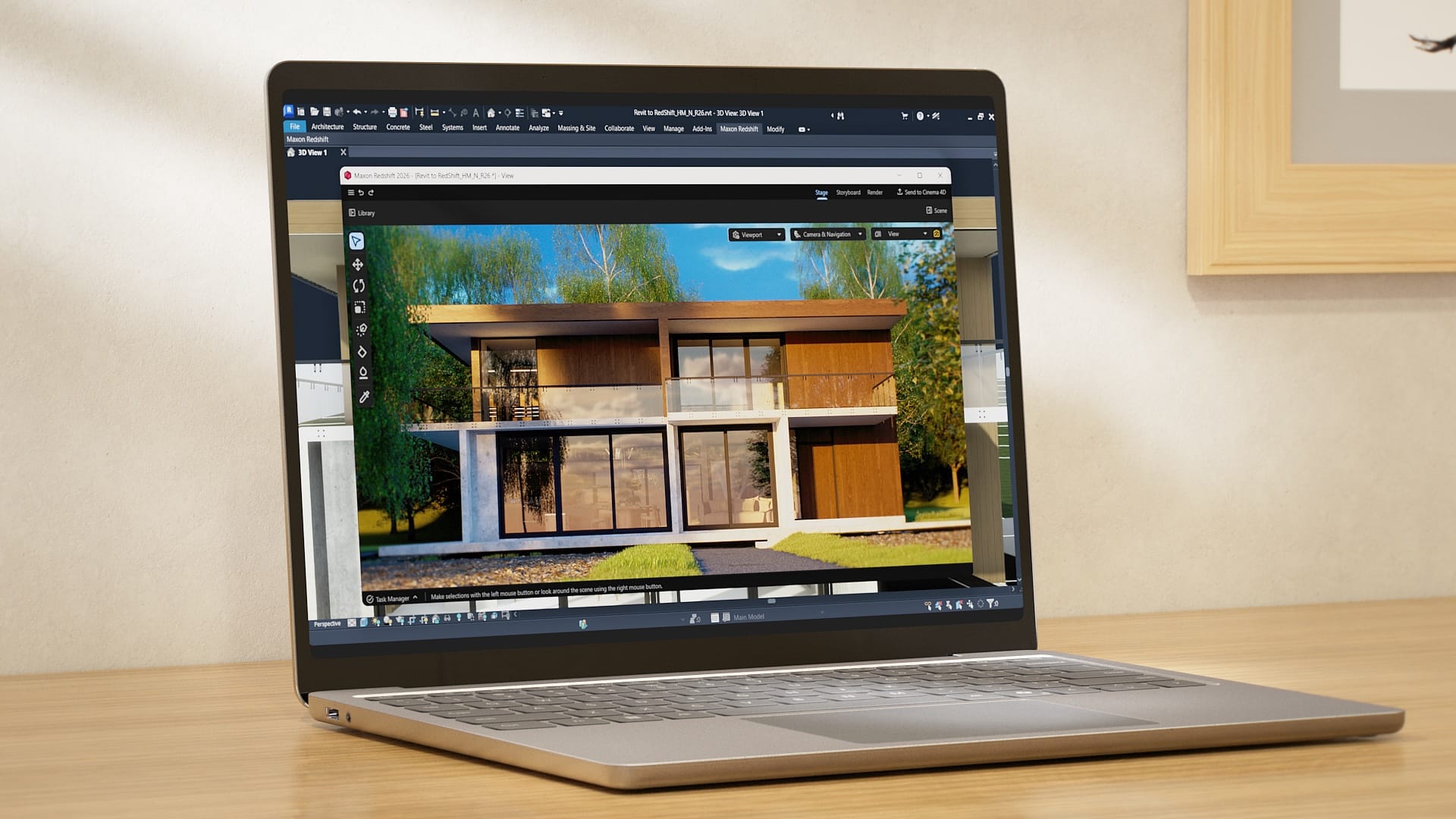
Maxon’s new AEC industry push continues with Redshift for Autodesk Revit and more. A beta version of Redshift for Graphisoft Archicad is also available.
“The world architects create is inherently three-dimensional, yet much of the industry still relies on workflows built around two-dimensional representations,” said David McGavran, CEO of Maxon. “With Redshift for Archviz, our goal is to make 3D design the new standard across architecture, engineering, and construction. Through enabling digital projects to be experienced as if they already exist in the real world, we’re giving architects and interior designers a more powerful way to communicate ideas, make decisions, and bring their visions to life.”
Redshift for Revit Details
Now available, Redshift for Autodesk Revit delivers physically accurate lighting, reflections, shadows, and materials while remaining highly interactive. Maxon is also introducing three new platform features for architectural visualization:
-
Depth of Field enhances architectural renders by mimicking real-world camera effects in real time, helping designers guide visual focus and create more immersive client presentations.
-
AI Context-Aware Library Search analyzes the current view and suggests suitable assets, helping users build richer, more detailed scenes with less manual searching.
-
Maxon Plants Smart Transfer is designed to simplify the process of bringing high-quality vegetation assets into architectural scenes for more realistic environments and faster scene development.
Maxon says that for users on Apple Mac computers, Maxon Redshift leverages Apple’s new MetalFX technology for improved interactive frame rates and exceptional visual realism for macOS users.
”Architects and interior designers don’t think in floor plans. They think in light, materials, and how a space feels,” said Nicolas Burtnyk, EVP of Rendering at Maxon. “Redshift lets them shape all of that in real time, then see it at full photorealistic quality, iterating on and refining how a space looks and feels as they go.”
Maxon’s Ecosystem
Maxon’s Cinema 4D flagship application has long been a popular archviz application, particularly in DACH regions in Europe. Architosh has reviewed Cinema 4D in the past from the point of view of AEC visualization. And the solution is a stunning application for doing sophisticated animation work. As part of the Redshift Archviz solutions (Vectorworks, Revit, and Archicad), a single button pushes out the scene and its assets to Cinema 4D for more advanced still visuals and cinematic animation work.
To learn more and see the new Redshift for Autodesk Revit and Redshift for Graphisoft Archicad (beta), click on the appropriate links.
Architosh Analysis and Commentary
There are subtle differences in some of the implementations of Redshift for Archviz, but for the most part, the same features are common whether you are on Revit, Vectorworks, or Archicad. In terms of visualization competition, the new Maxon offerings do add competitive pressure for real-time interactive rendering solutions in the market. Both Chaos and Maxon are up against Epic Games and its Twinmotion tie-in with Autodesk Revit, which is partially integrated. On a cost basis, Maxon is undercutting Chaos’ pricing with Enscape, but the Chaos ecosystem is much larger and more mature. Ultimately, cost shouldn’t be the deciding factor between either of these solutions, but rather their other advantages.