At AIA 2026 San Diego, Graphisoft and its parent company, the Nemetschek Group, announced the next stage of its Design Intelligence Strategy, including previewing new collaboration and AI-assisted design initiatives currently being developed. The new platform will be fully cloud-native.
Design Intelligence Strategy
“Building on the Design Intelligence Strategy introduced last year, Graphisoft is unifying key components into a single, cloud-native platform that extends from feasibility studies to detailed BIM and lifecycle collaboration,” said Márton Kiss, Chief Product Officer, Design Division & Graphisoft. “This next step reinforces our mission to deliver an intuitive, data‑driven design experience that helps architects and engineers focus on how buildings should be built, not just how they can be built.”
Advancing Open Collaboration
Graphisoft notes in its press materials that the global construction industry experiences an annual USD 2.1 trillion loss each year due to project overruns and delays. In response to this waste and inefficiency, Graphisoft has announced that the Nemetschek Group is developing what it calls an “open collaboration fabric” of the Nemetschek Group design ecosystem, one that is more broadly open to the greater AEC industry than anything currently offered elsewhere.
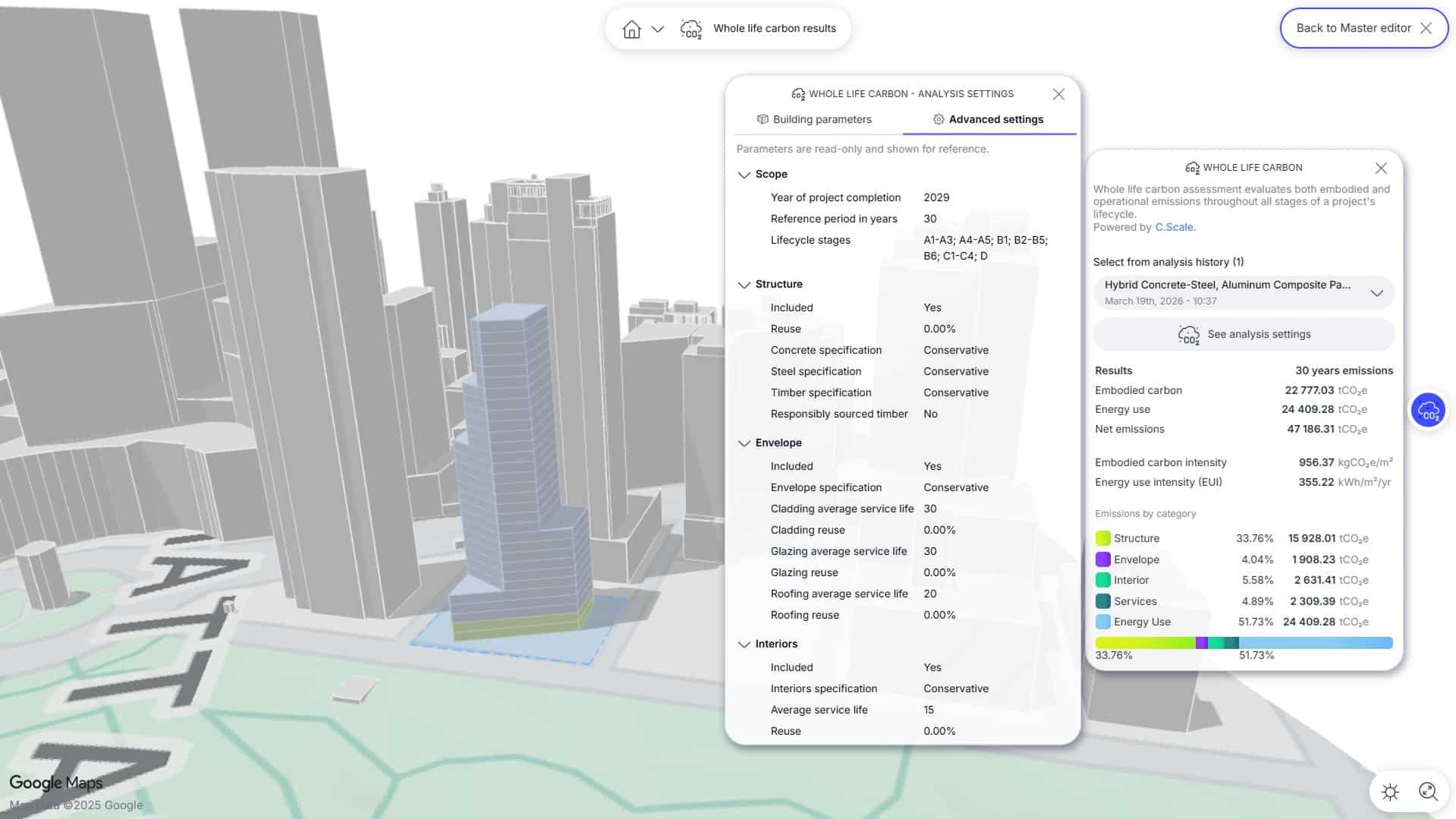
Design Intelligence Platform showing carbon analysis on a conceptual tower building in a city. See our discussion below on Previewing AI-Assisted Design.
To address roadblocks, cost overruns, broken handovers, misalignment, and miscommunication, the Design Intelligence technologies will synchronize models, documents, issues, and decisions across Graphisoft solutions and the broader Nemetschek portfolio while robustly supporting standards such as IFC (Industry Foundation Classes), BCF (BIM Collaboration Format), PDF, DWG, and RVT (Revit). The solution, due in early 2026, will be a browser-based, multidisciplinary collaboration environment that brings architects, engineers, builders, owners, and operators into a common single source of truth.
“Our goal is simple,” said Sylwester Pawluk, VP, Product Management – Collaboration, Graphisoft and Nemetschek Group. “To offer the AEC industry a truly open alternative — one that is trustworthy and accessible for everyone. This is the open collaboration layer our entire industry has been missing.”
Previewing AI-Assisted Design
Also in development is a next-generation, web-based design intelligence platform that is infused with AI-driven workflows and integrated simulations to help design teams make smarter decisions with greater impact on the project earlier in the design-build process.
Users will be able to explore hundreds of massing, layout, and building performance scenarios in seconds, all while keeping project stakeholders aligned in a shared, browser-based workspace, without requiring BIM expertise. This design intelligence platform (which will have an exciting name, Graphisoft executives tell Architosh) is being developed to scale across the Nemetschek Group and its solutions, with AI-assisted solutions planned for early access in October.
Márton Kiss, Chief Product Officer, Design Division & Graphisoft, stated:
From the start, our goal with the Design Intelligence Strategy has been to help design teams make decisions faster and with more confidence. With these new developments and our other AI tools, users will spend less time on manual work and more time designing better buildings for their clients.
Readers interested in gaining a further peek into Graphisoft’s Design Intelligence Strategy can do so at this link. And we provide additional contextual oversight below.
Archicad—Autodesk Forma Connection
In other critical news from AIA26 San Diego, Graphisoft also announced its new Archicad—Autodesk Forma Connection, coming this month (June). This connection enables Archicad to fully participate in the Autodesk Forma CDE (common data environment), formerly known as Autodesk Construction Cloud (ACC) and BIM Collaborate Pro. (see, Architosh: “Autodesk Construction Cloud (ACC) is now Autodesk Forma,” 31 Mar 2026).
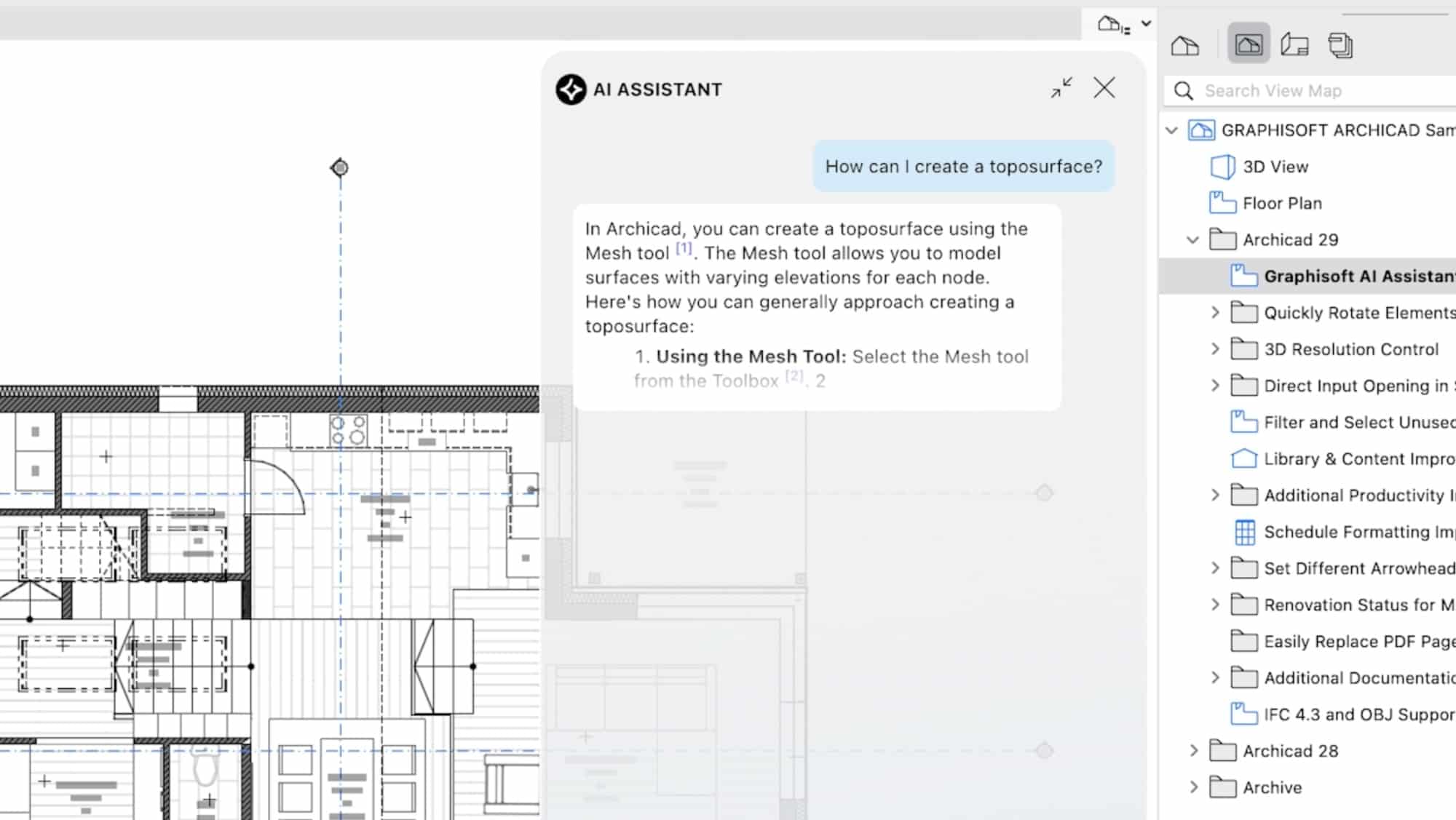
A view of Archicad with its AI Assistant providing assistance to the user.
Graphisoft is also building its AI portfolio, including its new AI Assistant and AI Visualizer, plus additional upcoming AI services built on the common platform described above. In fact, AI is a core pillar of the Design Intelligence Strategy, and readers can learn more about that here.
Architosh Analysis & Commentary
It is important to clarify that this combined Graphisoft press statement timed for AIA26 is saying essentially two things. First, what was last year called “Project Aurora” is now simply Graphisoft’s “design intelligence platform,” a web-browser-based cloud software system akin to other BIM 2.0 systems with differences, of course. The design intelligence platform (DIP) helps with design intent exploration, including site potential or test-fitting, space planning, sustainability (energy impacts of early-stage design modeling and layouts), plus cost/time impacts from an early-stage looking forward.
The second thing announced was the “design intelligence strategy,” which is exactly what it sounds like: a strategy to link together Graphisoft and Nemetschek tools with an open BIM model framework supporting wide data exchange via APIs and MCPs across portfolios. This means native BIM connectors (see below) and the synchronization of data with 2nd and 3rd party clouds, such as the newest (and certainly not the last) Autodesk Forma.
This “design intelligence platform” is just one component area of the larger Graphisoft – Nemetschek Group design intelligence strategy discussed above. Starting with Agentic workflows (AI embedded in all products), project intelligence, generative design, optioneering, quality checking, and simulations (all BIM 2.0 characteristics) feed into the project as it advances from these new cloud-based tools into Graphisoft’s and the Nemetschek Group’s older desktop era tools like Archicad. Importantly, the Nemetschek Group’s ecosystem strategy includes modernizing its portfolio of solutions to include updated APIs and MCP (model context protocol) for interoperability with modern data and AI workflows. This means that projects may begin in the design intelligence platform (which will have its own new name) and then push out data to Archicad and possibly other Nemetschek solutions.
Furthermore, Nemetschek’s existing desktop-era design tools will have native BIM data connectors. This means they will read each other’s data natively. This is a monumental change from past postures the daughter companies had toward each other. This means that Archicad users can benefit from Vectorworks Landmark’s superb land planning and terrain modeling capabilities, things that Archicad or Revit lack, for example. It also means more streamlined workflows between, say, engineers working in Allplan and RISA and architects working in Archicad or Vectorworks. Moreover, Vectorworks’s new acquisition of Morpholio Trace won’t stay exclusive to Vectorworks long-term. That tool will likely flush out its BIM integration path with Vectorworks users and push those capabilities to Archicad and maybe Allplan users as well. Morpholio—much like Vectorworks Landmark—is too valuable a tool to keep exclusively connected to one daughter company.
These are just some of the plans and ideas that are both possible and coming when the Nemetschek Group pulls its diverse portfolio of solutions into an intelligent, cloud-native single platform with API and MCP data exchange and native geometry interoperability. When you step back and look at how the Nemetschek Group is now beginning to operate and compare it to its chief rival ecosystem (the world of Autodesk), we see new reflections of each other that echo how the AEC market and its users want to operate. All AEC/O users want better data and geometry model interoperability. They also want “mix and match” streamlined solutions within company ecosystems—something few of the big four AEC software firms truly deliver. This last point is crucial because AEC firms vary widely in size, expertise, building types, and regions.