Timed for Nvidia’s GTC this week, which began yesterday, Miris is announcing how it is unlocking high-fidelity 3D asset streaming at scale. Architosh had a preview of this exciting technology last week, and we are impressed with it.
Miris is a newer 3D technology company we have never written about before that will be at Nvidia GTC as part of AI heavyweight company Coreweave (both 913). Miris will be demoing their exciting tech inside the Coreweave booth.
Miris
Miris is launching a public beta of its new 3D asset streaming platform. Miris is building the infrastructure to deliver high-fidelity 3D streaming at internet scale, and its technology sets it apart. Let’s discuss how things are a bit different right now. Developers today are forced to pick a lane: trade streaming speed for fidelity, or fidelity for reach. Miris says that neither really scales at the size of the Internet. This is the problem they are solving, delivering photo-realistic 3D at the cost (price) of 2D streamed content.
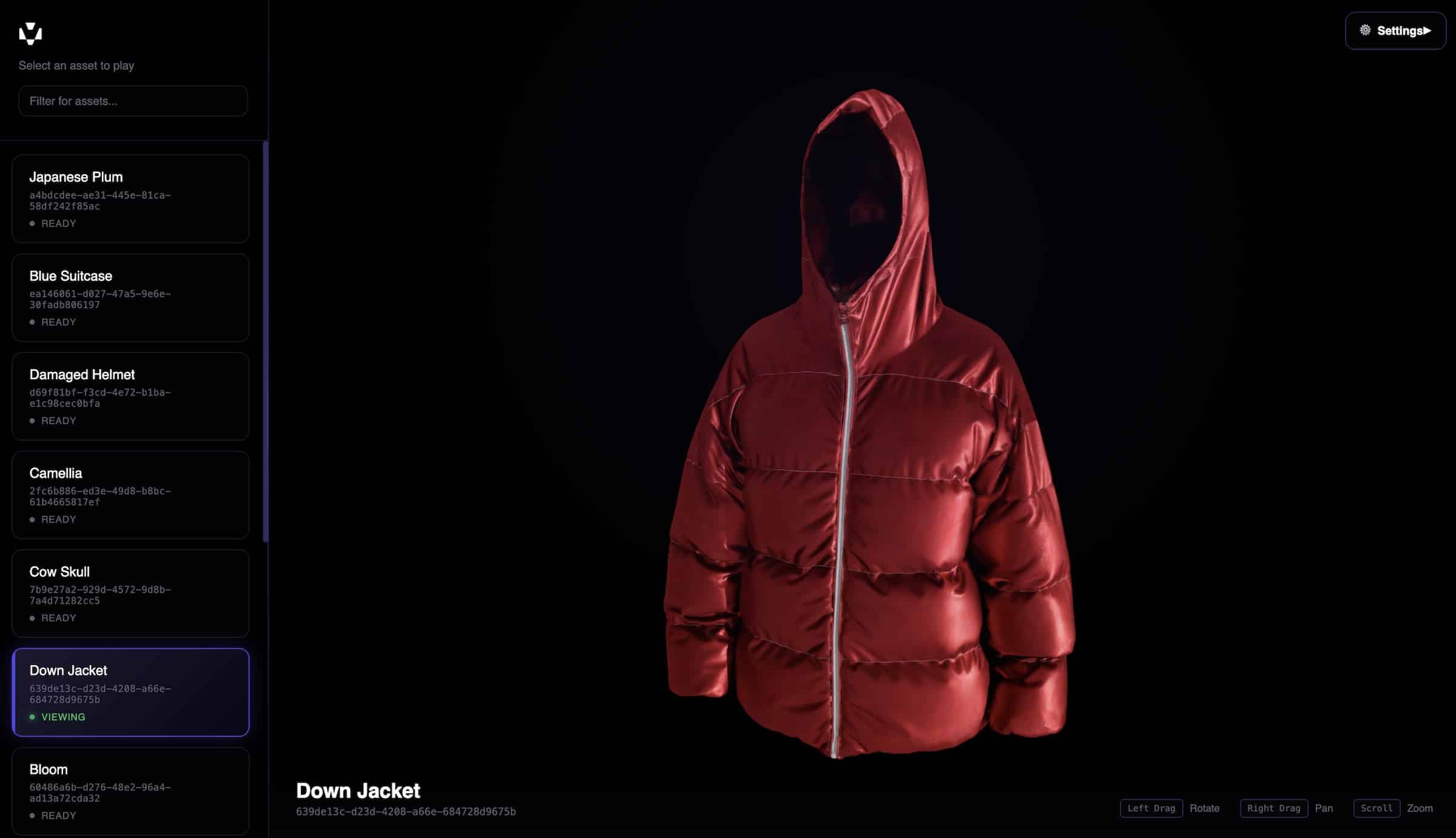
An example of Miris streaming technology in action. Notice the visual detail and quality. When zoomed in more, 3D texture data streams in real-time, zooming out purges that data, making the whole UI extremely fast while retaining high-visual fidelity.
Miris CTO Sean Looper says:
Until now, companies had to choose between visual quality and cost at scale. We eliminated that choice. Miris is a fundamentally different approach that eliminates tradeoffs for developers. We’re excited to open the public beta and kickstart the future of 3D asset delivery.
Rather than sending rendered pixels, which requires GPU infrastructure on a per-user basis, or entire asset files, which requires user downloads and asset compression, Miris uses adaptive spatial streaming to achieve sub-second load times and horizontal scaling.
Miris does this by implementing what is known as “preconditioned 3D assets” for on-demand delivery, only transmitting necessary geometry and texture data in real time. Miris features at launch:
- Sub-second load times for complex 3D assets – Even a 500MB product model loads and responds as quickly as a simple 5MB scene.
- High visual fidelity without massive client downloads – Only necessary geometric and texture data are transmitted, enabling real-time delivery.
- Internet-scale without per-user GPU costs– Since edge GPUs are not needed for every concurrent user, the architecture scales without additional infrastructure costs, supporting lower total cost of ownership compared to pixel streaming.
Miris is making it simple and cost-effective for organizations to enhance their applications’ user experience with high-fidelity 3D assets. They are doing this by tackling the four pillars of an ideal system for streamed 3D:
- Speed — sub-second load. No app to install
- Fidelity — Photorealistic quality is preserved
- Scale — Stream 3D as easily as video. Billions of viewers.
- Cost — Economics comparable to serving images.
Developers with beta access can use Miris with sample assets or their own content. Detailed documentation provides guidance on the integration process, and the entire flow is self-serve.
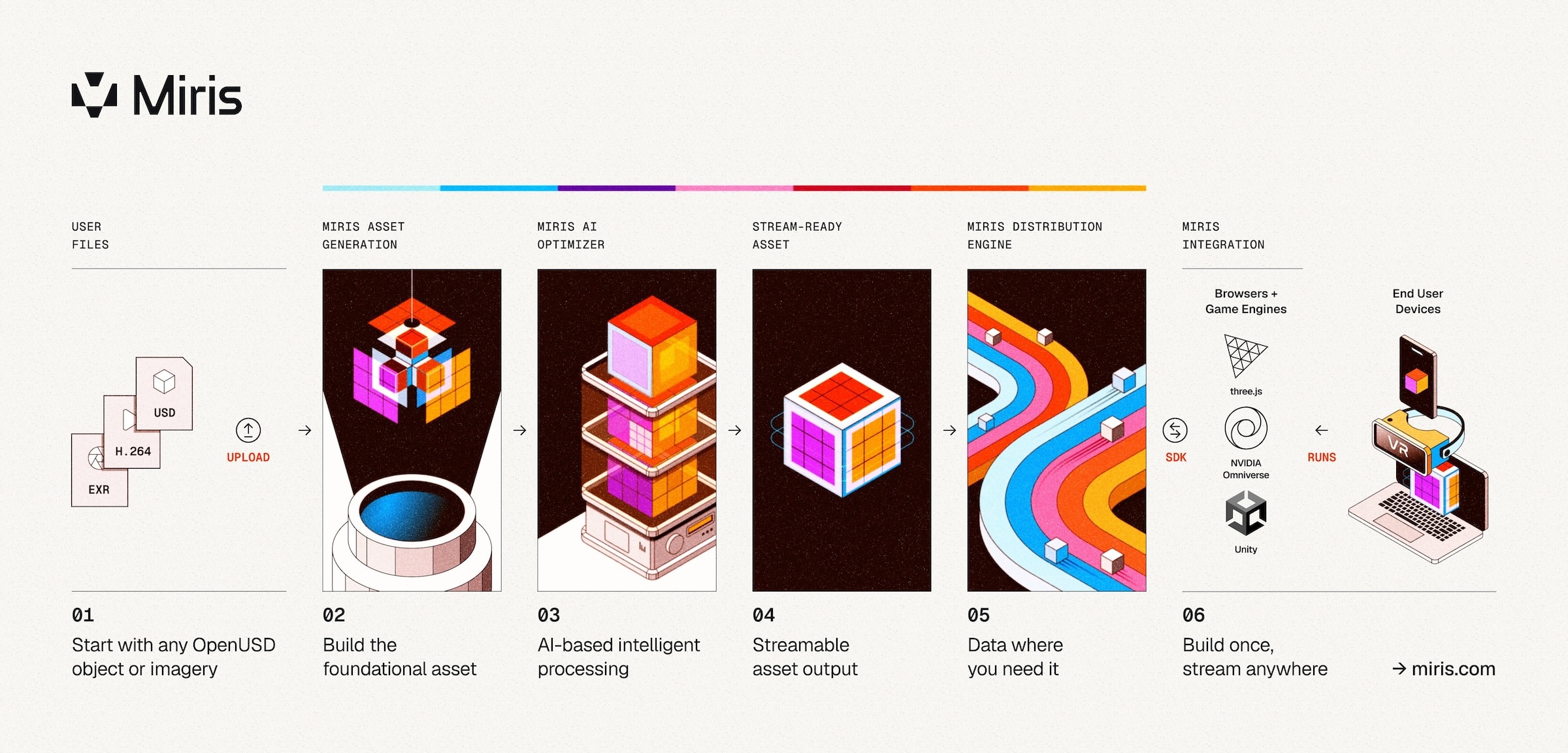
Miris technology in a diagram. The. steps and stacks are highlighted in stages.
Sign up for the public beta here.
About Miris
Miris is a 3D streaming infrastructure company applying the same paradigm shift to spatial content that adaptive streaming brought to video. Instead of downloading complete assets or renting cloud GPUs to render frames remotely, Miris streams spatial data that reconstructs on end-user devices in real time. Content loads in under a second, refines progressively, and scales to millions of concurrent users at CDN economics. Founded in 2024 and backed by IAG Capital Partners, Miris is headquartered in Culver City, CA. https:/
Architosh Analysis and Commentary
Miris’ technology could be used across a wide variety of industries, including the AEC building industry, from windows to lighting to furniture. We also think this technology could enable streaming of 3D building scenes as well, but Miris did not focus its press materials or press-invite presentations in that direction. We will be following this company closely.