IN THE HOME AEC HIEARCHY, GEOTHERMAL heating and cooling has long been relegated to the realm of the “bespoke luxury” project—a high-performance trophy for million-dollar homes where the owner is willing to bear the “green premium” for long-term sustainability. But as the industry shifts toward aggressive decarbonization and grid-strained municipalities tighten energy codes, a new narrative is emerging.
From Alphabet X Lab
Dandelion Energy, a startup incubated within Alphabet’s X Lab, is attempting to move geothermal from a niche architectural choice to a standardized industrial product. By targeting the top 25 production homebuilders in the United States, Dandelion is not just selling geothermal systems; it is re-engineering part of the business logic of production housing, offering housing customers superior cost of ownership and heating and cooling operational costs, while also delivering other tangible benefits.
To understand how this shift is occurring, Architosh spoke with Wyatt Roberts, Vice President of New Construction at Dandelion Energy. A building scientist and Certified Passive House Designer (CPHD), Roberts is the architect of Dandelion’s expansion into the high-volume market—most notably a massive 1,500-home partnership with Lennar in the Denver metro area.
The Risk Mitigation Barrier
For a titan like Lennar, the primary hurdle to innovation is rarely the technology itself—it is the disruption of a hyper-optimized, risk-averse workflow. “They are very motivated to not have problems,” Roberts notes. “Their risk mitigation is significant, and they are conservative in adopting new technologies.”

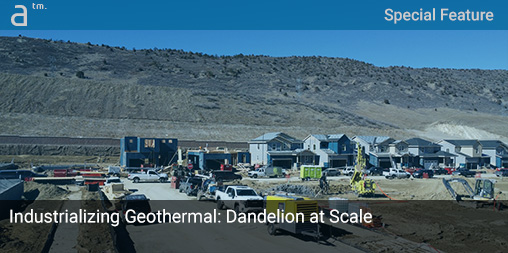
Dandelion’s geothermal partnership with Lennar homes in this picture of a development in Colorado.
In the production homebuilding world, a single localized failure in a new HVAC system can cascade into thousands of warranty claims across a national footprint. Consequently, Dandelion’s first challenge wasn’t just proving that the earth is a stable thermal battery; it was proving that they could supply the system at a scale that matched Lennar’s pace without introducing new liabilities.
“The first hurdle was small relative to the pricing hurdle,” explains Roberts. “They were happy to give it a try as long as it didn’t cost a penny more than traditional systems. And that became our next challenge.”
De-conglomerating the Supply Chain
The traditional AEC perception is that geothermal costs roughly three times as much as a gas-fired furnace. According to Roberts, this is often a byproduct of a fragmented, multi-layered supply chain. “In the high-end home market, the GC calls his preferred HVAC subs, who then call the drillers, and they put this conglomerate together… There are all these layers of markup, and it ends up costing 2.5x – 3x more than what is possible with a traditional system.”
Dandelion’s solution is a vertically integrated design-build operation. By controlling the engineering and drilling, they have driven hard costs down by nearly 40% compared to one-off installs by driving economies of scale in their supply chain and mobilization costs. However, they focus solely on the geothermal system itself and aren’t looking to replace the builder’s trusted partners with the entire HVAC system. Instead, they act as a turn-key distributor, offering certification and installation training for the HVAC subcontractors who already work with Lennar. This allows Dandelion Energy to maintain specification control of the geothermal system while keeping the labor force familiar and the delivery model scalable.
Cracking the Cost-Basis Code: The HERS Advantage
The true breakthrough in the “cost win” for builders lies in the nuances of energy modeling and the HERS (Home Energy Rating System). In markets like Colorado and Maryland, Dandelion has leveraged incentive landscapes to bridge the cost comparison gap entirely.
In Colorado, for instance, a $25,000 whole-home energy rebate requires homes to be Energy Star Next Gen and DOE Energy-Ready. “Only $5,000 is directly attributed to the geothermal,” Roberts reveals, “but because the geothermal efficiency is so high, it allowed [Lennar] to hit other HERS rating targets with less costly building components.”
By maximizing HERS points through a geothermal system that is vastly more efficient than fossil-based systems, builders can eliminate expensive components elsewhere—such as triple-paned glass or specialized wall insulation. In effect, the geothermal system becomes a strategic asset that reduces the total construction cost of the building envelope.
The Case for Single-Home Loops
One of the most debated topics in industrialized geothermal is the choice between centralized “district” systems and individual loops. While district systems offer a certain communal elegance, Dandelion has found that for production homes, the greater economy lies in single-home systems drilled directly under the footprint of the building.
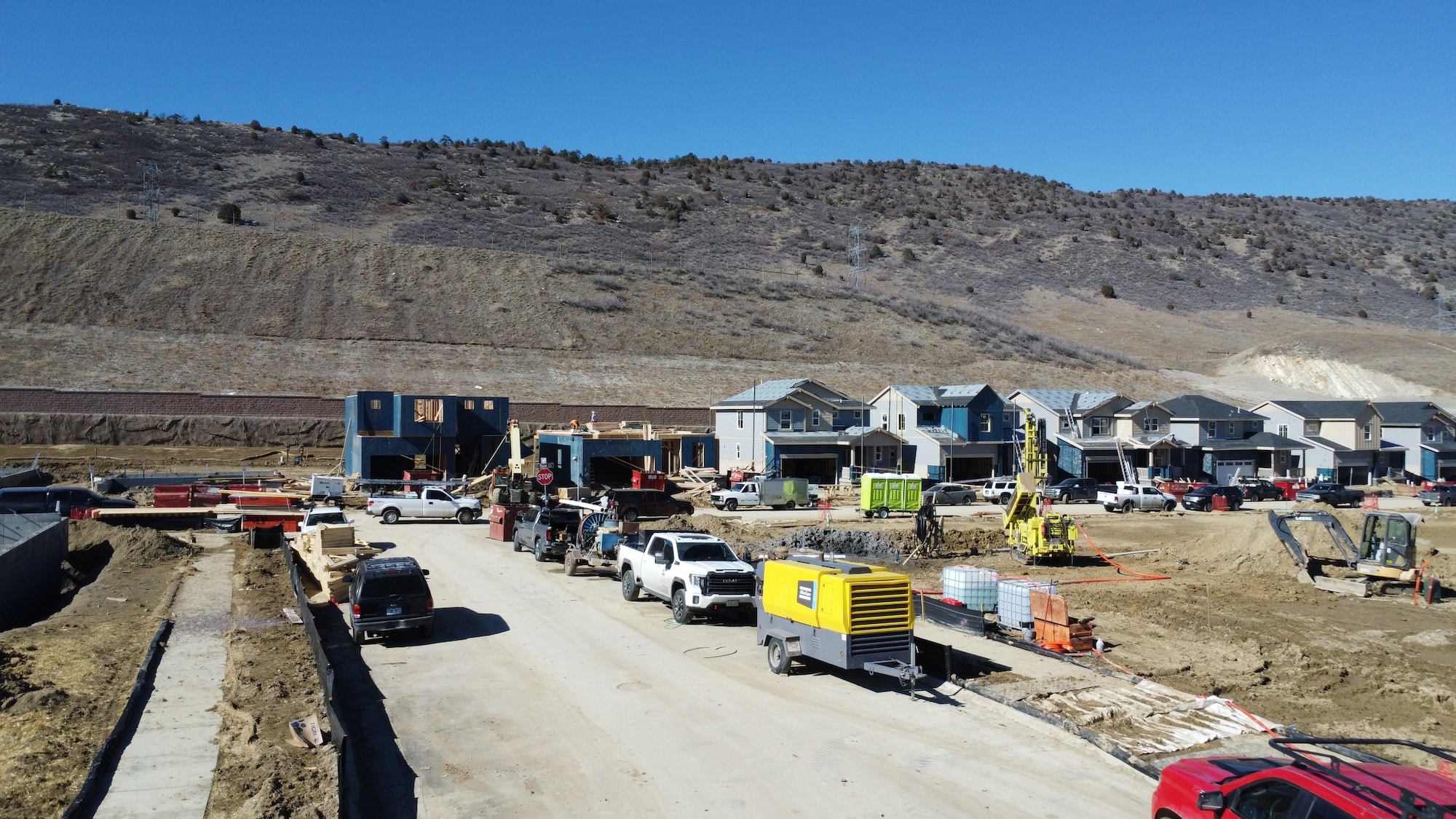
Another view of the Lennar development with geothermal deployment at scale with Dandelion.
“This eliminates the extra pumping and other equipment costs of distributing the system around an entire neighborhood,” says Roberts. “A single loop per house is more cost-efficient… and the pumping power is much lower. You can just use the pumps in the heat pump.”
The efficiency of this model is further boosted by the mobilization scale. By drilling dozens of homes simultaneously, the expensive “heavy equipment mobilization” cost is amortized across the entire neighborhood. Depending on site geology, Dandelion typically utilizes either a single 600-foot bore or two 300-foot bores to tap into the earth’s constant temperature. In Colorado, where deep earth remains in the low 50s, the system leverages a tight thermal delta—sending water out at 30°F in winter and receiving it back at 42°F—to provide the base energy for the compressor with minimal electrical lift.
Site Planning and Lifecycle Value
Beyond the balance sheet, the move to geothermal solves a significant spatial problem for the AEC professional. On modern, high-density “tiny lots,” the removal of the outdoor condenser unit is a major victory for site planning and outdoor livability. Dandelion’s system uses a packaged heat pump with an integrated air-handler, moving the entire thermal process indoors.
The result is a quantitative win for the homeowner:
- Operating Costs: Roughly half that of traditional fossil fuel systems.
- Equipment Longevity: Because the heat pump is protected indoors, it boasts a 20-25 year lifecycle, compared to the weather-beaten 10-15 years of an outdoor unit.
- Infrastructure Permanence: The ground loop piping is warranted for 60 years, effectively becoming a permanent part of the home’s real estate value.
These are substantial quantitative wins for the homeowner, especially in the near-term value of monthly energy costs.
Societal Impact and the Grid
The broader implications are staggering. A recent U.S. Department of Energy study suggests that widespread geothermal deployment could result in $1 trillion in electricity grid savings. Because geothermal reduces summer peak demand by 3-4kW and winter peak by 3-6kW, it serves as a stabilizer for a grid increasingly strained by the “electrify everything” movement. Additionally, the AI infrastructure race worldwide is further straining electric grids, compounding the “electricfy everything” movement.
“My passion is with the production builders because it makes a societal impact at the scale we are working,” Roberts concludes. By aligning the financial incentives of the builder with the performance demands of the energy grid and the pocketbooks of the homeowner, Dandelion Energy is proving that the “green premium” is a relic of the past.
In the new AEC landscape, geothermal isn’t just a sustainable choice—it’s a competitive advantage.