
Apple just missed the perfect opportunity to update the two year-old new Mac Pro. A machine that still ships. So Mac users need to get used to one obvious fact—something different is coming our way and we hope, and we hope, it returns back to the basics we crave.
The Mac Pro We Hardly Knew
The crowning achievement in hardware disappointment at this year’s WWDC is certainly the lack of an update to the new Mac Pro. Introduced in December 2013, it had been speculated by some that Apple would only update the machine every other CPU update, bypassing architecture tweaks and instead waiting for new manufacturing changes (i.e.: new chip lithography process changes shrink chips into less power-hungry packages). Earlier this year, that is what happened.
MORE: The chip the new Mac Pro may have been waiting for…
With no announcement in Q1 and no hardware at all at this year’s WWDC, it is clear that one of two things is going to happen:
- Apple will quietly exit the professional computer markets such as film and broadcast, architecture and engineering, 3d animation and special effects, photography and graphics, science and medicine, and audio and music production, et cetera, or…
- Apple will re-introduce a new type of professional Mac in a brand new architecture
We are crossing our fingers and praying that Apple doesn’t choose the first option. Why should it? Apple’s Macs have never been as popular and native macOS software for professional markets—like the ones above—have never been this robust. Sure, we can talk about the demise of Apple’s own film industry pro apps, but let’s look beyond that for a moment.
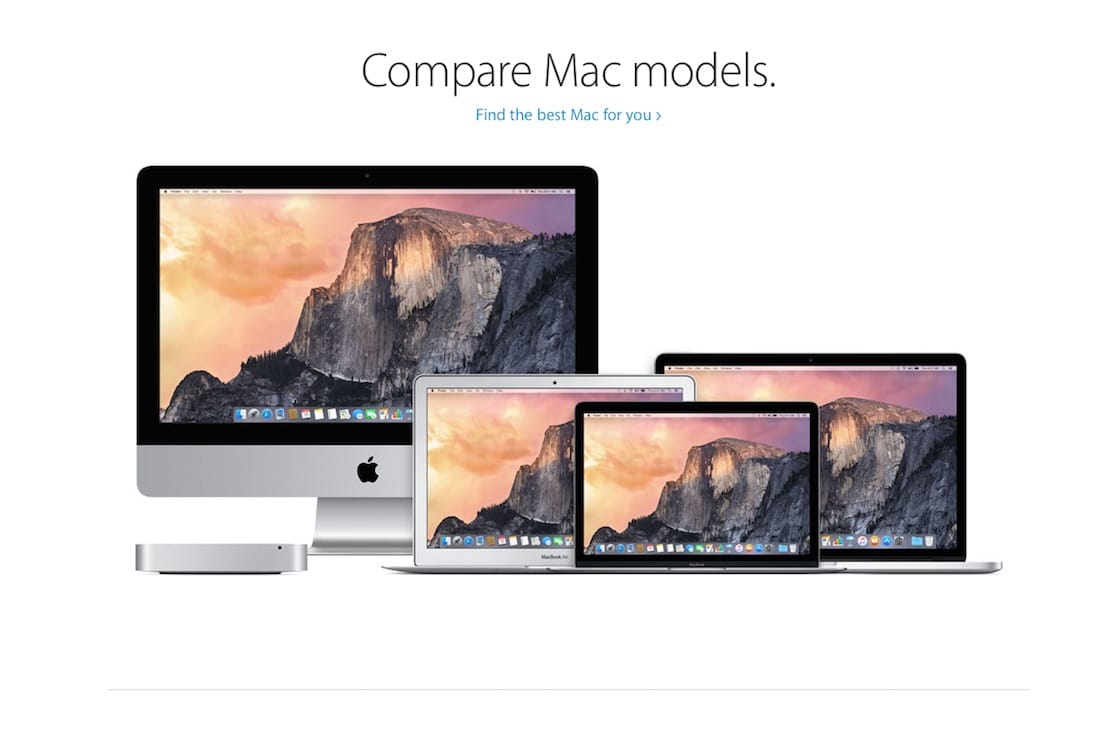
01- Apple’s latest website Mac page refresh has omitted the new Mac Pro but includes the Mac mini. The Mac Pro is Apple’s “pro mac” and it still sells it. But according to some accounts, the Mac Pro accounts for less than 1 percent of all Mac sales.
Apple’s Macs are so popular that they have totally penetrated the mechanical CAD (MCAD) market, a market traditionally dominated by hardcore Wintel blowhards. Autodesk, a company that for well over a decade truly turned its back on the Mac, is now one of Apple’s biggest “big-boy” developer supporters.
And Apple knows very well just how much architects love the Mac. They have even ramped up the presence of the career “type” in numerous keynotes and marketing films, including this WWDC’s own keynote. (see image 03 below)
Why Did The Mac Pro Fail?
We think we know a lot about why the Mac Pro failed. Here at Architosh we have conducted quite a bit of research through surveys. We also talk to all the major CAD and 3D software companies, particularly those serving the building industry.
The Mac Pro didn’t fail, specifically, because it came in another iconic bold simple form, like a cube or sphere or cylinder. It failed not because of shape or sizer, per se, but because it simply did not deliver the things Mac professionals need in the right way. It also failed because it missed on value for one of the biggest pro groups of all—architects.
The Scalable Acquisition of Power
Architects were loyal buyers of the old Mac Pro, and the G4 and G5 Power Macs before that. Why? Because they need power. But they also need a scalable approach to the acquisition of power. The older pro machines did that beautifully. The low-end models provided a reasonable price step up from the top consumer Macs. And yet, they performed better. And they provided pro-level flexibility.
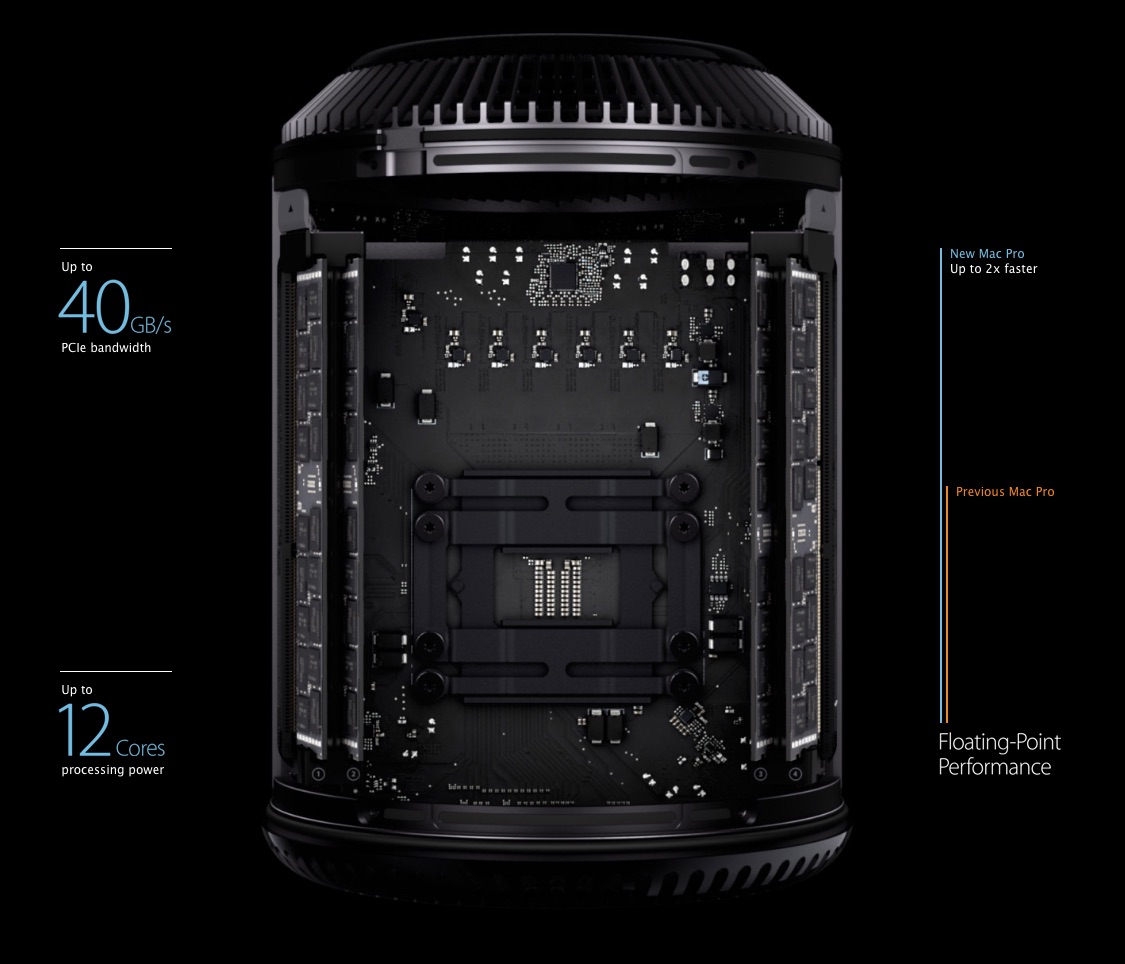
02 – The iconic 2013 Mac Pro is an amazingly beautiful creation, but strategic choices made it impractical for most of the Architecture industry. You would simply get more bang for the buck with a fast iMac than with the “pro” Mac choice. Apple could theoretically fix all this within the design today, but most likely the company will choose another direction.
Contrast that today and the Mac Pro is a big step up in price with zero to negative performance gain for a typical architect. Why? Because all of the major architectural CAD/BIM packages on the market, with the exception of one, will perform at least a bit faster with a high frequency Intel i7 processor than any of the Xeons in the Mac Pro. That’s because the vast majority of CAD and BIM, and even 3D applications, are frequency bound.
The result? Architects have been buying the i7 iMacs in droves instead. iMacs power architecture offices worldwide running everything from the popular SketchUp to Revit to TurboCAD to AutoCAD—you name it. (see: Architosh, “Firm Profile: Candusso Arquitetos—Visualized on the Mac,” 12 April 2012)
Where once architects were firmly the land of Mac Pros, when the latest version came in 2013 those days began to wane.
Putting A Number to Failure
A stat that floated into our ears from reportedly a source in the know, yet we will warn a source we have no track record with, is that today’s Mac Pros account for less than 1 percent of all shipping Macs. In the holiday quarter for 2015, Apple shipped 5.7 million Macs. So 1 percent of 5.7 million Macs is just 57,000 units. And that’s the best quarter and that’s a full 1 percent. It is possible that Apple is selling less than 150,000 Mac Pros a year.
It is important to note that in all of 2002, Apple sold just 3.1 million Macs. Averaged per quarter that is just 750,000 Macs. Divided equally, just for simplicity sake, by its Four Quadrant product strategy—a desktop and mobile variant in pro and consumer lines—that is 187,500 Macs per quarter per category.
But we don’t have to guess quite like that. The company actually reported Power Mac G4 quarterly sales back in 2002 of 212,000 units, with a modest 5 percent growth over the year ago quarter. Now we if roughly multiply that by 4x, Apple sold approximately 848,000 Power Macs in 2002; 27% of all Macs that year were professional desktop machines.
So Apple’s pro desktop branch, in Jobs’ famous Four Quadrant computer strategy, may have withered from being a true quarter of Apple’s computer tree to now just 1 percent or less.¹ Today, with over 100,000 million Mac users worldwide, it is a true shame that Apple has failed to move its users uphill into pro-level hardware, particularly when so many Mac users today are indeed actually professionals in demanding fields.
Fields of Dreams Abound
One of Apple’s most obvious professional fields with a high percentage of Mac users is Architecture. In a research study Architosh undertook a decade ago, architects replace their primary desktop computer on average every 3.1 years. There are, by some estimation, over 1.2 million licensed or chartered architects worldwide, with an estimation of between 3.6 and 5.2 million people working in the field in total.² This would include CAD technicians, visualization and modeling specialists, and other architectural roles, and including all intern-level architects not yet licensed or registered.

03 – Here is an architect. Apple loves showing architects in their marketing materials. And for good reason. Architects do in fact love the Mac and all the other devices too. But Apple has been letting the architecture industry down for a long time on the pro desktop side of things. While the iMac makes sense for a good percentage, an equal or greater percentage would opt in for a more powerful machine they can use for a longer period of time. The iMac is also a poor choice—and increasingly so—for rendering and animation workflows.
Ten years ago, in many European countries Apple’s Mac share of the Architecture market in those countries exceeded 30 percent. Today those markets are even higher and rising. Apple’s potential, in just the Architecture industry, worldwide, is likely in the 20 – 30 percent range. It arguably has the favorable chance to sell to at least 20 percent of 3.6 million professionals in just this industry. Since they replace their machines on average every 3.1 years, Apple could be selling new computers to 1/3 of 720,000 architects worldwide, or roughly 240,000 Macs to architects. Undoubtedly, some of these professionals need a mobile machine, but the vast majority of architectural professionals need a powerful desktop computer.
Apple is very likely selling Mac computers of all kinds to approximately 3/4 of a million architectural users worldwide. But if our source is correct, if the Mac Pro is less than 1 percent of all Macs sold, than the vast majority of architects worldwide are using iMac desktops and Mac mobile computers and somehow making do.
The Solution
To conclude, if Apple’s Mac Pro sales are so paltry that they yield just 150,000 to 200,000 per year (less than 1%), this is just one quarter of Power Mac sales in 2002. Put another way, if Mac Pros today actually account for about 4% of all Mac sales, they approximate 2002 sales for Power Macs.
The solution to this poor performance however is rather simple. Apple needs to stop making signature, iconic machines aimed more for the Smithsonian Institute than for actual production uses and start learning their core pro markets and tailor the next pro desktop design to around those needs.
Apple’s marketing materials and keynote slides don’t belie the situation. (see image 03) Yes, architects are truly Apple users. It’s just a huge percentage of us would love to scale our purchases upward to more powerful desktop machines. We need them. And that’s just focusing in on the Architecture market. For the other “pro” Mac markets Apple has traditionally served, the current Mac situation is often worse.
Let’s hope no hardware at WWDC 2016 portends to something really great come this fall.
Footnotes
1 – Apple stopped breaking out sales of its Macs in the oughts though through the years a variance between mobiles and desktops has been communicated.
2 – According to the International Union of Architects, there are 1.2 million licensed, chartered or equivalent architects worldwide, 566,000 just in Europe. But those without full credentials include the recently graduated intern architects, draftsman and CAD technicians, 3D visualization artists working in architecture offices, construction-related and project management professionals who often have slightly different academic backgrounds than those from accredited architecture schools.


Reader Comments
https://t.co/uKhwQaTkHf — Adding insult to injury…WWDC 2016 sans hardware says a lot about the Mac Pro in particular. Here’s the story.
“Apple will quietly exit the professional computer markets such as film and broadcast, architecture and engineering, 3d animation and special effects, photography and graphics, science and medicine, and audio and music production, et cetera, or…”
a lot of lucrative markets it would be leaving behind IF this happened to be the case.
“Apple will quietly exit the professional computer markets such as film and broadcast, architecture and engineering, 3d animation and special effects, photography and graphics, science and medicine, and audio and music production, et cetera, or…”
a lot of lucrative markets it would be leaving behind IF this happened to be the case.
If Jobs Failed Twice, Why Would Ives & Team Succeed? RIP new Mac Pro https://t.co/G87y0osfgk via @architosh
A few years ago, we all needed desktop computers for CAD, rendering and productivity software. Now we don’t. The Mac Pro is a very nice machine, and I considered purchasing one for my own professional use. But as an architect, a laptop can do all of the CAD, rendering and productivity that I need. My Macbook Pro can drive a 4K monitor, but I can unplug it and take it to site meetings.
https://t.co/uKhwQaTkHf — Adding insult to injury…WWDC 2016 sans hardware says a lot about the Mac Pro in particular. Here’s the story.
But Woodie Logov, but can your Macbook do any of the new VR technology that has bit the architecture market big time? Can you it power IrisVR using the Vive or Oculus? The answer is no. Today Apple is focused on minimizing the thermal envelop of their equipment to maximize battery life of mobiles and to go as thin as possible on all their equipment. There is a balance between those goals and providing enough horse power so mac “pros” can tap into all the leading edge tech just like legions of folks on Windows do. If doesn’t have to be either this, or that. I can be both.
RT @architosh: If Jobs Failed Twice, Why Would Ives & Team Succeed? RIP new Mac Pro: Apple just missed the perfect opport… https://t.co/g…
RT @architosh: If Jobs Failed Twice, Why Would Ives & Team Succeed? RIP new Mac Pro: Apple just missed the perfect opport… https://t.co/g…
FWIW, I offer all of that thinking it would be great if Apple made the Pro more scalable and they opted for a smaller form factor than the prior mega tower. Heck, I’d love it if they worked up a Mac Pro mini as well as a larger revamped Mac Pro.
MacDailyNews has covered this story and some of their reader comments are very much in tune with this article. Here’s a sampling (share your thoughts below):
– disposableidentity writes:
“It is uninteresting as an object. It is less so as a product. You know what is interesting? An object that does exactly its job, and surprises us with the pleasure of using it.”
– DavGreg writes:
“There is no reason Apple could not license Mac OS X but restrict it to certain markets.”
Actually, licensing can be tricky business. Companies like HP, Dell, etc don’t want to hear the word “restrict” in their partnerships. What would make most sense is for Apple to form a subsidiary or acquire one that is simply a workstation maker. BOXX would be a great purchase for them.
Finally, Grrrilla wrote something interesting and smart:
“And just like the iPhone SE, I think they’d sell surprisingly well, in spite of having an older form factor.”
@ mutatioveritas –
thanks for the great feedback. The big disappointment with the older Power Macs and cheesegrater Mac Pro was that Apple never took us pros seriously at the GPU level. We wanted scaleable “workstation class” GPU options. So with the 2013 Mac Pro on this note they hit it nearly out of the park. Not only did they provide dual GPUs, but they were pure workstation cards. Sadly, they didn’t go with Nvidia so for many who rely on CUDA this was a bit of a no-go. But—and this is really important—in principle they finally gave the Mac Pro the GPU scalable options it always deserved.
The old Mac Pro used Xeons too so nothing was horrible about the new Mac Pro about its chip selection. Some complained they wanted up to 16 – 24 cores (dual chip configs) but the percentage needing that is truly small in our own survey study.
The bigger issue was that the Intel i7 was a faster solution for the dollar for most CAD and BIM solutions in AEC. When the 5K iMac came out not long after that was definitely the case. With such strong iMacs out there, it was hard for companies to justify the spend on Mac Pros vs iMacs.
What is happening in Architecture is a continued migration to fully 3D workflows and continuations of advanced rendering. These trends challenge the single-threaded, high-frequency orientation of this particular market. The market needs more responsive “spectrum like” thinking around configurations, something the PC market always gave people. So here we were with the coolest new Mac Pro in years, and with real workstation GPU scalability to boot, but no frequency-oriented option (ie: no i7 choice).
Pros should have optionality to hit various points at both price and multi-core vs frequency oriented software workflows. If BOXX can do it, so can Apple. And they can do it with one form factor Mac.
Thanks Ivan. Much appreciated. Corrected.
I waited three years for a real update for the Mac Pro to buy one. My wait was in vain. As the new Mac Pro was introduced, I gagged; and purchased the old Mac Pro while it was still possible. I don’t regret my decision, but it was a huge slap in the face what I paid for old technology; one that I’ve not forgotten. I’ve stuck with Apple since the Apple II. I’m not sure what to do next as Apple does not make a single Mac I care to purchase. Oh well. Nothing lasts forever, it is said.
“Apple will quietly exit the professional computer markets such as film and broadcast, architecture and engineering, 3d animation and special effects, photography and graphics, science and medicine, and audio and music production, et cetera, or…”
a lot of lucrative markets it would be leaving behind IF this happened to be the case.
@ Kira, – thanks for sharing…and you are not alone in those concerns and thoughts.
If Jobs Failed Twice, Why Would Ives & Team Succeed? RIP new Mac Pro https://t.co/G87y0osfgk via @architosh
[…] Source link […]
A few years ago, we all needed desktop computers for CAD, rendering and productivity software. Now we don’t. The Mac Pro is a very nice machine, and I considered purchasing one for my own professional use. But as an architect, a laptop can do all of the CAD, rendering and productivity that I need. My Macbook Pro can drive a 4K monitor, but I can unplug it and take it to site meetings.
But Woodie Logov, but can your Macbook do any of the new VR technology that has bit the architecture market big time? Can you it power IrisVR using the Vive or Oculus? The answer is no. Today Apple is focused on minimizing the thermal envelop of their equipment to maximize battery life of mobiles and to go as thin as possible on all their equipment. There is a balance between those goals and providing enough horse power so mac “pros” can tap into all the leading edge tech just like legions of folks on Windows do. If doesn’t have to be either this, or that. I can be both.
I’m more of a generalist when it comes to hardware and software, so apologies if the following is missing some important info. While I certainly trust the reports of what architects share in terms of their decision-making, it’s not clear that your analysis accounts for some important considerations. First, aside from the screen being included, aren’t the Mac Pro and 27″ iMac kind of in the same category in terms of scalability? Neither one can do much by way of user upgrades beyond RAM for the iMac and RAM+SSD for the MP. Granted, the scalability for both is constrained largely to Thunderbolt ports, which the MP has more of. With that said, I imagine you’d have to be doing something massive intensive to really saturate the two Thunderbolt 2 ports on the iMacs, which will become even more capable when both the iMac and MPs (assuming) get upgrades to TB3. It sounds as though you and other professionals are arguing that a similarly unscalable iMac isn’t in fact the basis for the decision, but rather the fact that the i7 is a very capable CPU with the right bells and whistles added on (e.g., 64GB RAM, 512MB-1TB SSD). If I’m hearing you correctly, you and others are basically arguing that it’s better to get a similarly unscalable computer with a screen and good performance. I’m personally leery about an iMac purchase because of what seems to be an increasingly hit and miss prospect for what hardware will and will not work with target display mode down the line. The iMac appears to offer the flexibility of being plugged into future hardware as a display, though more recent incompatibilities with other Mac hardware make this a question mark for future systems.
Second, isn’t there room for also recognizing the ways in which hardware has become so broadly capable as another factor in decision-making? For example, if an i5 or i7 will give you solid performance, why splurge for a Xeon system from any brand unless you’re seriously hitting some bottlenecks in your workflow? Apple was one of the first computer makers to go for PCIe SSDs in their systems and it makes for an incredibly capable system, whether it’s a lowly MacBook Air, much less the desktop systems. Even a desktop quad core i5 with a ~1200+ MB/s PCIe SSD will make a SATA SSD system seem a little delayed.
Second, and I admit I’m not aware of all the coding that goes into architecture software, but isn’t there also room for some analysis of the kinds of effort that the software makers are putting into coding for multi-CPU systems as well as GPU acceleration? For example, if the software maker isn’t coding to take advantage of 6, 8, or 12 cores in a MP, much less the Pro GPUs, then it’s not surprising if a quad core i7 is able to keep up with the Xeon chips. Any number of tech sites that review hardware and software have found these very issues. e.g., The hardware is up to snuff, but without the coding to support it, you might not get much more out of 4 or more CPU cores. Assuming this is the case, we can ask the same questions of the software makers, why aren’t they optimizing their software for the big rigs? Based on you analysis of the sales of MPs, we might have an answer. If 97% of an install base is using i5 and i7 chips (for whatever reason) and 3% are using Xeons, which do you dedicate your resources towards coding for?
In any case, just some thoughts. I’m off to bone up on my CAD et al. software and hardware reviews. 😉
I’m more of a generalist when it comes to hardware and software, so apologies if the following is missing some important info. While I certainly trust the reports of what architects share in terms of their decision-making, it’s not clear that your analysis accounts for some important considerations. First, aside from the screen being included, aren’t the Mac Pro and 27″ iMac kind of in the same category in terms of scalability? Neither one can do much by way of user upgrades beyond RAM for the iMac and RAM+SSD for the MP. Granted, the scalability for both is constrained largely to Thunderbolt ports, which the MP has more of. With that said, I imagine you’d have to be doing something massive intensive to really saturate the two Thunderbolt 2 ports on the iMacs, which will become even more capable when both the iMac and MPs (assuming) get upgrades to TB3. It sounds as though you and other professionals are arguing that a similarly unscalable iMac isn’t in fact the basis for the decision, but rather the fact that the i7 is a very capable CPU with the right bells and whistles added on (e.g., 64GB RAM, 512MB-1TB SSD). If I’m hearing you correctly, you and others are basically arguing that it’s better to get a similarly unscalable computer with a screen and good performance. I’m personally leery about an iMac purchase because of what seems to be an increasingly hit and miss prospect for what hardware will and will not work with target display mode down the line. The iMac appears to offer the flexibility of being plugged into future hardware as a display, though more recent incompatibilities with other Mac hardware make this a question mark for future systems.
Second, isn’t there room for also recognizing the ways in which hardware has become so broadly capable as another factor in decision-making? For example, if an i5 or i7 will give you solid performance, why splurge for a Xeon system from any brand unless you’re seriously hitting some bottlenecks in your workflow? Apple was one of the first computer makers to go for PCIe SSDs in their systems and it makes for an incredibly capable system, whether it’s a lowly MacBook Air, much less the desktop systems. Even a desktop quad core i5 with a ~1200+ MB/s PCIe SSD will make a SATA SSD system seem a little delayed.
Second, and I admit I’m not aware of all the coding that goes into architecture software, but isn’t there also room for some analysis of the kinds of effort that the software makers are putting into coding for multi-CPU systems as well as GPU acceleration? For example, if the software maker isn’t coding to take advantage of 6, 8, or 12 cores in a MP, much less the Pro GPUs, then it’s not surprising if a quad core i7 is able to keep up with the Xeon chips. Any number of tech sites that review hardware and software have found these very issues. e.g., The hardware is up to snuff, but without the coding to support it, you might not get much more out of 4 or more CPU cores. Assuming this is the case, we can ask the same questions of the software makers, why aren’t they optimizing their software for the big rigs? Based on you analysis of the sales of MPs, we might have an answer. If 97% of an install base is using i5 and i7 chips (for whatever reason) and 3% are using Xeons, which do you dedicate your resources towards coding for?
In any case, just some thoughts. I’m off to bone up on my CAD et al. software and hardware reviews. 😉
FWIW, I offer all of that thinking it would be great if Apple made the Pro more scalable and they opted for a smaller form factor than the prior mega tower. Heck, I’d love it if they worked up a Mac Pro mini as well as a larger revamped Mac Pro.
MacDailyNews has covered this story and some of their reader comments are very much in tune with this article. Here’s a sampling (share your thoughts below):
– disposableidentity writes:
“It is uninteresting as an object. It is less so as a product. You know what is interesting? An object that does exactly its job, and surprises us with the pleasure of using it.”
– DavGreg writes:
“There is no reason Apple could not license Mac OS X but restrict it to certain markets.”
Actually, licensing can be tricky business. Companies like HP, Dell, etc don’t want to hear the word “restrict” in their partnerships. What would make most sense is for Apple to form a subsidiary or acquire one that is simply a workstation maker. BOXX would be a great purchase for them.
Finally, Grrrilla wrote something interesting and smart:
“And just like the iPhone SE, I think they’d sell surprisingly well, in spite of having an older form factor.”
The word in the caption is “opt” not “op”. Fourth graph from end, the word is “do” not “due”.
The word in the caption is “opt” not “op”. Fourth graph from end, the word is “do” not “due”.
@ mutatioveritas –
thanks for the great feedback. The big disappointment with the older Power Macs and cheesegrater Mac Pro was that Apple never took us pros seriously at the GPU level. We wanted scaleable “workstation class” GPU options. So with the 2013 Mac Pro on this note they hit it nearly out of the park. Not only did they provide dual GPUs, but they were pure workstation cards. Sadly, they didn’t go with Nvidia so for many who rely on CUDA this was a bit of a no-go. But—and this is really important—in principle they finally gave the Mac Pro the GPU scalable options it always deserved.
The old Mac Pro used Xeons too so nothing was horrible about the new Mac Pro about its chip selection. Some complained they wanted up to 16 – 24 cores (dual chip configs) but the percentage needing that is truly small in our own survey study.
The bigger issue was that the Intel i7 was a faster solution for the dollar for most CAD and BIM solutions in AEC. When the 5K iMac came out not long after that was definitely the case. With such strong iMacs out there, it was hard for companies to justify the spend on Mac Pros vs iMacs.
What is happening in Architecture is a continued migration to fully 3D workflows and continuations of advanced rendering. These trends challenge the single-threaded, high-frequency orientation of this particular market. The market needs more responsive “spectrum like” thinking around configurations, something the PC market always gave people. So here we were with the coolest new Mac Pro in years, and with real workstation GPU scalability to boot, but no frequency-oriented option (ie: no i7 choice).
Pros should have optionality to hit various points at both price and multi-core vs frequency oriented software workflows. If BOXX can do it, so can Apple. And they can do it with one form factor Mac.
Thanks Ivan. Much appreciated. Corrected.
I waited three years for a real update for the Mac Pro to buy one. My wait was in vain. As the new Mac Pro was introduced, I gagged; and purchased the old Mac Pro while it was still possible. I don’t regret my decision, but it was a huge slap in the face what I paid for old technology; one that I’ve not forgotten. I’ve stuck with Apple since the Apple II. I’m not sure what to do next as Apple does not make a single Mac I care to purchase. Oh well. Nothing lasts forever, it is said.
@ Kira, – thanks for sharing…and you are not alone in those concerns and thoughts.
Hey@Apple @tim_cook design Mac Pro to meet Architecture market production
needs = mucho sales https://t.co/phGqBKVkvd
Hey@Apple @tim_cook design Mac Pro to meet Architecture market production
needs = mucho sales https://t.co/phGqBKVkvd
If Jobs Failed Twice, Why Would Ives & Team Succeed? RIP new #MacPro https://t.co/gLx4YhLUDG
If Jobs Failed Twice, Why Would Ives & Team Succeed? RIP new #MacPro https://t.co/gLx4YhLUDG
This is one area where being a Wintel (and Linux) blowhard is to your benefit. Apple cannot be all things to all people. They are one company, and moreover one with a high volume high margin strategy for consumer and other general purpose hardware for whom intangibles such as UX/UI, supportability, reilability, consistency, interoperability and aesthetics are the main differentiators. As such, they cannot keep up with smaller companies who can take general purpose operating systems like Windows, Linux (and theoretically Android) and use it to power the highest performance hardware configurations available, and in process fully exploit the fact that their consumers will be professional and other tech-savvy niche segments that are willing to trade off “user-friendliness” for power and flexibility.
As for the software makers, they have their own business needs and pressures to consider, and that means designing their products for the most powerful systems that are commercially available. If they don’t do it, the competition will, and as their target market is so small – maybe a few hundred thousand to few million people in each field – and their products so expensive to develop that getting left behind because of trying to support underpowered hardware may mean going out of business. Of course, AutoDesk will always be fine, but the smaller companies selling even more specialized software will not.
The only way for Apple to “keep up” would be to license an OS to third party manufacturers. Except that since this is not Apple’s business model, they would have far more to lose than gain. Even if the licensing terms were designed to – for example – keep companies from underselling Apple on their existing consumer-based product lines like MacBooks/iPads and thereby prevent a “race to the bottom” type situation that currently plagues Windows and Android, piracy would become a real problem, especially in countries where violating western IP is a core business tactic. As these JUST HAPPEN to be the countries where most of the world’s remaining tech hardware companies that would license a hypothetical “macOS Enterprise” are, license an OS to those companies today, and there would be a dozen MacBook Air knockoffs available on eBay in 6 months, not to mention free macOS images on torrents.
So there are just going to be some areas where Apple will never be able to compete because of the nature of the market and the type of company that Apple is. Servers and other rack/data center enterprise hardware is another one.
The one way that Apple could possibly compete in this space: emulate Google’s Project Ara for smartphones and tablets (which LG and Lenovo have successfully implemented in viable products this year) with modularized hardware. Apple could create professional PCs that would allow vital components to be upgraded annually by replacing modules that contain (for example) processing, graphics and perhaps even bus hardware. That would keep Apple from having to redesign new systems from the ground up every time a third party creates a better CPU, GPU, I/O or networking component. Of course, they will not have the level of optimization and integration that Apple likes, but that could be saved for the consumer and general purpose products. The professionals who just need the latest and the fastest could just order the latest modules from Apple and plug them right in.
Beyond an approach like that, Apple just is not the sort of company that is able to keep up in this space and probably should not try.
Joe King — all very good points. Thanks for the excellent response. I would agree that Apple cannot and will not likely license its OSs to other hardware companies. But, while I agree with almost everything you said, Apple is definitely rich enough to support a dedicated team for the pro markets and provide their loyal users with “standards” oriented machines.
Let’s look at it this way. They went backwards to produce the iPhone SE (originally the iPhone 5), in an old body, and the phone is taking off like hot-cakes. Why? Because it is well suited and practical for what a lot of people want. That same logic can easily apply to a redo of the Mac Pro. Just give us a beautiful aluminum box again (it can certainly be smaller) and pro customers will love them again for it.
This is one area where being a Wintel (and Linux) blowhard is to your benefit. Apple cannot be all things to all people. They are one company, and moreover one with a high volume high margin strategy for consumer and other general purpose hardware for whom intangibles such as UX/UI, supportability, reilability, consistency, interoperability and aesthetics are the main differentiators. As such, they cannot keep up with smaller companies who can take general purpose operating systems like Windows, Linux (and theoretically Android) and use it to power the highest performance hardware configurations available, and in process fully exploit the fact that their consumers will be professional and other tech-savvy niche segments that are willing to trade off “user-friendliness” for power and flexibility.
As for the software makers, they have their own business needs and pressures to consider, and that means designing their products for the most powerful systems that are commercially available. If they don’t do it, the competition will, and as their target market is so small – maybe a few hundred thousand to few million people in each field – and their products so expensive to develop that getting left behind because of trying to support underpowered hardware may mean going out of business. Of course, AutoDesk will always be fine, but the smaller companies selling even more specialized software will not.
The only way for Apple to “keep up” would be to license an OS to third party manufacturers. Except that since this is not Apple’s business model, they would have far more to lose than gain. Even if the licensing terms were designed to – for example – keep companies from underselling Apple on their existing consumer-based product lines like MacBooks/iPads and thereby prevent a “race to the bottom” type situation that currently plagues Windows and Android, piracy would become a real problem, especially in countries where violating western IP is a core business tactic. As these JUST HAPPEN to be the countries where most of the world’s remaining tech hardware companies that would license a hypothetical “macOS Enterprise” are, license an OS to those companies today, and there would be a dozen MacBook Air knockoffs available on eBay in 6 months, not to mention free macOS images on torrents.
So there are just going to be some areas where Apple will never be able to compete because of the nature of the market and the type of company that Apple is. Servers and other rack/data center enterprise hardware is another one.
The one way that Apple could possibly compete in this space: emulate Google’s Project Ara for smartphones and tablets (which LG and Lenovo have successfully implemented in viable products this year) with modularized hardware. Apple could create professional PCs that would allow vital components to be upgraded annually by replacing modules that contain (for example) processing, graphics and perhaps even bus hardware. That would keep Apple from having to redesign new systems from the ground up every time a third party creates a better CPU, GPU, I/O or networking component. Of course, they will not have the level of optimization and integration that Apple likes, but that could be saved for the consumer and general purpose products. The professionals who just need the latest and the fastest could just order the latest modules from Apple and plug them right in.
Beyond an approach like that, Apple just is not the sort of company that is able to keep up in this space and probably should not try.
Joe King — all very good points. Thanks for the excellent response. I would agree that Apple cannot and will not likely license its OSs to other hardware companies. But, while I agree with almost everything you said, Apple is definitely rich enough to support a dedicated team for the pro markets and provide their loyal users with “standards” oriented machines.
Let’s look at it this way. They went backwards to produce the iPhone SE (originally the iPhone 5), in an old body, and the phone is taking off like hot-cakes. Why? Because it is well suited and practical for what a lot of people want. That same logic can easily apply to a redo of the Mac Pro. Just give us a beautiful aluminum box again (it can certainly be smaller) and pro customers will love them again for it.
Hello Anthony:
This is the opposite of the iPhone SE, which Apple offered for the same reason that they offered the iPad Mini, the Mac Mini, the iPod Shuffle and the MacBook Air: to compete in down market segments against good products offered by competing platforms. The Mac Mini and MacBook Air were mixed bags but the iPod Shuffle and iPad Mini worked perfectly, as they caused competing MP3 players from the likes of Microsoft and Sony as well as Android tablets generally to mostly fail in the marketplace.
So it isn’t about the beautiful aluminum box. (Especially since Apple products didn’t begin to consistently feature aluminum until relatively recently). It is about having the hardware capable of powering the latest professional software. Apple’s current method of designing and delivering products (hardware + OS) will generally have them 12-18 months behind the latest tech. Changing their methodology – and doing so just for their Pro line of devices – probably isn’t worth it because such devices will only make up a small percentage of their overall device sales and revenue. Maintaining different multiple design methodologies is cumbersome to manage as well as expensive, so unless there is going to be some tangible payoff it is best not to bother.
So Apple does not just need the beautiful aluminum box, but A) the ability to easily and meaningfully upgrade the performance of that beautiful box so that it will be able to keep up with the performance offered by competing platforms and B) do so without introducing a new management, design, R&D, manufacturing, marketing supply chain etc. layer that is specific to one product (or product line).
I suppose they could achieve this by spinning off a separate, self-managed division or acquiring a division and allowing it to operate independently, but either way they wouldn’t make truly Apple products. So, looks like modularity is the best way to marry Wintel workstation with the Apple UX/UI and the pretty box.
Hello Anthony:
This is the opposite of the iPhone SE, which Apple offered for the same reason that they offered the iPad Mini, the Mac Mini, the iPod Shuffle and the MacBook Air: to compete in down market segments against good products offered by competing platforms. The Mac Mini and MacBook Air were mixed bags but the iPod Shuffle and iPad Mini worked perfectly, as they caused competing MP3 players from the likes of Microsoft and Sony as well as Android tablets generally to mostly fail in the marketplace.
So it isn’t about the beautiful aluminum box. (Especially since Apple products didn’t begin to consistently feature aluminum until relatively recently). It is about having the hardware capable of powering the latest professional software. Apple’s current method of designing and delivering products (hardware + OS) will generally have them 12-18 months behind the latest tech. Changing their methodology – and doing so just for their Pro line of devices – probably isn’t worth it because such devices will only make up a small percentage of their overall device sales and revenue. Maintaining different multiple design methodologies is cumbersome to manage as well as expensive, so unless there is going to be some tangible payoff it is best not to bother.
So Apple does not just need the beautiful aluminum box, but A) the ability to easily and meaningfully upgrade the performance of that beautiful box so that it will be able to keep up with the performance offered by competing platforms and B) do so without introducing a new management, design, R&D, manufacturing, marketing supply chain etc. layer that is specific to one product (or product line).
I suppose they could achieve this by spinning off a separate, self-managed division or acquiring a division and allowing it to operate independently, but either way they wouldn’t make truly Apple products. So, looks like modularity is the best way to marry Wintel workstation with the Apple UX/UI and the pretty box.
and then you have the option of using autodesk’s cloud based solutions like fusion360 for CAD/CAM – I design locally on my macbook pro 13, Collaborate online live with my team, and render and animate in the autodesk ‘cloud’ using a few hundred thousand cpu’s and just pay for the rendering time used. http://www.autodesk.com/360-cloud and check out all of autodesks new cloud based services..
For the other 95% of my work (filmmaker), I’m waiting for an updated macbook pro 15 so I can render my darn FCPx faster!.. common Apple gimmi a real speed boost already !!!!
and then you have the option of using autodesk’s cloud based solutions like fusion360 for CAD/CAM – I design locally on my macbook pro 13, Collaborate online live with my team, and render and animate in the autodesk ‘cloud’ using a few hundred thousand cpu’s and just pay for the rendering time used. http://www.autodesk.com/360-cloud and check out all of autodesks new cloud based services..
For the other 95% of my work (filmmaker), I’m waiting for an updated macbook pro 15 so I can render my darn FCPx faster!.. common Apple gimmi a real speed boost already !!!!
Thanks for the feedback Tony! You raise a good point and another reason why the Mac Pro may never be updated again. If pro users choose to render in the cloud increasingly more, than this is an augment against users needing lots of processor cores, one of the chief differences between the i7 and Xeons.
On the other hand, the Pro box that people actually want gives pros real flexibility. And flexibility goes a long way in the face of many changes afoot in the market.
Thanks for the feedback Tony! You raise a good point and another reason why the Mac Pro may never be updated again. If pro users choose to render in the cloud increasingly more, than this is an augment against users needing lots of processor cores, one of the chief differences between the i7 and Xeons.
On the other hand, the Pro box that people actually want gives pros real flexibility. And flexibility goes a long way in the face of many changes afoot in the market.
From December 2015 IDC report:
“Despite the substantial shift in spending and usage models from PCs toward tablets and phones in recent years, very few people are giving up on their PC – they are just making it last longer,” said Loren Loverde.
http://www.idc.com/getdoc.jsp?containerId=prUS40704015
This is another reason why a flexible, upgradable Mac Pro is more appealing to Mac Pros. Given the demand to buy many more electronic devices (and stay up on them, particularly phones) it comes as no surprise that folks need their personal computers to last longer. This is an another argument why the Mac Pro has done poorly. Without the clear path to upgradeable GPUs, for example, why would people purchase a machine they can’t see using for five years without an upgrade path?
If Apple created a new Mac Pro that spoke to professional flexibility and upgradeability on key performance items like GPUs and even CPUs, this would attract folks to outlay top dollar to get into a machine they can grow and live with for many years.
From December 2015 IDC report:
“Despite the substantial shift in spending and usage models from PCs toward tablets and phones in recent years, very few people are giving up on their PC – they are just making it last longer,” said Loren Loverde.
http://www.idc.com/getdoc.jsp?containerId=prUS40704015
This is another reason why a flexible, upgradable Mac Pro is more appealing to Mac Pros. Given the demand to buy many more electronic devices (and stay up on them, particularly phones) it comes as no surprise that folks need their personal computers to last longer. This is an another argument why the Mac Pro has done poorly. Without the clear path to upgradeable GPUs, for example, why would people purchase a machine they can’t see using for five years without an upgrade path?
If Apple created a new Mac Pro that spoke to professional flexibility and upgradeability on key performance items like GPUs and even CPUs, this would attract folks to outlay top dollar to get into a machine they can grow and live with for many years.
If Jobs Failed Twice, Why Would Ive & Team Succeed? RIP new Mac Pro | Architosh – New Mac Pro ? https://t.co/9xKcC7fmkF
If Jobs Failed Twice, Why Would Ive & Team Succeed? RIP new Mac Pro | Architosh – New Mac Pro ? https://t.co/9xKcC7fmkF
couple things;
Apple’s revenues from Macintosh computers is much less than from it’s mobile devices.
Apple is consistently ignoring the enterprise. I’ve sought to install Macs in businesses where I work whenever possible. But when a company will not give out roadmaps or advance announcements of products, it is difficult to plan 12-18 months in advance. In fact this whole wink wink secrecy marketing tactic was old 5 years ago.
The last time I recommended iMacs for a certain media company, the decision maker responded that they were toy computers for students.
couple things;
Apple’s revenues from Macintosh computers is much less than from it’s mobile devices.
Apple is consistently ignoring the enterprise. I’ve sought to install Macs in businesses where I work whenever possible. But when a company will not give out roadmaps or advance announcements of products, it is difficult to plan 12-18 months in advance. In fact this whole wink wink secrecy marketing tactic was old 5 years ago.
The last time I recommended iMacs for a certain media company, the decision maker responded that they were toy computers for students.
[…] Architosh, spécialisé comme son nom l’indique dans l’actualité du Mac pour les architectes, dresse également un tableau très sombre de l’avenir du Mac Pro. Le constat est simple : si le Mac Pro […]
Comments are closed.